
Non-FictionInformativeEducational
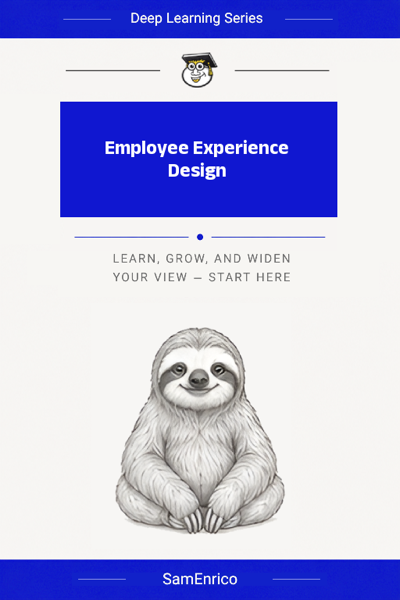
Employee Experience Design eBook
A Coursebook on Employee Experience Design
A Coursebook on Employee Experience Design
Formats
Free sample
Chapter 1: The $1.5 Trillion Blind Spot--–- Maria Vasquez was not a problem employee. She arrived early, stayed late, and had generated $4.2 million in sales for her employer over three years. Her quarterly reviews were flawless. Her manager once described her as "the kind of person you build a team around." On a Tuesday morning in March, Maria submitted her resignation via email at 6:47 AM. The exit interview, conducted by a junior HR generalist over a crackling conference line, lasted eleven minutes.
The official reason recorded in the company’s human resources information system was "career development." The real reason, which no one bothered to ask about, was far more damning: Maria had spent seven hours over the previous three weeks trying to get IT to restore her access to the customer relationship management system after a routine software update. She had submitted three tickets, attended two meetings with the help desk, and been told "we’re working on it" four times. In those three weeks, she lost an estimated $340,000 in pipeline opportunities. When she finally escalated to her manager, she was told, "That’s just how IT works around here." Maria didn’t leave for more money. She didn’t leave for a promotion.
She left because a broken system made her feel like a burden. And she took $4.2 million in annual recurring revenue with her.The Cost of Invisibility Maria’s story is not an aberration. It is not a cautionary tale about a single bad manager or a uniquely dysfunctional IT department. It is, instead, the most common and least discussed failure mode in modern organizations: the slow, grinding attrition caused by poorly designed employee experiences. According to data from the Society for Human Resource Management, the average cost of replacing a salaried employee is between six and nine months of their salary.
For a manager making $80,000 per year, that translates to $40,000 to $60,000 in recruiting, onboarding, and productivity loss. For a senior executive, the cost can exceed 200 percent of annual salary. Multiply those numbers by the millions of employees who voluntarily leave their jobs each year, and you arrive at a staggering figure: American businesses lose approximately $1.5 trillion annually to voluntary turnover. That is not a typo. One point five trillion dollars.
Every single year.And yet, the vast majority of organizations respond to this crisis with the same set of ineffective interventions. They increase salaries. They add perks. They launch employee recognition programs. They hire more recruiters.
These are not bad investments in isolation, but they are misdirected investments. They treat the symptom—departure—without diagnosing the disease: the daily accumulation of friction, frustration, and disrespect that Maria experienced. The data is unambiguous: according to a 2023 study by the Workforce Institute at UKG, 74 percent of employees say they would stay at their jobs if they simply felt heard. Not promoted. Not paid more.
Heard. The same study found that the number one predictor of retention was not compensation, not benefits, not even work-life balance. It was whether employees believed their employer would fix a problem once it was reported.This book is about fixing those problems. Not through intuition or good intentions, but through systematic design.The Great Misdiagnosis Over the past five years, journalists, consultants, and executives have offered dozens of explanations for the seismic shifts in the labor market. They have pointed to the Great Resignation, a post-pandemic reckoning in which millions of workers reevaluated their relationship with work.
They have pointed to quiet quitting, the phenomenon of employees doing exactly what they are paid for and nothing more. They have pointed to labor activism, unionization efforts, and the rise of "rage applying." Each of these phenomena has been analyzed, debated, and, in many cases, moralized. Workers have been called lazy. They have been called entitled. They have been told to be grateful for their paychecks.Almost everyone has missed the point.The Great Resignation was not a mass failure of work ethic.
Quiet quitting is not a character flaw. Labor activism is not a fad. These are the predictable outcomes of poorly designed systems. When an employee quietly quits, they are not making a moral choice to underperform. They are making a rational decision to stop expending discretionary effort in an environment that consistently fails to respect their time, their competence, or their dignity.
When an employee leaves for a seemingly identical role at a competitor, they are not chasing a few thousand dollars. They are escaping a broken experience. The data supports this: according to a 2022 study by MIT Sloan, the number one predictor of turnover was not pay, not remote work policy, not industry. It was toxic culture, defined as a failure to promote inclusive, respectful, and manageable working conditions. Companies with the worst cultural ratings had turnover rates 54 percent higher than companies with the best cultural ratings.This book argues that most organizations are not failing because they have bad people.
They are failing because they have bad systems. And bad systems can be redesigned.What This Book Is and Is Not Before we go further, it is important to establish what this book is not. This is not a book about engagement ping-pong tables, free snack bars, or nap pods. It is not a collection of HR checklists or policy templates. It is not a feel-good manifesto about "loving where you work." Those books have their place, but they have failed to move the needle on the $1.5 trillion problem.
Employees do not quit because they lack on-site yoga. They quit because their expense reports take six weeks to process. They quit because they have to re-enter the same information into three different systems. They quit because no one listens when they report a problem. They quit because they feel like burdens, not assets.What this book is, instead, is a systematic methodology for designing employee experiences that work.
It draws from disciplines that have, until recently, been almost entirely absent from human resources: user experience design, behavioral economics, systems thinking, and organizational psychology. It borrows tools from software development, lean manufacturing, and service design. It is, in essence, a coursebook for a new kind of professional—the Employee Experience Designer—whose job is not to administer policies but to architect interactions.This book is organized around a simple but powerful framework: you cannot fix what you cannot see, and you cannot improve what you do not measure. We will begin by establishing the strategic case for employee experience design, including the distinction between engagement and experience that so many organizations confuse. We will then move to the methodology: how to discover what employees actually feel, how to diagnose the friction points that drain their energy, how to co-create solutions with the people who will use them, and how to pilot those solutions before rolling them out broadly.
We will then examine the specific levers of experience—digital tools, physical spaces, cultural norms, and manager behaviors—and finally, we will explore how to measure what matters and sustain improvement over time.Throughout, we will follow a single case study: Unilever’s decade-long transformation of its employee experience, which reduced turnover among high-potential employees by over 40 percent and generated hundreds of millions of dollars in…
This is the end of the free sample. Get the eBook to keep going. Buy now
About this book
Details
- Author
- Sessions Salome
- Publisher
- SamEnrico
- Language
- English
- Genre
- Non-Fiction, Informative, Educational
- Released
- 2026-06-02
- Pages (approx.)
- 146
- Available as
- eBook, Audiobook

Read better in the ZLOADR app
Your eBooks on your phone or tablet. Sign in with your SamEnrico account and start reading.
More by Sessions Salome
 Examination Dream JungianSessions Salome$11.99
 Immunotherapy SurvivorSessions Salome$11.99
 Zeaxanthin Macular GuideSessions Salome$11.99
 Persuasive Change Management PlanSessions Salome$11.99
 Empathy Without ExhaustionSessions Salome$11.99
 Quadrant Two Time InvestmentSessions Salome$11.99
 Perfectionism Focus FixSessions Salome$11.99
 Social Media Body Comparison ResetSessions Salome$11.99
 Political Body Language GuideSessions Salome$11.99
 The Storming of the Shanhai Pass: The Last Stand of the MingSessions Salome$11.99
 Scream Coaster: The Night the Smiler CrashedSessions Salome$11.99
 Red Tails Over Berlin: The Secret Missions of the Tuskegee AirmenSessions Salome$11.99
You may also like
 Hong Kong Handover 1997Dunn Johnnie$11.99
 Zumba For Postnatal Recovery CourseNeal Christian$11.99
 Zumba for BeginnersLadner Nikia$11.99
 YouTube Comment Mining GuideHumes Pandora$12.99
 Worry Box MeditationCarlin Rudy$11.99
 Workplace Stress MeditationNguyen Lynn$11.99
 Workplace Stress and Sleep RepairHawley Ivory$11.99
 Workplace Perfectionism CureDelaney Jeffry$11.99
 Workplace Injustice Anger GuideWallen Isabelle$11.99
 Work Addiction and Burnout LinkGreenwood Ester$11.99
 Women in Yoga and WellnessBeattie Galina$11.99
 Women in Stand Up ComedyChun Evangeline$11.99