
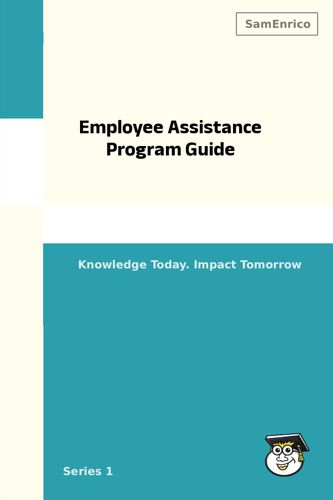
Employee Assistance Program Guide eBook
Uses EAP counseling and resources effectively.
Uses EAP counseling and resources effectively.
Formats
Free sample
Chapter 1: The $10,000 Mistake--Every year, millions of working adults leave an average of $10,000 in free benefits sitting on the table. They do not cash this check because they do not know it exists. They do not claim this money because they believe a lie someone told them long ago: that asking for help is a sign of weakness, or that workplace resources are only for people who have hit rock bottom.If you are reading this sentence, you have already made a different choice. You have decided to learn about something your employer has already paid for, something that could save your career, your relationships, or even your life. That something is your Employee Assistance Program, and this chapter will show you why everything you think you know about it is probably wrong.The Most Expensive Poster on the Wall Walk through almost any workplace in America, and you will find it.
In the break room, next to the OSHA compliance notice and the healthcare open enrollment flyer, there is a poster. It is often beige or soft blue, designed to be inoffensive. It says something like, "Your Employee Assistance Program: Confidential Support Available 24/7." There is a phone number. There is a website. There is a small logo of a smiling person or a helping hand.Most employees have walked past that poster hundreds of times without really seeing it.
Those who do notice it usually have one of two reactions. The first is a vague sense that the poster is for "other people"—the ones with serious drinking problems, the ones going through divorce, the ones who are "messed up." The second reaction is a quiet suspicion that the number on that poster is not really confidential, that someone in HR is keeping a list, that using the EAP is the first step toward being labeled as a problem employee.Both reactions are wrong. And both reactions are extraordinarily expensive.The average employer spends between twenty and fifty dollars per employee per year on EAP services. That money has already been budgeted, already been spent, already been allocated to you. If you do not use the EAP, your employer does not get a refund.
The money simply disappears into the administrative overhead of a program nobody uses. You have effectively paid for a service you are refusing to claim.Consider the math. A single hour of therapy with a licensed counselor outside of an EAP typically costs between one hundred fifty and two hundred fifty dollars. The average EAP provides between five and eight sessions per issue, per year. That is between seven hundred fifty and two thousand dollars of clinical services that you have already purchased but have not collected.
Add legal consultations, which typically cost three hundred to five hundred dollars per hour outside of an EAP. Add financial coaching, identity theft restoration, elder care placement services, and student loan counseling. A comprehensive EAP package can easily exceed ten thousand dollars in annual value for an employee who uses it strategically.This chapter will help you stop making that mistake. But before we get to the how, we need to confront the why. Why have you not used your EAP?
Why has almost everyone you know not used theirs? The answer lies in a set of myths so powerful and so pervasive that they have convinced an entire workforce to throw away billions of dollars in benefits every single year.Myth One: The Spy Network Let us start with the fear that keeps most people from picking up the phone. The fear that someone will find out. The fear that the EAP counselor is actually a secret agent for Human Resources, that the things you say in confidence will somehow end up in your personnel file, that your boss will receive a report titled "Reasons Why Jane Is Falling Apart."This fear is not irrational. It is a product of lived experience.
Most employees have learned, through painful encounters, that the workplace is not a safe space for vulnerability. People have been fired after disclosing a medical condition. People have been passed over for promotion after taking mental health leave. People have watched colleagues disappear after "asking for help." In this context, the idea that a program sponsored by your employer could be truly confidential sounds naive at best and dangerous at worst.Here is the truth that changes everything.Employee Assistance Programs are governed by federal and state privacy laws that are among the strongest in the United States. The Health Insurance Portability and Accountability Act, known as HIPAA, applies to most EAPs.
Under HIPAA, your EAP records are treated the same way as your medical records at a hospital. They are separate from your personnel file. They cannot be accessed by your manager, your HR generalist, or your company's leadership without your explicit, written, time-limited consent.But what about the EAPs that are not covered by HIPAA? Some employers, particularly small organizations, contract with EAP vendors that fall under different regulations. In those cases, the confidentiality protections are often even stronger, because the vendor has no contractual obligation to share any information with the employer beyond the most basic utilization data.Let us be precise about what your employer actually sees.When your company contracts with an EAP vendor, the vendor typically provides the employer with a quarterly or annual report.
That report contains aggregate, anonymized data. It might say something like: "Fifteen percent of employees used the EAP this quarter. The most common presenting issues were anxiety, family conflict, and financial stress." The report does not include names. It does not include departments. It does not include anything that could identify you.Your HR department receives this report because they need to know whether the program they are paying for is being used.
They do not receive clinical notes. They do not receive session summaries. They do not receive diagnoses. They receive a check box that says "services rendered" and a number that counts how many employees called.There is one exception to this rule, and it is important to understand it clearly. If you sign a release of information, you can authorize your EAP counselor to speak with your HR department.
This is sometimes necessary when you are requesting a reasonable accommodation under the Americans with Disabilities Act, or when you need to document medical leave under the Family and Medical Leave Act. In those cases, you control exactly what information is shared. You decide the scope. You decide the duration. You can revoke the release at any time.Without that signed release, your EAP counselor cannot even confirm to your employer that you are a client.
If your boss calls the EAP and asks, "Is one of my employees using your services?" the only lawful answer is, "We cannot confirm or deny any individual's participation."The confidentiality fortress is real. It is backed by federal law, professional ethics, and the financial self-interest of EAP vendors who would go out of business if they ever betrayed a client's trust. The fear that someone will find out is the single most expensive belief in the modern workplace, and it is time to let it go.Myth Two…
This is the end of the free sample. Get the eBook to keep going. Buy now
About this book
Details
- Author
- Poland Evette
- Publisher
- SamEnrico
- Language
- English
- Genre
- Non-Fiction, Self-Help, EAP
- Released
- 2026-06-07
- Pages (approx.)
- 138
- Available as
- eBook, Audiobook

Read better in the ZLOADR app
Your eBooks on your phone or tablet. Sign in with your SamEnrico account and start reading.
More by Poland Evette
 MBSR For Lived Experience WorkbookPoland Evette$11.99
 Bamboo Forest Visualization SwayPoland Evette$11.99
 PCOS Podcast ListPoland Evette$11.99
 The John Bardeen Double LaureatePoland Evette$11.99
 The Untold Story of the Harlem Globetrotters: How They Conquered the WorldPoland Evette$11.99
 Prohibited Conduct Terms GuidePoland Evette$12.99
 Finding Your First Chinese StudentsPoland Evette$12.99
 Understanding Osteopetrosis, (Generic Term)Poland Evette$17.99
 How to Become a Cone OperatorPoland Evette$11.99
 Trenchless Technology SpecialistPoland Evette$11.99
You may also like
 Hong Kong Handover 1997Dunn Johnnie$11.99
 Zumba For Postnatal Recovery CourseNeal Christian$11.99
 Zumba for BeginnersLadner Nikia$11.99
 YouTube Comment Mining GuideHumes Pandora$12.99
 Worry Box MeditationCarlin Rudy$11.99
 Workplace Stress MeditationNguyen Lynn$11.99
 Workplace Stress and Sleep RepairHawley Ivory$11.99
 Workplace Perfectionism CureDelaney Jeffry$11.99
 Workplace Injustice Anger GuideWallen Isabelle$11.99
 Work Addiction and Burnout LinkGreenwood Ester$11.99
 Women in Yoga and WellnessBeattie Galina$11.99
 Women in Stand Up ComedyChun Evangeline$11.99