
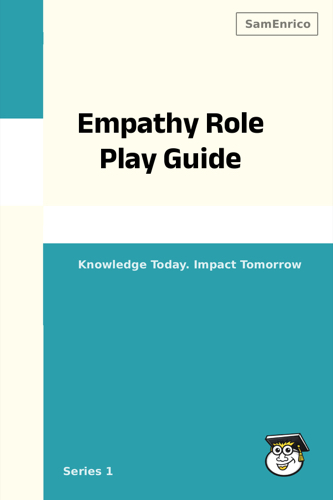
Free sample
Chapter 1: The Empathy Lie--–- The email arrived at 11:47 on a Tuesday. Sarah, a regional manager for a medical supply company, had just finished her third Zoom call of the morning. The message was from her direct report, Marcus: “Can we talk? Something happened with the Jackson account.” No emoji, no exclamation point, no “hope you’re well.” Just six words that landed like a punch.Sarah prided herself on being an empathetic leader. She had taken the Linked In assessment.
She had watched the Brené Brown special. She kept a “How can I support you?” sticky note on her monitor. So when Marcus appeared in her office doorway fifteen minutes later—shoulders hunched, jaw tight—she did what came naturally. She leaned forward, made eye contact, and said, “I’m so sorry you’re dealing with this. You’re handling it really well.”Marcus nodded.
He said thank you. He told her about the client who had yelled at him, the deadline that had moved up, the impossible ask from upper management. Sarah listened. She nodded. She said, “That sounds so hard” at all the right moments.
When he left thirty minutes later, he seemed calmer. She felt like a good boss. A good person. An empathetic person.Three weeks later, Marcus resigned. In his exit interview, he said something that haunted her: “I never felt like you actually heard me.
You said all the right things, but I left every conversation feeling worse.”Sarah had done everything the empathy books told her to do. And it had failed.She is not alone.The Most Expensive Mistake in Human Connection This is a book about a skill that almost everyone believes they have and almost no one actually practices. It is a book about the gap between feeling empathetic and being empathetic—between knowing the right words and landing them in a way that transforms another person’s experience. And it begins with an uncomfortable truth: most of what you have been taught about empathy is wrong.Not partially wrong. Not slightly outdated.
Fundamentally, structurally, dangerously wrong.The mistake is subtle enough to go unnoticed and pervasive enough to damage every relationship it touches. Here it is: We have been treating empathy as a feeling when it is actually a performance. A skill. A set of observable, learnable, repeatable behaviors that can be practiced like a free throw or a piano scale. And because we treat it as a feeling—something you either have or you don’t, something that flows naturally from a good heart—we never actually practice it.
We never rehearse. We never fail in private so we can succeed in public. We just show up to life’s most important conversations with no training and wonder why people feel unheard.Consider the evidence. A 2018 study in the Journal of Experimental Social Psychology found that people consistently overestimate their empathic accuracy by a staggering margin. When asked to predict how well they understood another person’s emotions, subjects rated themselves at 84% accuracy.
Their actual accuracy? 34%. That gap—fifty percentage points between what we believe and what we deliver—is the cost of the empathy lie. It is the space where marriages fray, teams disintegrate, parents lose their teenagers, and leaders lose their best people.Sarah believed she was empathetic. Her employee rating scores said otherwise.
The problem was not her intention. The problem was her method.Why Your Brain Fights Against Empathy To understand why good people fail at empathy, you need to understand a quirk of human neurology. The brain contains a remarkable system called mirror neurons—specialized cells that fire both when you perform an action and when you observe someone else performing that same action. When you watch someone smile, the smiling neurons in your brain fire. When you see someone flinch, your flinch neurons activate.
This system is the biological basis of empathy, the reason you can feel someone else’s joy or wince at their pain.Here is what no one tells you: mirror neurons require repetition to strengthen. They are not fixed at birth. They are built through practice, like any other neural pathway. The first time you try to match someone’s emotional state, your brain stumbles. The hundredth time, it flows.
The thousandth time, it happens before you even know it is happening.This is neuroplasticity—the brain’s lifelong ability to reorganize itself by forming new neural connections. For decades, scientists believed that adult brains were fixed, that you could not teach an old dog new tricks. We now know that every time you practice a skill, you physically change the structure of your brain. White matter increases. Synaptic connections strengthen.
Pathways that were once barely visible become superhighways.Here is the implication: If you are not deliberately practicing empathy, your empathic ability is not staying the same. It is actively declining.Think about what most people do instead of practice. They read articles. They watch TED talks. They take personality assessments.
They nod along to podcasts. This is passive learning—consuming information without changing behavior. Passive learning feels productive because it produces the illusion of competence. You finish a book about empathy and think, “I’ve got this now.” But reading about a skill and performing a skill activate completely different neural circuits. Reading engages your visual cortex and language centers.
Performing engages your motor cortex, your mirror neuron system, your emotional processing regions. One does not automatically transfer to the other.This is why Sarah could recite every empathy principle in the literature and still fail when it mattered. She had knowledge without fluency. Information without integration. She was like a pianist who had read every book about the piano but never touched the keys.The Mirror Test: How Passive Learning Fools You There is a famous experiment in cognitive psychology called the “tennis serve study.” Researchers divided novice tennis players into three groups.
The first group physically practiced serves for twenty days. The second group mentally visualized serves for twenty days—imagining every movement in perfect detail but never touching a ball. The third group did nothing. The results were striking: the physical practice group improved by 30%. The visualization group improved by 23%.
The control group improved by zero.Now here is the part that matters for this book. When researchers asked participants in the visualization group how much they thought they had improved, they estimated 45%—almost double their actual gain. Passive practice (even active visualization) produced an illusion of competence. The participants genuinely believed they had gotten better. They had not.This is the mirror test for your own empathy practice.
Right now, before you read another sentence, I want you to think about the last three conversations you had where someone was upset. Not the ones where you think you did well—the ones where you walked away feeling like something was off. The ones where the other person seemed to withdraw or shut down. The ones where you said “I understand” and they looked at you like you had just spoken a foreign language.Write them down. Just three words for each: who it was, what they were upset about, and how you responded.…
This is the end of the free sample. Get the eBook to keep going. Buy now
About this book
Details
- Author
- Houghton Karry
- Publisher
- SamEnrico
- Language
- English
- Genre
- Non-Fiction, Self-Help / Role Play
- Released
- 2026-06-07
- Pages (approx.)
- 150
- Available as
- eBook, Audiobook

Read better in the ZLOADR app
Your eBooks on your phone or tablet. Sign in with your SamEnrico account and start reading.
More by Houghton Karry
 Design Thinking for MeetingsHoughton Karry$11.99
 Detox for Intellectual DisabilitiesHoughton Karry$11.99
 College Student Sleep GuideHoughton Karry$11.99
 DBT for DissociationHoughton Karry$11.99
 Workplace NVC HandbookHoughton Karry$11.99
 Cleopatra Naval StrategyHoughton Karry$11.99
 Remote Work for CoachesHoughton Karry$11.99
 The Ghost Guns of the Seven Years' War: How Artillery Shaped EmpiresHoughton Karry$11.99
 Leaping Through Royal Courts: The Grace and Power of Black Ballet PioneersHoughton Karry$11.99
 Service Providers Guide to Grief CounselingHoughton Karry$11.99
 How to Produce Tool BoxesHoughton Karry$11.99
 A Collector's Handbook to the Hillman Minx (1934)Houghton Karry$11.99
You may also like
 Hong Kong Handover 1997Dunn Johnnie$11.99
 Zumba For Postnatal Recovery CourseNeal Christian$11.99
 Zumba for BeginnersLadner Nikia$11.99
 YouTube Comment Mining GuideHumes Pandora$12.99
 Worry Box MeditationCarlin Rudy$11.99
 Workplace Stress MeditationNguyen Lynn$11.99
 Workplace Stress and Sleep RepairHawley Ivory$11.99
 Workplace Perfectionism CureDelaney Jeffry$11.99
 Workplace Injustice Anger GuideWallen Isabelle$11.99
 Work Addiction and Burnout LinkGreenwood Ester$11.99
 Women in Yoga and WellnessBeattie Galina$11.99
 Women in Stand Up ComedyChun Evangeline$11.99