
Non-FictionSelf-HelpSuicide Prevention
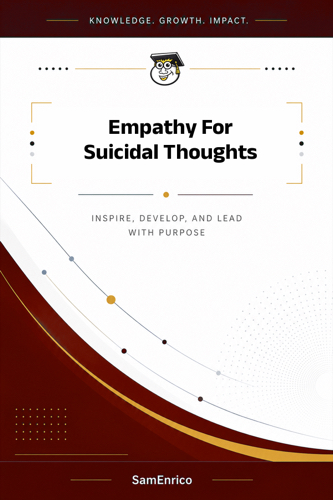
Empathy For Suicidal Thoughts eBook
Respond to suicidal disclosure with validation tha
by Leblanc Zena
Respond to suicidal disclosure with validation that increases safety and connection.
Formats
Free sample
Chapter 1: The Hot Stove Reflex--–- It happens in less than a second. Someone you love looks at you with an expression you have never seen before—or perhaps one you have learned to dread—and says the words that stop your heart: “I don’t want to be here anymore.” Or “I think I might kill myself.” Or simply, “I want to die.”Before you can think, your body reacts. Your chest tightens. Your stomach drops. Your mouth goes dry.
And then, before you can choose your response, you do something. You say something. You pull away, or you clamp down. You change the subject, or you launch into a frantic speech about everything they have to live for. You go silent, or you start problem-solving at lightning speed.This is the Hot Stove Reflex.
You have touched something burning, and your nervous system has jerked your hand back before your brain could even register the heat. It is not a moral failure. It is not a sign that you do not care. It is a biological, psychological, and social survival response that has been wired into you by fear, by culture, and by the terrifying weight of being present with someone who wants to die.But here is the problem. The Hot Stove Reflex, for all its evolutionary logic, is precisely the wrong response to suicidal disclosure.
When you pull away—even subtly—you confirm the suicidal person’s deepest fear: that they are too much, that they are poison, that no one can bear to be near them. When you clamp down with forced positivity or frantic advice, you tell them that their pain is so unacceptable that it must be immediately covered over or solved away. Both responses deepen the very state that drives people toward suicide: the feeling of being trapped, alone, and fundamentally cut off from human connection.This chapter is about unlearning the Hot Stove Reflex. It is about recognizing why your natural reactions backfire, understanding the psychology of thwarted belongingness, and learning the first and most critical skill of empathic presence: overriding panic with grounded attention. By the end of this chapter, you will have a new framework for understanding what suicidal disclosure actually is—not a problem to be solved, but an invitation to be present—and a simple, practical tool for regulating your own nervous system before you respond.The Two Faces of Panic: Pulling Away and Clamping Down The Hot Stove Reflex takes two primary forms.
They look opposite, but they emerge from the same source: fear. And they produce the same result: the suicidal person feels more alone than before they spoke.Pulling Away: The Withdrawal Response Withdrawal can be loud or quiet. Loud withdrawal looks like changing the subject, making an excuse to leave the room, or suddenly becoming very busy with a phone or a task. Quiet withdrawal looks like silence, a blank face, a slight lean backward, or a noncommittal “Hmm” followed by nothing. In both cases, the message is the same: I cannot hold this with you.Consider a father whose teenage daughter says, “I’ve been thinking about killing myself.” He freezes.
His mind goes blank. After a long, terrible silence, he says, “You don’t mean that. You’re just tired.” Then he walks into the kitchen and starts washing dishes. He is not a bad father. He is a terrified father.
But his daughter does not experience his fear as love. She experiences it as confirmation that her pain is unspeakable—so terrible that even her own father cannot bear to hear it. She learns, in that moment, that disclosure was a mistake. Next time, she will stay silent.Withdrawal is the most dangerous response to suicidal disclosure, and it is the most common. Research on thwarted belongingness—a concept we will explore in depth in Chapter 2—shows that suicidal crises are driven not primarily by pain but by the sense that one is cut off from others.
When you withdraw, you are not protecting yourself from liability or emotional contagion. You are stepping into the very wound the suicidal person is trying to show you.Clamping Down: The Fix-It Response Clamping down looks different, but it is equally harmful. This is the person who immediately launches into action mode: “You have so much to live for! Think about the kids! We’ll get you a therapist tomorrow.
Have you tried exercising? Meditation? What about that vacation you’ve been wanting to take?”The fix-it response is seductive because it feels like caring. You are doing something. You are offering solutions.
You are not running away. But here is the truth that most people never realize: clamping down is a form of rejection. You are saying, implicitly, that you cannot tolerate the pain as it is. You must transform it, solve it, or eliminate it immediately. You are not sitting with the person in their suffering.
You are trying to move them out of it as fast as possible, and that speed communicates a profound lack of acceptance.A young man tells his best friend, “I don’t see the point anymore. I’ve been looking up methods online.” His friend responds, “Don’t say that, man. You’ve got so much going for you. Let’s grab a beer and watch the game. You’ll feel better.” The friend means well.
He wants to distract, to comfort, to restore normalcy. But the young man hears: You are not allowed to feel this way. Your pain is an inconvenience. I need you to perform wellness so I can feel okay. He will not reach out to this friend again.Clamping down also includes guilt-based responses: “How could you do that to your mother?” or “Suicide is selfish.” These responses are overtly harmful, but they come from the same panicked desire to control the situation.
They say: Your pain is not as important as my fear of losing you. Your suffering must be subordinated to my comfort.Why Withdrawal and Clamping Down Feel Inevitable If these responses are so harmful, why do we default to them? The answer lies in three interconnected drivers: fear of contagion, fear of liability, and fear of our own helplessness.Fear of Contagion: Many people carry an unspoken belief that suicidal thoughts are catching—that if you sit too long with someone who wants to die, you might start wanting to die yourself. This belief is not supported by research. Empathy does not cause suicidality.
But the fear is real, and it drives withdrawal. You pull back to protect your own mental health, not realizing that your presence is the single most protective factor you can offer.Fear of Liability: Especially for professionals, but increasingly for friends and family, there is a terror of doing or saying the wrong thing and being held responsible for an attempt. This fear drives both withdrawal (if I don’t engage, I can’t be blamed) and clamping down (if I fix it fast, I can’t be blamed). Neither response is driven by the suicidal person’s needs. Both are driven by the supporter’s self-protection.Fear of Helplessness: This is the deepest driver.…
This is the end of the free sample. Get the eBook to keep going. Buy now
About this book
Details
- Author
- Leblanc Zena
- Publisher
- SamEnrico
- Language
- English
- Genre
- Non-Fiction, Self-Help, Suicide Prevention
- Released
- 2026-06-08
- Pages (approx.)
- 157
- Available as
- eBook, Audiobook

Read better in the ZLOADR app
Your eBooks on your phone or tablet. Sign in with your SamEnrico account and start reading.
More by Leblanc Zena
 HIIT Immune System BoostLeblanc Zena$11.99
 The Post Scream Repair GuideLeblanc Zena$11.99
 Step Eleven Prayer Meditation GuideLeblanc Zena$11.99
 The Norman Feudalism GuideLeblanc Zena$11.99
 The Last Kingpin: The Rise and Fall of Frank MatthewsLeblanc Zena$11.99
 Shoestring Startup PR GuideLeblanc Zena$12.99
 Customer Event Retention GuideLeblanc Zena$12.99
 The Breeder's Guide to Lavender TurkeysLeblanc Zena$11.99
 Interior Design AssistantLeblanc Zena$11.99
 How to Start a Battery for Flash Lamp Business (Beginners Guide)Leblanc Zena$11.99
You may also like
 Hong Kong Handover 1997Dunn Johnnie$11.99
 Zumba For Postnatal Recovery CourseNeal Christian$11.99
 Zumba for BeginnersLadner Nikia$11.99
 YouTube Comment Mining GuideHumes Pandora$12.99
 Worry Box MeditationCarlin Rudy$11.99
 Workplace Stress MeditationNguyen Lynn$11.99
 Workplace Stress and Sleep RepairHawley Ivory$11.99
 Workplace Perfectionism CureDelaney Jeffry$11.99
 Workplace Injustice Anger GuideWallen Isabelle$11.99
 Work Addiction and Burnout LinkGreenwood Ester$11.99
 Women in Yoga and WellnessBeattie Galina$11.99
 Women in Stand Up ComedyChun Evangeline$11.99