
Non-FictionSelf-HelpDivorce Support
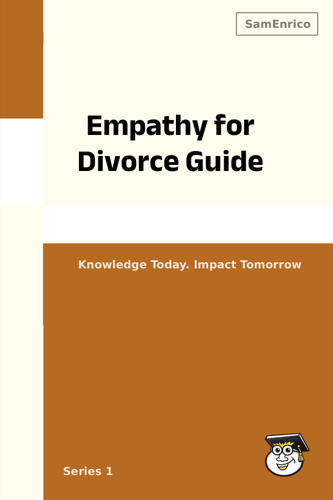
Empathy for Divorce Guide eBook
Validate loss and identity change after split.
by Hong Jerrica
Validate loss and identity change after split.
Formats
Free sample
Chapter 1: The Waiting Room...--–- You are not broken. You are not behind. You are not the only one who feels like a ghost in their own life. You are, quite simply, in The Waiting Room.This is not a metaphor you will read once and forget. This is the actual geography of divorce—the liminal, unnerving, and profoundly lonely space between the life you planned and the life you cannot yet imagine.
You did not ask to be here. You did not pack a bag for this trip. And yet, here you are: sitting in a room with no windows, no exit sign, and no estimated wait time.The Waiting Room is where every divorced person lives for a while. Some stay for weeks. Some stay for years.
But everyone stays. And the first act of empathy—the first gift this book will give you—is to stop pretending you are anywhere else.Most divorce guides make a catastrophic error right out of the gate. They assume you want to "move on." They offer five-step plans, co-parenting apps, and financial spreadsheets. They treat divorce as a logistics problem with an emotional side effect. But you are not a logistics problem.
You are a person who has lost the future you were promised, the routines that held you together, and the quiet assumption that someone would be there at the end of the day.You are grieving. And grief does not follow a spreadsheet.This chapter is not about fixing you. It is not about manifesting a better future or reframing your pain into a "growth opportunity." Those things will come—later, in other chapters, when you are ready. Right now, this chapter has one job: to name what you have lost, to validate that the loss is real even if no one else sees it, and to convince you that numbness is not a personality flaw. It is the soul's anesthesia.
And anesthesia exists for a reason.So take a breath. Find a chair. You are in The Waiting Room now. And you are allowed to stay as long as you need.The Two Kinds of Loss (And Why One Gets All the Casseroles)When someone dies, the world shows up. They bring food.
They send flowers. They say, "I'm so sorry for your loss." They give you permission to be a wreck for a while. There is a ritual—a funeral, a shiva, a celebration of life—that marks the before and the after. Grief is visible. Loss is named.
You are allowed to fall apart.Divorce gets none of this.No one brings you a casserole when you separate from your spouse. In fact, people often do the opposite. They look away. They change the subject. They say things like "at least you didn't have kids" (you have kids) or "you're better off" (you are not better off yet) or "everything happens for a reason" (you do not want a reason, you want your life back).This is because our culture understands visible loss—death, illness, disaster—but it is deeply uncomfortable with invisible loss.
And divorce is packed with invisible loss.Visible loss is the kind that leaves a body behind. There is a funeral. There is an obituary. There is a grave you can visit. Society has a script for visible loss.
You are supposed to be sad. You are supposed to take time off work. You are supposed to lean on friends.Invisible loss is the kind that leaves everything looking exactly the same—except nothing is the same. Your spouse is still alive, so no one sends flowers. But they are also not coming home, so you are grieving someone who is still breathing.
Your house looks the same, but the silence is different. Your friends look the same, but the invitations have stopped. Your reflection looks the same, but you do not recognize the person staring back.Invisible loss is the slow disappearance of a shared future. It is the inside joke that will never be told again. It is the holiday tradition that now feels like a minefield.
It is the assumption—the quiet, bedrock assumption—that you would grow old with this person, that you would hold their hand in a hospital room, that you would bicker about grandchildren and argue about where to retire.That assumption is gone. And no one brought you a casserole.This chapter is your casserole. Not in the literal sense—you will still have to feed yourself, unfortunately—but in the ritual sense. This is the place where your invisible loss becomes visible. This is where you get to say, out loud, without someone rushing to "cheer you up," what you have lost.The Inventory of What No One Else Sees You are going to do something now that might feel strange.
You are going to make a list. Not of what went wrong, not of who was at fault, not of what you should have done differently. You are going to list the things you lost that no one else would think to mourn.This is called The Inventory of What No One Else Sees. And it is the most important exercise in this entire chapter.Take out a notebook. Open to a fresh page.
Or open a note on your phone. Or say it out loud to the empty room. Whatever works. But do not skip this. The inventory is not busywork.
It is the first act of claiming your grief as real.Here are some examples from people who have sat in The Waiting Room before you:"I lost the sound of his keys in the door at 6:15 PM. I didn't realize I was listening for it until it stopped.""I lost the way we watched TV in silence, not talking, just existing in the same room. Now the silence is loud.""I lost the person who knew which parent to call when the school nurse phoned. Now every decision is mine alone.""I lost the future vacation we were supposed to take when the kids left for college. We were going to go to Italy.
I have never been to Italy. Now I would have to go alone, or not at all.""I lost the inside joke about the burned toast. It was stupid. It was ours. Now I make toast and no one laughs.""I lost the assumption that someone would notice if I didn't come home."Do you see what these have in common?
They are not about betrayal or anger or who filed first. They are about the texture of a life that no longer exists. They are about the small, private, almost embarrassing losses that you cannot put in a legal filing.Now it is your turn.Write down five things you lost that no one else can see. Do not censor yourself. Do not worry if they sound silly or small.
Grief is not a competition. The person who lost a shared Netflix password is not grieving less than the person who lost a thirty-year marriage. Grief is grief. It does not have a minimum threshold.Still stuck? Try these prompts:What sound do you listen…
This is the end of the free sample. Get the eBook to keep going. Buy now
About this book
Details
- Author
- Hong Jerrica
- Publisher
- SamEnrico
- Language
- English
- Genre
- Non-Fiction, Self-Help, Divorce Support
- Released
- 2026-06-07
- Pages (approx.)
- 146
- Available as
- eBook, Audiobook

Read better in the ZLOADR app
Your eBooks on your phone or tablet. Sign in with your SamEnrico account and start reading.
More by Hong Jerrica
 Work Addiction and Leisure DeficitHong Jerrica$11.99
 Arc de Triomphe GuideHong Jerrica$11.99
 Stress and Hormonal ImbalanceHong Jerrica$11.99
 Concrete Dreams: The Stadium Builders Who Shaped the WorldHong Jerrica$11.99
 German Vacation Days TradeHong Jerrica$12.99
 How to Start a Photographic Goods Importer (wholesale) Business (Beginners Guide)Hong Jerrica$11.99
 How to Produce a BankHong Jerrica$11.99
 CapoeiraHong Jerrica$11.99
You may also like
 Hong Kong Handover 1997Dunn Johnnie$11.99
 Zumba For Postnatal Recovery CourseNeal Christian$11.99
 Zumba for BeginnersLadner Nikia$11.99
 YouTube Comment Mining GuideHumes Pandora$12.99
 Worry Box MeditationCarlin Rudy$11.99
 Workplace Stress MeditationNguyen Lynn$11.99
 Workplace Stress and Sleep RepairHawley Ivory$11.99
 Workplace Perfectionism CureDelaney Jeffry$11.99
 Workplace Injustice Anger GuideWallen Isabelle$11.99
 Work Addiction and Burnout LinkGreenwood Ester$11.99
 Women in Yoga and WellnessBeattie Galina$11.99
 Women in Stand Up ComedyChun Evangeline$11.99