
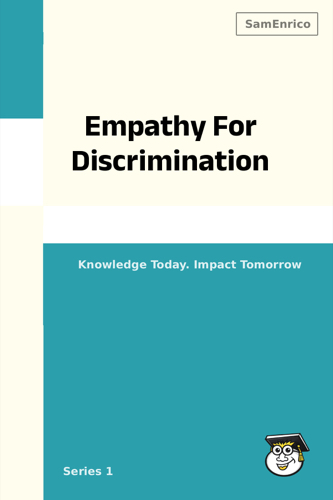
Empathy For Discrimination eBook
Validate experiences of racism, sexism, homophobia
Validate experiences of racism, sexism, homophobia, or other bias without questioning.
Formats
Free sample
Chapter 1: The First Three Seconds...--Most people who desperately want to be good allies have no idea they are causing harm in the first three seconds of every difficult conversation. They lean forward, furrow their brow, and say something that sounds like concern but lands like an accusation. They ask for more information. They ask for context. They ask for the other side.
They ask for proof. And in doing so, they transfer every ounce of burden from their own shoulders onto the person who is already bleeding from a wound they did not ask for.This is not because they are bad people. It is not because they secretly harbor prejudice or don't care about justice. It is because no one has ever taught them the difference between listening to understand and listening to defend. It is because their brain, in a fraction of a second, has interpreted someone else's pain as a threat to their own self-image.
And it is because they have never been given the tools to pause, to feel the discomfort, and to choose a different response.This chapter is about those first three seconds. It is about why your first instinct is almost always wrong, what drives that instinct, and how to override it with something that actually helps. By the time you finish reading, you will understand the single most common reason that well-intentioned people cause secondary harm. And you will have a practical, repeatable skill that will change every conversation you have about discrimination for the rest of your life.Let me tell you about a woman named Denise.Denise is a senior manager at a mid-sized tech company. She has been through diversity training three times.
She has a "Believe Women" sticker on her laptop. She has read articles about microaggressions and implicit bias. She considers herself an ally, and by most measures, she is far ahead of her peers. She genuinely wants to do the right thing.One afternoon, her direct report James asks to speak with her privately. James is a Black man on her team, a high performer she has been mentoring for a promotion.
He closes the door, sits down, and takes a breath. Then he says: "Denise, I need to tell you something. In the last two team meetings, David has interrupted me three times. He never interrupts white team members. I think it's racial."Denise's heart rate increases.
Her face flushes. She has worked hard to build a collaborative team culture. David is one of her most enthusiastic employees — a bit talkative, maybe, but not a racist. She likes David. She also likes James.
She does not want to believe that one of her people is systematically harming another. That would mean she failed to notice. That would mean her team is not as safe as she thought. That would mean she has work to do that she does not know how to do.So she says: "I hear you. But are you sure he meant it that way?
David is kind of awkward. He interrupts everyone sometimes. I've seen him do it to Sarah, and she's white."James says nothing for a moment. His face goes still in the way that people's faces go still when they have decided that speaking further will cost more than it is worth. He nods.
He says "Okay, thanks for listening." He leaves the room.Six months later, James quits. In his exit interview, he says he didn't feel supported. He says he raised concerns and was dismissed. He says he learned that speaking up at this company did not change anything, so he found a place where his voice mattered.Denise is blindsided. She thought she handled that conversation well.
She thought she was being fair by asking questions. She thought she was helping James see that the situation might be more complicated than he realized. She thought she was being a good manager by not jumping to conclusions.She was not helping. She was asking James to prove that his experience was real before she would believe it. She was asking him to provide evidence, to consider alternative explanations, to manage her discomfort with the possibility that someone she liked was causing harm.
She was asking him to do emotional labor that she should have done herself. And in the first three seconds of that conversation — before she said a single word — she made a choice. Not a conscious choice. Not a malicious choice. A reflexive choice.
A choice driven by a reflex that nearly all of us have and nearly all of us deny.That reflex is the subject of this chapter. I call it the But Reflex, and it is the single greatest barrier to genuine empathy for discrimination.The But Reflex Defined The But Reflex is the almost automatic human response to add a condition, a caveat, or a counterpoint after hearing something that makes us uncomfortable. It is the "but" that escapes your lips before you even know you are saying it. But it is also the "but" that lives in your tone of voice, in the skeptical arch of your eyebrow, in the pause that lasts one second too long, in the question that sounds like curiosity but functions as doubt."I believe you, but have you considered...""That's valid, but maybe they didn't mean it...""I hear you, but that's never happened here before..."The "but" does not need to be spoken aloud to do its damage. A sigh.
A glance away. A too-bright "Okay!" that moves the conversation along without acknowledging the pain. All of these are the But Reflex in disguise. All of them communicate the same devastating message: Your experience is not quite enough for me. I need more before I can fully believe you.The But Reflex is not a character flaw.
It is not a sign that you are secretly a bad person. It is a survival mechanism that has been repurposed into a relationship destroyer. Your brain is wired to protect you from social threats — from being blamed, from being associated with wrongdoers, from having to change your behavior or your beliefs. When someone shares an experience of discrimination, your brain scans for ways that this story could reflect badly on you. And then it tries to deflect that reflection by questioning the story.Denise's brain did not hear "James is hurting." It heard "You are a bad manager." "You hired a racist." "You failed to create a safe environment." These were not accusations James made.
Denise's defensive listening manufactured them out of thin air. And then she responded to the accusations in her own head rather than to the pain in front of her.This happens in milliseconds. You do not decide to be defensive. Your brain decides for you. That is why the But Reflex is so hard to kill.
You cannot simply decide to be a better listener. You have to retrain your brain's automatic response. And that starts with understanding what drives it.The Anatomy of Defensive Listening Before you can stop the But Reflex, you have to understand the deeper pattern that produces it. That pattern is called defensive listening…
This is the end of the free sample. Get the eBook to keep going. Buy now
About this book
Details
- Author
- Gaddy Janiece
- Publisher
- SamEnrico
- Language
- English
- Genre
- Non-Fiction, Self-Help, Social Justice
- Released
- 2026-06-12
- Pages (approx.)
- 147
- Available as
- eBook, Audiobook

Read better in the ZLOADR app
Your eBooks on your phone or tablet. Sign in with your SamEnrico account and start reading.
More by Gaddy Janiece
 The Financial Self Compassion WorkbookGaddy Janiece$11.99
 Ruminococcus InterpretationGaddy Janiece$11.99
 Workplace Boundary GuideGaddy Janiece$11.99
 Blended Family Stress Self CareGaddy Janiece$11.99
 Mayor of a Port CityGaddy Janiece$11.99
 Sleep Apnea and AsthmaGaddy Janiece$11.99
 Pomodoro For Data AnalysisGaddy Janiece$11.99
 Elderly Memory Sleep GuideGaddy Janiece$11.99
 The Tide of Tongues: Black Linguists Who Charted the Depths of LanguageGaddy Janiece$11.99
 The Last Masterpiece: How a Forgotten Artist Outlived His FameGaddy Janiece$11.99
 The Silk Road Conspiracy: Marco Polo’s Forbidden MapGaddy Janiece$11.99
 Supplier Vetting for DropshippingGaddy Janiece$12.99
You may also like
 Navigating Social Justice TalksBradbury Blaine$11.99
 Anger And Injustice GuideBillingsley Reita$11.99
 NVC For Activism GuideDelaney Layne$11.99
 Loving Kindness for Racial HealingWills Mardell$11.99
 Opioid Dependency Stigma Breaking CourseMccabe Nena$11.99
 NVC In Social Justice GuidePolanco Charles$11.99
 Confronting Privilege Constructively GuideCohen Leah$11.99
 NVC for Social ChangeWallace Harold$11.99
 EQ for Social JusticeDominguez Mammie$11.99
 Forgiveness for Cultural BetrayalWayne Hilde$11.99
 Thin Privilege Awareness GuideCabrera Marvel$11.99
 The Empathy for Discrimination GuideMireles Cyrus$11.99