
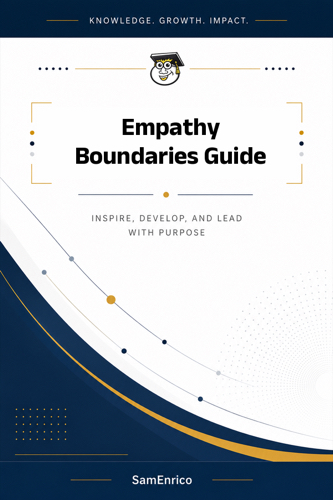
Free sample
Chapter 1: The Exhausted Gift--–- You are not broken. You are not "too much." You are not weak for crying at a commercial, for feeling physically ill after an argument that didn't even involve you, or for needing three hours alone after a family dinner. The fact that you are reading this book right now suggests something else entirely: you are carrying a gift that no one taught you how to unwrap safely.Let me ask you something. Have you ever walked into a room and immediately known a fight had happened there—even though no one said a word? Have you ever sat next to someone in pain and felt their ache in your own bones?
Have you ever been accused of being "too sensitive," "dramatic," or "overly emotional" so many times that you started to believe it? If you answered yes to any of these, you are not imagining things. You are not weak. And you are not alone.You are likely an empath.The term "empath" has been thrown around so casually in recent years that it has begun to lose its meaning. On social media, everyone is an empath.
In casual conversation, people use it as a synonym for "nice person." But being an empath is not a personality badge you collect because you feel bad when your friend is sad. That is called being a decent human being with basic emotional intelligence. Being an empath is something else entirely. It is a specific, measurable, and often exhausting way of experiencing the world—one in which your nervous system literally absorbs the emotions, physical sensations, and even the energetic residue of the people and places around you.This chapter is not here to give you a trendy label. It is here to give you a diagnosis.
A real, functional, actionable understanding of what is happening inside your body and brain. By the end of these pages, you will know definitively whether you are an empath, a Highly Sensitive Person (HSP), or simply a kind person who has been taught to neglect their own needs. And once you know that, you can finally stop fighting yourself and start protecting yourself.The Three Confusions: Kindness, Sensitivity, and Empathy Before we get to the self-assessment, we need to clear up a major source of confusion that has left millions of empaths feeling misunderstood and mislabeled. There are three distinct states that people constantly mix up, and mixing them up is dangerous. If you believe you are simply "too sensitive" when you are actually an empath, you will try to harden yourself instead of learning to filter.
If you believe you are an empath when you are actually a kind person with poor boundaries, you will adopt dramatic "energy shielding" techniques when what you really need is a simple script for saying no.Let me break this down clearly.The Kind Person is someone who possesses basic emotional intelligence and genuine care for others. They feel sad when a friend is sad. They offer help when someone is struggling. They are generous with their time and attention. However, a kind person does not absorb the emotions of others.
They observe them. They can listen to a friend's grief, offer comfort, and then go home and cook dinner without feeling weighed down by an invisible anchor. Their empathy is a choice, not an automatic takeover. If this sounds like you, your problem is not empathic absorption—it is that you have been taught that your kindness should be unlimited. You need boundaries, not energetic hygiene.The Highly Sensitive Person (HSP) , a term coined by psychologist Dr.
Elaine Aron, describes approximately 15 to 20 percent of the population who have a more sensitive nervous system. HSPs process sensory information more deeply. They are bothered by bright lights, loud noises, strong smells, and rough fabrics. They need more downtime after stimulating events. They notice subtleties that others miss.
However—and this is crucial—HSPs do not necessarily absorb the emotions of others. Their sensitivity is primarily sensory and cognitive, not emotional and energetic. An HSP might feel overwhelmed in a crowded mall because of the noise and lights. An empath might feel overwhelmed in that same mall because they are absorbing the anxiety, frustration, and exhaustion of every person they pass.The Empath takes the HSP's sensitivity one step further. The empath's nervous system not only registers stimuli but takes it in.
Emotional contagion is not a theoretical concept for you; it is a lived experience. When someone cries, you cry. When someone is angry, you feel a tightness in your chest. When someone is in physical pain, you flinch as if the pain were your own. This is not imagination.
Neuroscientists have identified mirror neurons—brain cells that fire both when you perform an action and when you observe someone else performing that action. In empaths, this mirror neuron system appears to be more active and less discriminating. You do not choose to mirror. You simply mirror.This is the first and most important distinction you will make in this entire book: Are you absorbing, or are you understanding? Understanding emotions is a skill.
Absorbing them is a wiring. One can be learned and unlearned. The other must be managed.The 5-Question Self-Assessment: Are You an Empath?Forget the vague quizzes you have taken online that ask if you cry at movies or care about your friends. Those are meaningless. The following five questions are designed to identify the specific neurological and energetic pattern of empathic absorption.
Answer each one honestly. There is no "good" or "bad" score. There is only information.Question One: After spending time with someone who is struggling, do you feel physically different—tired, heavy, headachy, or nauseated—even if you did not do anything to help them?This is the hallmark of an empath. Not feeling bad for them. Feeling bad with them, in your own body.
If you regularly find that listening to a friend's problems leaves you with a tension headache, or that sitting next to an anxious coworker makes your stomach churn, you are likely absorbing their physical state. Non-empaths can listen to hours of venting and feel mentally tired but not physically altered. Your body is telling you something.Question Two: Have you ever walked into a room and known, within seconds, that something was wrong—even though everyone was smiling and saying everything was fine?Empaths read the gap between words and energy. You do not need someone to tell you they are upset. You can feel it.
This is not magic. It is pattern recognition combined with sensory absorption. You are picking up on micro-expressions, muscle tension, breathing patterns, and energetic shifts that others miss. But for an empath, this information does not stay at the level of observation. It becomes a felt experience.
You do not just know they are upset. You feel upset.Question Three: Do you find crowds, busy stores, or public transportation so exhausting that you need significant recovery time afterward—often more recovery time than the activity itself lasted?Everyone gets tired after a busy day. But empaths experience crowd fatigue differently. It is not just sensory overload (though that can…
This is the end of the free sample. Get the eBook to keep going. Buy now
About this book
Details
- Author
- Paredes Myrta
- Publisher
- SamEnrico
- Language
- English
- Genre
- Non-Fiction, Self-Help / Boundaries
- Released
- 2026-06-06
- Pages (approx.)
- 137
- Available as
- eBook, Audiobook

Read better in the ZLOADR app
Your eBooks on your phone or tablet. Sign in with your SamEnrico account and start reading.
More by Paredes Myrta
 Design Thinking for PresentationsParedes Myrta$11.99
 Children's Bedtime MeditationParedes Myrta$11.99
 Detox for Deaf PatientsParedes Myrta$11.99
 DBT for Substance UseParedes Myrta$11.99
 Parent Child NVC GuideParedes Myrta$11.99
 Remote Work for MarketersParedes Myrta$11.99
 Elizabeth Spy NetworkParedes Myrta$11.99
 The First Conviction: How DNA Solved the Florida Rape Case That Changed Forensics (1987)Paredes Myrta$11.99
 The Casablanca Cartel: The Prohibition-Era Drug War That Shook AfricaParedes Myrta$11.99
 A Collector's Handbook to the Hillman MinxParedes Myrta$11.99
 How to Produce an Impact MillParedes Myrta$11.99
 Service Providers Guide to Family CounselingParedes Myrta$11.99
You may also like
 Hong Kong Handover 1997Dunn Johnnie$11.99
 Zumba For Postnatal Recovery CourseNeal Christian$11.99
 Zumba for BeginnersLadner Nikia$11.99
 YouTube Comment Mining GuideHumes Pandora$12.99
 Worry Box MeditationCarlin Rudy$11.99
 Workplace Stress MeditationNguyen Lynn$11.99
 Workplace Stress and Sleep RepairHawley Ivory$11.99
 Workplace Perfectionism CureDelaney Jeffry$11.99
 Workplace Injustice Anger GuideWallen Isabelle$11.99
 Work Addiction and Burnout LinkGreenwood Ester$11.99
 Women in Yoga and WellnessBeattie Galina$11.99
 Women in Stand Up ComedyChun Evangeline$11.99