
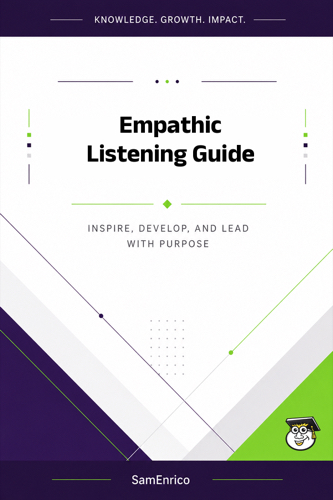
Non-FictionSelf-HelpEmpathyEmotional Intelligence
Empathic Listening Guide eBook
Feel into another's emotional experience while mai
Feel into another's emotional experience while maintaining your own boundaries.
Formats
Free sample
Chapter 1: The Empathy Trap--–- The first time I realized I had been listening wrong my entire life was not in a therapy office or a leadership seminar. It was in a coffee shop, watching a friend cry into her latte while I sat across from her, my chest tight, my jaw clenched, my mind racing through a mental list of solutions I was desperate to offer. She had just told me about her husband’s affair. Her voice cracked on the word “betrayal.” And I, the person who prided myself on being a good friend, a compassionate human, someone who felt things deeply, opened my mouth and said the one thing I now know is the most useless sentence in the English language.“I know exactly how you feel.”She stopped crying. She looked at me.
And then she said nothing for a very long time. I thought I had connected with her. In fact, I had left her. I had left her story and entered my own memory of a breakup six years prior, a breakup that had nothing to do with marriage, children, or fifteen years of shared history. I was not with her.
I was with a ghost of my own past, and I had invited her to join me there. She declined. She wiped her eyes, said “I should go,” and left.That was the day I started asking a question that would change the way I listen forever: Why does feeling someone’s pain so often fail to help them feel seen?The answer, it turns out, is both simple and devastating. Most of us have been taught that empathy means feeling what the other person feels. We believe that the depth of our caring is measured by the intensity of our emotional takeover.
We think that if we are not crying with them, we are not really listening. And this belief—this well-intentioned, culturally reinforced misunderstanding—is the single greatest obstacle to genuine connection.This chapter is called The Empathy Trap because that is exactly what it is: a snare disguised as a virtue. The trap promises intimacy but delivers exhaustion. It promises understanding but delivers enmeshment. And it is the reason so many sensitive, caring people eventually burn out, pull back, or secretly resent the very people they love most.Let me be clear from the beginning.
I am not arguing against empathy. I am arguing against a version of empathy that has gone viral in our culture—a version that confuses emotional takeover with emotional connection, that treats the listener as a sponge rather than a witness, and that ultimately harms both the speaker and the listener. The empathy I will teach you in this book is something else entirely. It is cleaner. It is more sustainable.
And paradoxically, it requires you to feel less of the other person’s pain, not more.To understand why, we have to start with three distinctions that most people never learn. These distinctions are the foundation of everything that follows. Read them carefully, because they will challenge almost everything you think you know about being a good listener.The Three False Friends: Active Listening, Sympathy, and the Empathy You Think You Know Before I give you the real definition of empathic listening, we have to clear away three imposters. These imposters wear the mask of connection but deliver something else entirely. They are not useless.
They have their place. But they are not empathy, and treating them as if they are will leave both you and the speaker feeling strangely empty.The First Imposter: Active Listening Active listening is a technique. It was developed by clinical psychologists in the 1950s as a way to demonstrate that you are paying attention. The tools of active listening include paraphrasing (“So what you’re saying is…”), summarizing (“Let me see if I’ve got this…”), and asking clarifying questions (“What happened after that?”). These are useful skills.
In a work meeting, they prevent misunderstandings. In a therapy session, they help the clinician track the narrative. In a conversation with a stranger, they signal basic respect.But active listening is not empathy. It is a behavioral shell that can be performed without any emotional resonance whatsoever. A robot could be programmed to paraphrase.
A sociopath could nod and say “Tell me more.” Active listening, by itself, is emotionally neutral. It is a car with no engine. It looks like listening from the outside, but the speaker can feel the absence of genuine warmth. Have you ever told someone something painful and watched them nod in all the right places while their eyes remained flat? That is active listening without empathy.
It is technically correct and spiritually absent.The Second Imposter: Sympathy Sympathy is what most people mean when they say “I feel sorry for you.” It is feeling for someone rather than feeling with them. Sympathy operates from a distance. It preserves a hierarchy: I am the one who is okay, and you are the one who is suffering. I look down at your situation with kindness, but I do not enter it.The problem with sympathy is not that it is cruel. It is not.
Sympathy is often well-intentioned. The problem is that the speaker can feel the gap. When you say “Oh, that’s so sad” with a pitying tilt of your head, you are not standing beside the speaker in their pain. You are standing across from it, observing it like a museum exhibit. Sympathy says, “Your situation is unfortunate.” Empathy says, “I am here with you in the unfortunate.” The difference is the difference between watching someone drown from the shore and jumping into the water.
One is safer for you. The other is actually helpful to them.The Third Imposter: Emotional Takeover (What Most People Call Empathy)Here is where things get tricky. Most people—including many therapists, coaches, and self-help authors—define empathy as feeling what the other person feels. They quote the old Cherokee saying about walking a mile in another person’s moccasins. They invoke mirror neurons and emotional resonance.
And they conclude that the more you feel their pain, the better you are listening.This is wrong. And it is dangerously wrong.Feeling what the other person feels is not empathy. It is emotional contagion. It is the automatic, involuntary process by which one person’s emotional state triggers a similar state in another person. You have experienced this a thousand times.
You walk into a room where two people have just finished fighting, and the tension hits you like a wall. You sit next to someone who is vibrating with anxiety, and your own heart rate rises within minutes. You watch a video of someone crying, and your eyes prickle with tears. That is not empathy. That is your nervous system being hijacked by their nervous system.Emotional contagion is evolutionarily useful.
In a tribe on the savanna, if one person saw a predator and felt fear, everyone else needed to feel that fear instantly. Contagion saved lives. But in a modern conversation where your friend is telling you about their chronic illness, their job loss, or their…
This is the end of the free sample. Get the eBook to keep going. Buy now
About this book
Details
- Author
- Gould Bernetta
- Publisher
- SamEnrico
- Language
- English
- Genre
- Non-Fiction, Self-Help, Empathy, Emotional Intelligence
- Released
- 2026-06-09
- Pages (approx.)
- 135
- Available as
- eBook, Audiobook

Read better in the ZLOADR app
Your eBooks on your phone or tablet. Sign in with your SamEnrico account and start reading.
More by Gould Bernetta
 Envy in Weight LossGould Bernetta$11.99
 TM for Workaholism GuideGould Bernetta$11.99
 The Self Talk for MistakesGould Bernetta$11.99
 The Psychopaths Charm WeaponGould Bernetta$11.99
 The Star Keepers of Nubia: Astronomy and the Legacy of the Kushite Royal AstronomersGould Bernetta$11.99
 Understanding Tolosa–hunt SyndromeGould Bernetta$17.99
 Factoring Legal Framework GuideGould Bernetta$12.99
 Audacity Replaces Pro Tools GuideGould Bernetta$12.99
 How to Become a Dry-end OperatorGould Bernetta$11.99
 Space LawGould Bernetta$11.99
You may also like
 Hong Kong Handover 1997Dunn Johnnie$11.99
 Zumba For Postnatal Recovery CourseNeal Christian$11.99
 Zumba for BeginnersLadner Nikia$11.99
 YouTube Comment Mining GuideHumes Pandora$12.99
 Worry Box MeditationCarlin Rudy$11.99
 Workplace Stress MeditationNguyen Lynn$11.99
 Workplace Stress and Sleep RepairHawley Ivory$11.99
 Workplace Perfectionism CureDelaney Jeffry$11.99
 Workplace Injustice Anger GuideWallen Isabelle$11.99
 Work Addiction and Burnout LinkGreenwood Ester$11.99
 Women in Yoga and WellnessBeattie Galina$11.99
 Women in Stand Up ComedyChun Evangeline$11.99