
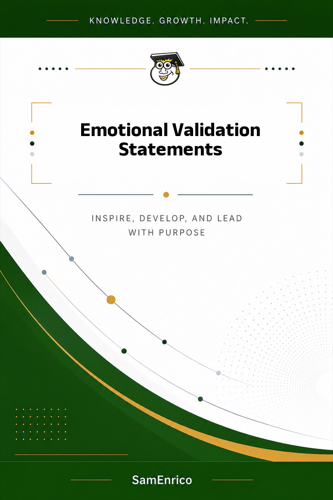
Non-FictionSelf-HelpEmotional Intelligence
Emotional Validation Statements eBook
Say it makes sense you feel that way to normalize
Say it makes sense you feel that way to normalize emotions.
Formats
Free sample
Chapter 1: The Invisible Wound--–- Every argument you have ever had that spiraled out of control, every child’s tantrum that left you feeling helpless, every silent treatment from a partner that felt like a punch to the gut—they all share a hidden cause. It is not a lack of love. It is not a personality flaw. It is not even the content of the disagreement. The real culprit is something so common, so woven into the fabric of everyday conversation, that most people never see it coming.
That culprit is invalidation.Invalidation is the act of dismissing, rejecting, or minimizing someone else’s emotional experience. It sounds like “Don’t cry,” “You’re overreacting,” “It’s not that bad,” “Calm down,” or the ever-popular “At least…” These phrases are so automatic that most people utter them multiple times a day without a second thought. And yet, research in interpersonal neurobiology reveals that each instance of invalidation registers in the brain much like physical pain. The same neural regions that activate when you stub your toe or burn your hand also light up when someone rolls their eyes at your tears or tells you that you shouldn’t feel the way you feel.This chapter is about naming that wound. Because you cannot heal what you cannot see.The Crisis Hidden in Plain Sight Consider a typical evening in millions of households.
A partner comes home from work, exhausted and frustrated. Their boss publicly criticized them in a meeting. They share this with their spouse, hoping for comfort. The spouse, well-intentioned, immediately offers solutions: “You should talk to HR,” or “Maybe you should start looking for another job,” or “Why didn’t you defend yourself?” The frustrated partner feels unheard. They try again: “I just need to vent.” The spouse, now feeling criticized for trying to help, replies, “Fine, I’ll just listen.” But the damage is done.
The frustrated partner shuts down. The spouse feels rejected. Both go to bed feeling slightly more distant than when they woke up.This scene plays out thousands of times every day, not because anyone is malicious, but because most people have never been taught the difference between validation and problem-solving. They have never learned that before a person can hear a solution, they first need to feel seen.The crisis of invalidation is not a crisis of bad intentions. It is a crisis of skill.
And like any skill, validation can be learned, practiced, and mastered.Why Your First Instinct Is to Fix, Not Feel If invalidation is so harmful, why do humans default to it so naturally? The answer lies in evolution and early conditioning.Evolutionarily, humans are problem-solving creatures. Your ancestors who stood around processing feelings while a predator approached did not survive long. The brain is wired to identify threats and neutralize them. When someone you care about expresses distress, your brain registers that distress as a problem to be solved.
Your heart rate increases. Your body tenses. You feel an urgent need to do something. That urgency, however well-intentioned, often manifests as unsolicited advice, premature solutions, or dismissive reassurance like “It will be fine.”The second driver is conditioning. Most people were raised by parents who themselves did not know how to validate.
When you cried as a child, you likely heard some version of “Stop crying,” “You’re okay,” or “It’s not a big deal.” These responses taught you that emotions are problems to be eliminated, not signals to be understood. You learned to suppress your own feelings and to suppress others’ feelings as well. Invalidation became a family heirloom, passed down without anyone realizing its weight.The third driver is personal discomfort. Watching someone else suffer triggers your own anxiety. Their pain reminds you of your own vulnerability.
Offering a fix or a platitude is often less about helping them and more about soothing yourself. When you say “Don’t worry,” you are really saying “I cannot tolerate your worry, so please stop having it.” This is not selfishness; it is self-protection. But it is also ineffective.The Approval Trap: How Praise Became a Drug One of the most insidious forms of invalidation is disguised as its opposite: praise. When you tell a child “Good job feeling sad,” you are not validating them; you are judging them. Praise creates a hierarchy.
It says, “Your feeling is acceptable to me,” which implies that it might not have been. The child learns to perform emotions that earn approval and hide emotions that do not.This dynamic, drawn from the insights of Alfred Adler and popularized in The Courage to Be Disliked, creates what psychologists call the approval trap. People become addicted to external praise. They shape their emotional lives around what others want to see. When praise does not come, they have two options: suppress the feeling (leading to depression, numbness, or anxiety) or amplify the feeling to force a reaction (leading to tantrums, outbursts, or dramatic behavior).Validation breaks the approval trap because it contains no judgment.
When you say “It makes sense you feel sad,” you are not saying the sadness is good or bad. You are saying it is understandable. You are saying the person is not broken for having it. That simple shift from praise to presence is the foundation of emotional freedom.The Cost of Chronic Invalidation The effects of repeated invalidation accumulate like compound interest. A single “Don’t cry” may seem harmless.
A thousand such dismissals, however, rewire the brain.People who grow up in chronically invalidating environments often develop what clinicians call defensive hostility. They learn that expressing vulnerability leads to rejection, so they preemptively attack others to avoid the pain of being dismissed. The spouse who yells “You never listen to me!” is not yelling because they are angry. They are yelling because they have been ignored so many times that they have stopped believing soft words will work. The teenager who slams a door and screams “You don’t understand!” is not being dramatic.
They are trying, desperately, to be seen.Chronic invalidation also corrodes self-trust. When your emotional reality is constantly denied, you begin to doubt your own perceptions. You ask yourself, “Maybe I am overreacting. Maybe it really isn’t a big deal.” This self-doubt is the breeding ground for anxiety, depression, and a host of personality disorders. You learn to gaslight yourself before anyone else gets the chance.In relationships, invalidation is a stronger predictor of divorce than disagreement itself.
Research by John Gottman found that contempt—a form of invalidation that says “You are beneath me”—is the single strongest predictor of marital failure. But even milder forms of invalidation, like stonewalling (refusing to engage) or defensiveness (“That’s not what happened”), steadily erode the bond between partners. Each invalidating comment is a small crack in the foundation. Over time, those cracks become fissures. And fissures, left unaddressed, become collapse.The Difference Between Validation and Agreement One of the greatest fears people have about validation is that it requires agreement.
If you validate someone’s anger at you, does that mean you are admitting fault? If you validate a child’s tantrum over not…
This is the end of the free sample. Get the eBook to keep going. Buy now
About this book
Details
- Author
- Wilburn Anthony
- Publisher
- SamEnrico
- Language
- English
- Genre
- Non-Fiction, Self-Help, Emotional Intelligence
- Released
- 2026-06-08
- Pages (approx.)
- 130
- Available as
- eBook, Audiobook

Read better in the ZLOADR app
Your eBooks on your phone or tablet. Sign in with your SamEnrico account and start reading.
More by Wilburn Anthony
 Corporate Restructuring Stress GuideWilburn Anthony$11.99
 NYC Pop Up Partnership ModelWilburn Anthony$12.99
 Stress and Weight Gain ConnectionWilburn Anthony$11.99
 Louis XVI Execution GuideWilburn Anthony$11.99
 The Purple Robe Heist: Justinian’s Golden GambitWilburn Anthony$11.99
 How to Produce Baking ChipsWilburn Anthony$11.99NYC Pop Up Partnership ModelWilburn Anthony$12.99
 How to Start a Bellows Made of Rubber Business (Beginners Guide)Wilburn Anthony$11.99
 Account Development ExecutiveWilburn Anthony$11.99
You may also like
 Hong Kong Handover 1997Dunn Johnnie$11.99
 Zumba For Postnatal Recovery CourseNeal Christian$11.99
 Zumba for BeginnersLadner Nikia$11.99
 YouTube Comment Mining GuideHumes Pandora$12.99
 Worry Box MeditationCarlin Rudy$11.99
 Workplace Stress MeditationNguyen Lynn$11.99
 Workplace Stress and Sleep RepairHawley Ivory$11.99
 Workplace Perfectionism CureDelaney Jeffry$11.99
 Workplace Injustice Anger GuideWallen Isabelle$11.99
 Work Addiction and Burnout LinkGreenwood Ester$11.99
 Women in Yoga and WellnessBeattie Galina$11.99
 Women in Stand Up ComedyChun Evangeline$11.99