
Non-FictionSelf-HelpEmotional Intelligence
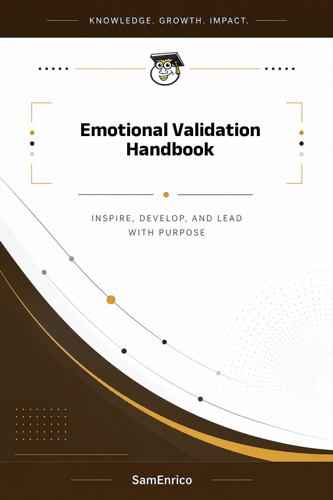
Emotional Validation Handbook
Learn to acknowledge feelings without fixing them
Learn to acknowledge feelings without fixing them using this practical empathy guide for better relationships.
Formats
About this book
Free sample
Chapter 1: The Fixer’s Dopamine Hit--–- You are about to do something kind. You are about to make it worse.Let me tell you about the last time I truly failed at this. A friend was sobbing on my couch. Her mother had just received a devastating diagnosis. The prognosis was unclear, the waiting was unbearable, and my friend’s face was swollen from crying.
I sat beside her for perhaps ninety seconds—long enough to feel deeply uncomfortable—and then I stood up. I walked to the kitchen. I opened the refrigerator. I pulled out a container of leftover pasta, a block of cheese, and a bag of grapes. I arranged them on a plate with the careful attention of a flight attendant serving first class.
I brought the plate back to the couch and held it out like a ceremonial offering.She looked at the plate. She looked at me. She said, “I don’t want a snack.”I said, “You haven’t eaten all day.”She said, “My mother might be dying.”I said, “That’s why you need energy.”She stopped crying. She stopped talking. She just stared at the grapes with an expression I now recognize as exhausted betrayal.
I had not helped her. I had not comforted her. I had, with the best intentions in the world, told her that her grief was a problem to be solved and that the solution was carbohydrates.This is the fixer’s trap. And you have walked into it hundreds of times.The Neuroscience of Unhelpful Help You are not a bad person for wanting to fix things. You are a human person with a brain that was shaped by millions of years of evolution in environments where problems required immediate action.
A rustle in the grass meant a predator. A drop in temperature meant find shelter. A crying baby meant feed it or it dies. Your brain is wired to treat distress as a call to action because, for most of human history, inaction was lethal.Here is what happens neurochemically when someone shares a problem…
This is the end of the free sample. Get the eBook to keep going. Buy now
Contents
- Chapter 1
- Chapter 2
- Chapter 3
- Chapter 4
- Chapter 5
- Chapter 6
- Chapter 7
- Chapter 8
- Chapter 9
- Chapter 10
- Chapter 11
- Chapter 12
Details
- Author
- Bayne Carmela
- Publisher
- SamEnrico
- Language
- English
- Genre
- Non-Fiction, Self-Help, Emotional Intelligence
- Released
- 2026-06-07
- Pages (approx.)
- 139
- Available as
- eBook, Audiobook

Read better in the ZLOADR app
Your eBooks on your phone or tablet. Sign in with your SamEnrico account and start reading.
More by Bayne Carmela
 Insomnia Relief Meditation WorkbookBayne Carmela$11.99
 The Late Shift MemoirBayne Carmela$11.99
 Macro Counting for Fat LossBayne Carmela$11.99
 The Tupac Shakur Hip Hop LegacyBayne Carmela$11.99
 The Battle of Thermopylae: Persia's Vengeance at the Hot GatesBayne Carmela$11.99
 Learn to Play the ApintiBayne Carmela$11.99
 Startup Online Banking GuideBayne Carmela$12.99
 Minority Firm Contract NegotiationBayne Carmela$12.99
 Sales AdministratorBayne Carmela$11.99
 How to Become a Steel-die PrinterBayne Carmela$11.99
You may also like
 Hong Kong Handover 1997Dunn Johnnie$11.99
 Zumba For Postnatal Recovery CourseNeal Christian$11.99
 Zumba for BeginnersLadner Nikia$11.99
 YouTube Comment Mining GuideHumes Pandora$12.99
 Worry Box MeditationCarlin Rudy$11.99
 Workplace Stress MeditationNguyen Lynn$11.99
 Workplace Stress and Sleep RepairHawley Ivory$11.99
 Workplace Perfectionism CureDelaney Jeffry$11.99
 Workplace Injustice Anger GuideWallen Isabelle$11.99
 Work Addiction and Burnout LinkGreenwood Ester$11.99
 Women in Yoga and WellnessBeattie Galina$11.99
 Women in Stand Up ComedyChun Evangeline$11.99