
Non-FictionSelf-HelpEmotional Regulation
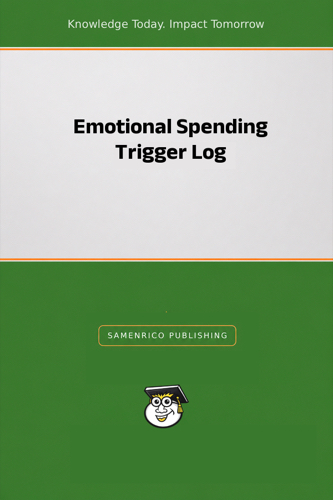
Emotional Spending Trigger Log eBook
Tracks moods before purchases to identify emotiona
Tracks moods before purchases to identify emotional drivers.
Formats
Free sample
Chapter 1: The Five-Second Cage Match--You have exactly five seconds.That is the window between the moment your brain decides to buy something and the moment your thumb clicks “purchase.” Five seconds is the time it takes to sneeze, to blink twice, to register that a traffic light has turned yellow. It is also the amount of time that separates financial freedom from another month of credit card interest.Here is what most people get wrong about emotional spending. They think the problem is the thing they bought. The shoes. The takeout.
The late-night Amazon order that arrives three days later and sits in the box for two weeks. They think if they could just have more willpower, or a better budget, or a stricter app, they would finally stop. But the purchase is not the problem. The purchase is the smoke. The emotion is the fire.
And by the time you see the smoke, by the time you are holding the receipt or staring at the confirmation email, the fire has already burned through whatever decision-making capacity you had left.This book is not about budgets. It is not about spreadsheets, or debt snowballs, or the fifty-thirty-twenty rule. Those tools are useful, but they are retrospective. They tell you what you did wrong after you have already done it. Looking at a budget app after a spending binge is like looking at a map after you have already driven off a cliff.
The information is accurate, but it arrives too late to help.This book is about the five seconds before the cliff. It is about the neurological gap between impulse and action, the tiny sliver of time where a choice actually exists. Most people do not even know that gap is there. They experience an urge, and then they experience a purchase, and they assume those two things are the same event. They are not.
Between the urge and the action, there is a pause. It is microscopic. It is barely perceptible. But it is the only place where freedom lives.The Emotional Spending Trigger Log is not a journal. It is not a diary where you confess your financial sins and hope for absolution.
It is a behavioral intervention tool disguised as a notebook. It is a mirror held up to the five seconds between wanting and having. And what you will see in that mirror is not a person who is “bad with money.” You will see a person who is using spending to solve a problem that spending cannot solve.This chapter will teach you the core mechanism of the entire book: the pause. You will learn the neurochemistry of the urge, the difference between autopilot and pilot mode, and the two waiting periods that will become your primary weapons against impulse spending. By the end of this chapter, you will have completed your first log entry, and you will understand why five seconds can change everything.The Dopamine-Cortisol See-Saw To understand why you spend money you do not have on things you do not need, you must first understand a chemical process that takes place in your brain in less time than it takes to read this sentence.Dopamine is the anticipation chemical.
It is not, contrary to popular belief, the pleasure chemical. Dopamine is released when you want something, when you chase something, when you imagine yourself having something. It is the molecule of longing. And it is incredibly powerful.When you see a pair of shoes online, when you add them to your cart, when you imagine wearing them and receiving compliments, your brain releases dopamine. You feel a high.
You feel excitement. You feel, for a few moments, as though purchasing those shoes will solve something. Maybe it will solve your boredom. Maybe it will solve your insecurity. Maybe it will solve the vague sense that your life is not quite what you wanted it to be.The shoes will not solve any of those things.
But the dopamine does not know that. The dopamine only knows that you are chasing something, and chasing feels good.Now here is the part that most people do not know. After the purchase, after the dopamine spike has faded, the brain releases cortisol. Cortisol is the stress hormone. It is the chemical that makes you feel regret, anxiety, and shame.
The more unnecessary the purchase, the more cortisol your brain releases. This is why you feel great when you click “buy” and terrible when you look at your bank statement. The dopamine-cortisol seesaw has tipped.The entire mechanism of emotional spending is a chemical loop. Trigger, urge, dopamine, purchase, cortisol, regret, repeat. The loop takes anywhere from thirty seconds to three minutes.
And most people run through it dozens of times per month without ever noticing what is happening inside their own skulls.The Emotional Spending Trigger Log interrupts this loop at the only point where interruption is possible: the moment between the urge and the purchase. When you write down what you are feeling, when you name the emotion, when you record the price and the item and the context, you force your brain to switch from fast, automatic processing to slow, deliberate processing. You step off the seesaw.This is not philosophy. This is neurology. Studies in impulse control have shown that the simple act of naming an emotion reduces its intensity by up to fifty percent.
The amygdala, which is the brain’s alarm system, calms down when the prefrontal cortex—the brain’s executive center—starts talking. Writing something down is a form of talking. You are telling your brain: “I see you. I see the urge. I am not going to obey it yet.”Autopilot Versus Pilot Mode Imagine you are driving a car on a straight, empty highway at midnight.
You have been driving for three hours. You are tired. You are not really paying attention. The car stays in its lane, the speed stays constant, and you arrive at your exit without remembering the last fifty miles. That is autopilot.Your brain runs on autopilot for most of the day.
Brushing your teeth, walking to the kitchen, checking your phone, scrolling social media—these actions happen without conscious thought. They are habits. They are loops. And for many people, spending money is also on autopilot.The autopilot spending loop looks like this. Trigger.
You see an ad, or you feel a pang of boredom, or you receive a notification that a sale is ending. Urge. Your brain releases dopamine. You feel a compulsion to buy. Action.
Your thumb clicks “buy now.” Reward. You feel a brief high, followed eventually by cortisol and regret.The entire loop takes less than ten seconds. From trigger to action, you are unconscious. You are not choosing. You are reacting.Pilot mode is different.
In pilot mode, you are aware. You are present. You are making decisions based on your long-term goals, not your short-term impulses. The pilot mode loop looks like this. Trigger.
You see the ad, feel the boredom, receive the notification. Pause. You stop. You breathe. You notice the urge without obeying it.
Observe. You ask yourself: What am I feeling right now? What do I actually need? Choose. You decide, consciously and…
This is the end of the free sample. Get the eBook to keep going. Buy now
About this book
Details
- Author
- Rauch Mallory
- Publisher
- SamEnrico
- Language
- English
- Genre
- Non-Fiction, Self-Help, Emotional Regulation
- Released
- 2026-06-06
- Pages (approx.)
- 140
- Available as
- eBook, Audiobook

Read better in the ZLOADR app
Your eBooks on your phone or tablet. Sign in with your SamEnrico account and start reading.
More by Rauch Mallory
 The TM Nonreligious ApproachRauch Mallory$11.99
 Husband Low Self Esteem GuideRauch Mallory$11.99
 Asthma and Gut LinkRauch Mallory$11.99
 Photo Data Breach ScriptsRauch Mallory$11.99
 Lucid Dreaming NightmaresRauch Mallory$11.99
 Dumpster Diving for DinnerRauch Mallory$11.99
 Counter Reformation Mystics Renewal CourseRauch Mallory$11.99
 High Performer BurnoutRauch Mallory$11.99
 Silent Coup: The Poisoned Chalice of Cleopatra SeleneRauch Mallory$11.99
 The Last Waltz: How a Ballerina Defied the Iron CurtainRauch Mallory$11.99
 Frozen Rivers: The Arctic Expedition That Redefined the CongoRauch Mallory$11.99
 How to Start a Crude Oil Extraction Business (Beginners Guide)Rauch Mallory$11.99
You may also like
 Hong Kong Handover 1997Dunn Johnnie$11.99
 Zumba For Postnatal Recovery CourseNeal Christian$11.99
 Zumba for BeginnersLadner Nikia$11.99
 YouTube Comment Mining GuideHumes Pandora$12.99
 Worry Box MeditationCarlin Rudy$11.99
 Workplace Stress MeditationNguyen Lynn$11.99
 Workplace Stress and Sleep RepairHawley Ivory$11.99
 Workplace Perfectionism CureDelaney Jeffry$11.99
 Workplace Injustice Anger GuideWallen Isabelle$11.99
 Work Addiction and Burnout LinkGreenwood Ester$11.99
 Women in Yoga and WellnessBeattie Galina$11.99
 Women in Stand Up ComedyChun Evangeline$11.99