
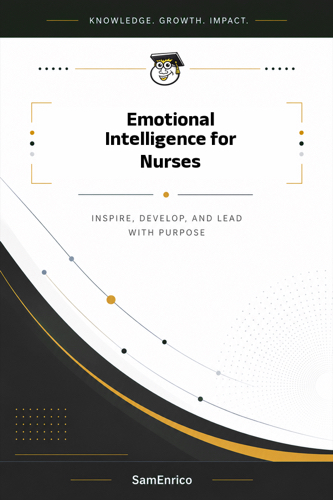
Emotional Intelligence for Nurses eBook
Prevents burnout and improves patient care with EQ
Prevents burnout and improves patient care with EQ skills.
Formats
Free sample
Chapter 1: The Amygdala Trap--The first time you felt it, you probably didn't even notice. It was just a flicker—a slight tightening in your chest, a flash of heat behind your sternum, the sudden realization that your jaw was clenched and you hadn't meant to clench it. Maybe it happened during a code when the attending raised his voice at you for no reason. Maybe it happened when the family member of a crashing patient grabbed your arm and screamed, "Do something!" Maybe it happened in the med room at 3 AM, when you realized you hadn't peed in eight hours and your third patient of the night had just been upgraded to ICU.You didn't name it at the time. You didn't have words for it.
You just pushed through, because that's what nurses do. You finished the task, completed the charting, answered the call light, and moved to the next room. The feeling faded—or so you told yourself. But it didn't really fade. It accumulated.
Like sediment at the bottom of a river, it built up, layer by layer, shift by shift, until one day something small triggered an explosion that felt entirely out of proportion to the trigger.You cried in the supply closet. Or you snapped at a new grad who didn't deserve it. Or you went home and screamed at your partner over a dish left in the sink. And then you asked yourself: What is wrong with me?The answer, it turns out, is nothing. Nothing is wrong with you.
You are not weak, not broken, not unsuited for this profession. You are, in fact, exactly as designed—which is to say, you have a brain that evolved to keep you alive in a world of predators and physical threats, not a world of crashing patients, moral compromises, and sleep deprivation. Your brain is doing its job. The problem is that its job description hasn't been updated in about 200,000 years.The Smoke Detector in Your Skull Deep inside your brain, tucked behind your ears and roughly the size and shape of an almond, sits a structure called the amygdala. Neuroscientists sometimes call it the brain's "smoke detector," but that understates its power.
A smoke detector simply beeps. Your amygdala can shut down your entire executive function in less than a second.Here's what the amygdala does: it scans your environment constantly, unconsciously, for threats. It does not think. It does not reason. It does not ask questions like "Is this threat real or imagined?" or "Is this threat happening now or might it happen later?" or "Is this person yelling at me actually dangerous or just scared?" The amygdala has one job and one job only: detect a potential threat and activate the body's stress response before your conscious brain even knows what's happening.In the environment where your amygdala evolved—the African savanna, roughly 200,000 years ago—this was an excellent system.
A rustle in the grass might be a lion. The amygdala fires, your body floods with cortisol and adrenaline, your heart rate spikes, blood rushes to your large muscle groups, and you either fight, flee, or freeze before your conscious brain has finished asking "What was that noise?" The ones who stopped to think got eaten. The ones who reacted survived. You are descended from the reactors.Now consider where you spend your days. A hospital is not a savanna.
The threats you face are rarely physical predators. They are, instead, a list that every nurse knows by heart: a crashing patient whose vitals are spiraling despite your best efforts. A family member screaming in the hallway because they are terrified their loved one is dying. A physician who speaks to you with contempt because he is exhausted, overworked, and displacing his own anxiety onto you. A staffing ratio that leaves you responsible for eight patients when the evidence says safe nursing is four.
A computer system that crashes while you're trying to pull medications for a septic patient. A new admit arriving just as you were about to sit down for the first time in six hours.Your amygdala does not know the difference between a lion and a screaming family member. It does not know the difference between a physical attack and a verbal one. It does not know that being short-staffed is not going to kill you in the next thirty seconds. All it knows is: Threat detected.
Activate stress response. Shut down everything non-essential.And what does your brain consider "non-essential" during a threat response? Almost everything you need to do your job.The Upstairs Brain Goes Offline Your prefrontal cortex—the part of your brain just behind your forehead—is sometimes called the "executive brain" or the "upstairs brain." This is where rational thought lives. This is where you plan, prioritize, problem-solve, regulate your emotions, feel empathy, and make complex decisions. This is the part of your brain that allows you to look at a crashing patient with a half-dozen competing priorities and decide, in order, what to do first, second, and third.When your amygdala fires, it sends a direct signal to your prefrontal cortex that says, essentially: Stand down.
We don't have time for thinking. I'm in charge now. Blood flow to the prefrontal cortex decreases dramatically. Neural activity in that region slows. Your ability to think clearly, to solve problems, to regulate your emotional responses—all of it degrades in real time.This is why nurses freeze during codes.
This is why you have said things you regretted the moment they left your mouth. This is why you have stood at a medication cart, staring at a patient's name, completely unable to remember if you already gave that antibiotic. This is not incompetence. This is neurobiology.The psychologist Daniel Goleman, who popularized the concept of emotional intelligence, famously described this as "amygdala hijack." The amygdala seizes control of your brain's response systems, and your prefrontal cortex—your thinking brain—is locked out of the control room until the threat passes. The hijack typically lasts anywhere from a few seconds to several minutes, depending on the intensity of the threat and your physiological state at the time it hits.
But here's the cruel irony: in a hospital setting, the threat rarely passes. It is followed by another threat, and another, and another. A code ends, but the patient still needs post-resuscitation care. A family member stops screaming, but now they are sobbing and need support. A physician leaves, but the next one arrives with a new set of demands.
Your amygdala never gets the all-clear signal. It stays in a state of chronic, low-grade activation, which means your prefrontal cortex never fully comes back online. You are working, day after day, with a partial brain. And no one ever taught you that this was happening.Your Emotional Signature: The Body Knows First Here is something your nursing education almost certainly did not teach you: before you feel an emotion consciously, your body already knows. The physiological changes that accompany an emotional response begin before your conscious brain has labeled the feeling.
This is not speculation. This is measurable, replicable, and has been known in psychophysiology for decades.Your "emotional signature" is the…
This is the end of the free sample. Get the eBook to keep going. Buy now
About this book
Details
- Author
- Reese Tiffany
- Publisher
- SamEnrico
- Language
- English
- Genre
- Non-Fiction, Self-Help, Nursing
- Released
- 2026-06-06
- Pages (approx.)
- 142
- Available as
- eBook, Audiobook

Read better in the ZLOADR app
Your eBooks on your phone or tablet. Sign in with your SamEnrico account and start reading.
More by Reese Tiffany
 Gratitude Walk PracticeReese Tiffany$11.99
 TM For Public Speaking Anxiety WorkbookReese Tiffany$11.99
 Eviction Notice DiaryReese Tiffany$11.99
 Self Esteem for Asexual PartnersReese Tiffany$11.99
 The Great Montreal Bank Heist: The First Fingerprint Case in CanadaReese Tiffany$11.99
 Understanding Mycositis FungoidesReese Tiffany$17.99
 How to Start a Music Publishing BusinessReese Tiffany$11.99
 The History and Future of ComputingReese Tiffany$11.99
 Honda SWOT Analysis GuideReese Tiffany$12.99
 Student's Accounting Shortcut GuideReese Tiffany$12.99
You may also like
 Hong Kong Handover 1997Dunn Johnnie$11.99
 Zumba For Postnatal Recovery CourseNeal Christian$11.99
 Zumba for BeginnersLadner Nikia$11.99
 YouTube Comment Mining GuideHumes Pandora$12.99
 Worry Box MeditationCarlin Rudy$11.99
 Workplace Stress MeditationNguyen Lynn$11.99
 Workplace Stress and Sleep RepairHawley Ivory$11.99
 Workplace Perfectionism CureDelaney Jeffry$11.99
 Workplace Injustice Anger GuideWallen Isabelle$11.99
 Work Addiction and Burnout LinkGreenwood Ester$11.99
 Women in Yoga and WellnessBeattie Galina$11.99
 Women in Stand Up ComedyChun Evangeline$11.99