
Non-FictionSelf-HelpManagement
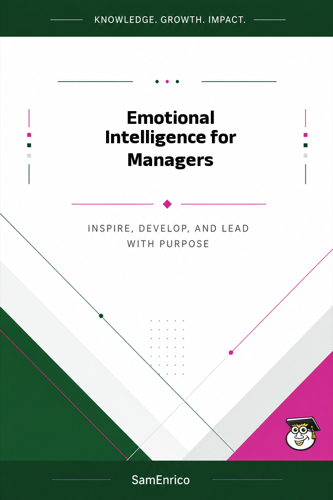
Emotional Intelligence for Managers eBook
Supervises teams with feedback, recognition, and c
by Payne Marcos
Supervises teams with feedback, recognition, and conflict resolution.
Formats
Free sample
Chapter 1: The Blind Spot--–- You have a blind spot the size of a conference table, and your team is probably afraid to tell you about it. This is not a metaphor. Research conducted by organizational psychologist Tasha Eurich found that 95 percent of managers believe they are self-aware, but only 10 to 15 percent actually meet the criteria. That gap—eighty percentage points of delusion—is not merely uncomfortable. It is expensive.
It is the reason good people quit, great ideas die, and teams that should be thriving settle for surviving.This chapter is not an introduction. It is an intervention.Before we talk about feedback, recognition, conflict resolution, or any of the other skills that make managers effective, we have to talk about you. Specifically, we have to talk about the instrument through which all management happens: your own mind. If you are a musician, the quality of your music depends on the quality of your instrument. If you are a surgeon, the outcome of your surgery depends on the sharpness of your tools.
You are a manager. The instrument of your work is your emotional awareness. And by the evidence, yours is probably out of tune.The argument of this book—and the argument of this chapter—is simple and, frankly, unforgiving: self-awareness is not a nice-to-have leadership trait. It is the foundational meta-skill from which all other emotional intelligence competencies grow. Without it, empathy becomes projection (you assume others feel what you feel).
Without it, feedback becomes blame (you criticize without understanding your own contribution to the problem). Without it, recognition becomes manipulation (you praise people for serving your needs, not for their own growth). Self-awareness is not the destination. It is the starting line. And most managers have not even found the starting line.The Three-Letter Trap Let us clear something up immediately.
There is a widespread misunderstanding about emotional intelligence, and it usually starts with the phrase "I'm just not a people person." Managers use this phrase as if it were a permanent diagnosis, like a blood type or a shoe size. "I'm just not a people person" is not a fact. It is an excuse. And it confuses personality with emotional intelligence.Here is the distinction that matters. IQ is your cognitive ability—your capacity for logic, abstract reasoning, problem-solving, and learning.
It is largely stable after adolescence, and while it predicts academic success reasonably well, it predicts leadership success only modestly. Personality is your stable set of traits—whether you are extroverted or introverted, conscientious or spontaneous, agreeable or competitive. Personality is the lens through which you see the world, but it is not destiny. You can be an introvert and still lead with charisma. You can be disagreeable and still build trust.EQ, emotional intelligence, is neither IQ nor personality.
It is a set of teachable, learnable skills that predict leadership success twice as reliably as IQ. Let me say that again because most managers skip right over it: twice as reliably. In a study of over 200 large, global organizations, researchers found that while cognitive ability mattered for entry-level technical roles, emotional intelligence was the strongest predictor of high performance in leadership positions. The higher you rise, the more EQ matters. Technical skills get you promoted.
Emotional intelligence keeps you there.But here is the catch. You cannot develop EQ without first knowing where you stand. And knowing where you stand requires self-awareness. This is why self-awareness is the meta-skill: it is the skill that enables all other skill development. If you do not know that you interrupt people, you will never learn to stop interrupting.
If you do not notice that you shut down when criticized, you will never learn to receive feedback gracefully. If you are unaware that your default stress response is to blame others, you will never learn to take accountability.The three-letter trap is the belief that emotional intelligence is something you either have or you don't. That is false. EQ is a skill. Skills can be learned.
But learning requires a mirror. This chapter is that mirror.The Emotional Blueprint Before we go any further, I want you to imagine something. Imagine that your emotional reactions follow a pattern as specific as your fingerprint. Under certain conditions, you reliably react in a certain way. Under other conditions, you react differently.
But the pattern is not random. It is your Emotional Blueprint, and once you learn to read it, you gain something invaluable: predictability. You can stop being surprised by your own reactions. You can start managing them.Your Emotional Blueprint has three components. Let us examine each.Component One: Triggers A trigger is a specific situation or stimulus that reliably provokes an emotional reaction in you.
Triggers are not universal. What sends one manager into a spiral—say, being questioned in front of peers—might barely register with another. The key is to identify your personal triggers with surgical precision. Not "stressful situations" (too vague). Not "difficult employees" (too broad).
Specific, observable, repeatable triggers.For example:"When someone interrupts me in a meeting, I feel my jaw clench and my voice rise.""When a deadline is moved up without warning, I experience a wave of resentment that lasts for hours.""When I receive criticism that feels unfair, my first instinct is to defend myself with evidence rather than listen."Notice the specificity. Notice the behavior tied to the trigger. This is not self-help vagueness. This is data collection.Component Two: Default Stress Responses When triggered, your brain does not pause to consider the most effective response. It defaults to one of four ancient survival patterns, drawn from the neuroscience of threat response.
These are often called "fight, flight, freeze, or appease," but in a managerial context, they look different.Fight looks like: arguing, blaming, raising your voice, sending a sharp email, interrupting, defending, or attacking. The fight response says: "I will overwhelm the threat."Flight looks like: avoiding the conversation, delegating upward, changing the subject, leaving the room, or suddenly becoming "too busy." The flight response says: "I will escape the threat."Freeze looks like: going silent, feeling paralyzed, saying nothing when you should speak, or nodding along while internally shut down. The freeze response says: "If I do not move, the threat will not see me."Appease looks like: agreeing when you disagree, apologizing excessively, over-explaining, people-pleasing, or sacrificing your own needs to keep the peace. The appease response says: "If I make the threat like me, it will not hurt me."Every manager has a dominant default response. Most have a secondary pattern that emerges when the first fails.
Your job is not to eliminate these responses—they are hardwired for survival. Your job is to recognize them as they are happening, so you can choose a response instead of being hijacked by one.Component Three: Recovery Patterns The third component of your Emotional Blueprint is recovery time. After an emotional event—a difficult conversation, a public failure, a conflict with a peer—how long does it take you to return to baseline? For some managers, recovery happens in minutes. For others, a single conflict can ruin an entire day, sometimes two.
And critically, your team feels your recovery time. They know when you are still carrying residue from a morning argument.…
This is the end of the free sample. Get the eBook to keep going. Buy now
About this book
Details
- Author
- Payne Marcos
- Publisher
- SamEnrico
- Language
- English
- Genre
- Non-Fiction, Self-Help, Management
- Released
- 2026-06-07
- Pages (approx.)
- 136
- Available as
- eBook, Audiobook

Read better in the ZLOADR app
Your eBooks on your phone or tablet. Sign in with your SamEnrico account and start reading.
More by Payne Marcos
 Secondhand Family LifePayne Marcos$11.99
 Gratitude for FamiliesPayne Marcos$11.99
 Senior Opinion Esteem GuidePayne Marcos$11.99
 The Self Esteem After Partner's BetrayalPayne Marcos$11.99
 Banksy: The Unseen Hand - How a Mysterious Artist Shaped Modern Protest ArtPayne Marcos$11.99
 How to Start a Music Directors - Independent BusinessPayne Marcos$11.99
 Access Control System TechnicianPayne Marcos$11.99
 AMD SWOT Analysis GuidePayne Marcos$12.99
 Accounting Formulas for Exam SuccessPayne Marcos$12.99
 Understanding Myelodysplastic SyndromesPayne Marcos$17.99
You may also like
 Hong Kong Handover 1997Dunn Johnnie$11.99
 Zumba For Postnatal Recovery CourseNeal Christian$11.99
 Zumba for BeginnersLadner Nikia$11.99
 YouTube Comment Mining GuideHumes Pandora$12.99
 Worry Box MeditationCarlin Rudy$11.99
 Workplace Stress MeditationNguyen Lynn$11.99
 Workplace Stress and Sleep RepairHawley Ivory$11.99
 Workplace Perfectionism CureDelaney Jeffry$11.99
 Workplace Injustice Anger GuideWallen Isabelle$11.99
 Work Addiction and Burnout LinkGreenwood Ester$11.99
 Women in Yoga and WellnessBeattie Galina$11.99
 Women in Stand Up ComedyChun Evangeline$11.99