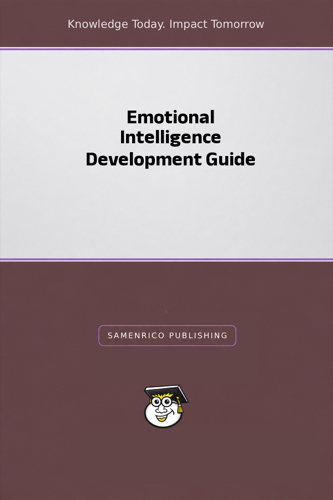
Emotional Intelligence Development Guide eBook
Builds self-awareness, empathy, and relationship s
Builds self-awareness, empathy, and relationship skills for personal and professional success.
Formats
Free sample
Chapter 1: The Meta-Skill--–- I was twenty-seven years old, standing in a hospital hallway, when I realized that my education had failed me entirely. I had graduated with honors. I had a job title that impressed strangers at dinner parties. I could parse a balance sheet, write a strategic memo, and cite Maslow’s hierarchy of needs from memory. But standing outside my mother’s hospital room after a frightening diagnosis, I had no idea what to do with my own fear.
My hands were shaking. My throat felt glued shut. And when a nurse asked me, gently, “Are you okay?” I said, “I’m fine,” in a voice that was clearly, embarrassingly, not fine.That moment was not a failure of intelligence. It was a failure of emotional intelligence. And it is the reason I am writing this book.For most of my life, I believed that being smart meant being rational.
I believed that emotions were noise—interruptions to clear thinking, obstacles to be suppressed or ignored. I was wrong. So was almost every educational and professional system I had grown up in. Schools taught me calculus but not how to recover from rejection. Workplaces rewarded technical skill but rarely taught conflict resolution.
Society celebrated the stoic genius—the lone figure who coolly calculates his way to success—while quietly ignoring the mountains of evidence that the most effective, happiest, and most successful people are not the ones who suppress emotions. They are the ones who know how to work with them.This book is about that knowledge. It is about emotional intelligence: the ability to recognize, understand, and manage your own emotions and the emotions of others. It is not about being “nice.” It is not about smiling through frustration or pretending to feel what you do not feel. It is about skill.
And like any skill, it can be learned, practiced, and mastered.The Myth We Have Believed For Too Long Let us begin by naming the enemy. The enemy is not emotion. The enemy is a century-old assumption that cognitive intelligence—IQ—is the primary driver of success. This assumption is so deeply embedded in our culture that we rarely question it. We sort children by test scores.
We hire based on credentials. We promote the person who speaks the most confidently in meetings, regardless of whether that person can manage a team through crisis.The assumption feels logical. Intelligence predicts academic performance. Academic performance predicts access to elite institutions. Elite institutions predict high-paying jobs.
Therefore, intelligence predicts success. This chain of reasoning is tidy, intuitive, and largely false.Consider the research. A longitudinal study of eighty Ph.D. candidates in science and engineering found that their GRE scores—a proxy for IQ—had almost no correlation with their later career success, as measured by publications, citations, or peer recognition. What predicted success instead?
Persistence. Optimism. The ability to collaborate. The capacity to recover from a failed experiment without spiraling into self-doubt. In other words, emotional intelligence.Consider the workplace.
A study of over 500 executives found that those with high emotional intelligence outperformed their peers by nearly 90 percent in leadership effectiveness, while those with high IQ but low EQ were rated as average or below average by their direct reports. Consider the data from Emotional Intelligence 2.0, which shows that EQ accounts for nearly 58 percent of performance in leadership roles. Not IQ. Not technical expertise. Not years of experience.
Emotional intelligence.And yet, most of us have never received a single hour of formal training in it.The Anatomy of an Emotional Hijack To understand why emotional intelligence matters, we must first understand what happens inside your brain when emotions run high. The story begins in a small, almond-shaped structure called the amygdala.The amygdala is your brain’s alarm system. It evolved to detect threats—not just physical threats like a predator in the bushes, but social threats like criticism, rejection, or exclusion. The amygdala works incredibly fast. In fact, it works faster than your conscious mind.
When the amygdala detects a threat, it sends an immediate signal to your body: prepare to fight, flee, or freeze. Your heart rate spikes. Your breathing quickens. Your muscles tense. Blood flows away from your prefrontal cortex—the rational, planning part of your brain—and toward your limbs, because your body is getting ready to run or fight.This is the emotional hijack.
The amygdala has taken over. And until your prefrontal cortex catches up—which takes about six seconds, on average—you are not thinking clearly. You are reacting.Here is what an emotional hijack looks like in real life. A colleague sends an email that you interpret as dismissive. Your amygdala reads “social threat.” Within milliseconds, your body is primed for battle.
You fire off a sharp reply. You regret it ten minutes later. Or a partner makes a joke that lands badly. Before you can think, you snap back with a cutting comment. The room goes silent.
You spend the rest of the evening pretending you are fine while replaying the moment in your head.These moments are not character flaws. They are neurological events. And they are preventable.Neuroplasticity: The Science of Change Here is the most important sentence in this chapter: emotional intelligence is not fixed.For decades, it was assumed that our emotional patterns were largely determined by genetics and early childhood experiences. If you were born with a reactive temperament, the thinking went, you would probably always be reactive. If you struggled to read social cues as a child, you would struggle as an adult.This assumption has been overturned by the science of neuroplasticity.
Neuroplasticity is the brain’s ability to reorganize itself by forming new neural connections throughout life. Every time you practice a skill—from playing the piano to regulating your anger—you strengthen the neural pathways that support that skill. And every time you let a reactive pattern run on autopilot, you strengthen that pathway instead.Think of your brain as a forest. Frequently traveled paths become wide, clear trails. Seldom traveled paths become overgrown.
Your emotional habits are those paths. If you have spent thirty years reacting with defensiveness whenever criticized, that neural pathway is a superhighway. Building a new pathway—curiosity instead of defensiveness—will require deliberate effort at first. You will have to push through the underbrush. But with repeated practice, that new path will widen.
The old path will grow over.The implication is radical: you are not stuck with the emotional patterns you inherited or developed. You can rewire your brain. You can learn to pause instead of snap, to listen instead of defend, to inquire instead of assume. The only requirement is deliberate practice over time.This does not happen overnight. Deep rewiring—changing a lifelong pattern like an anger response or an anxiety spiral—can take six to eighteen months of consistent practice.
That is the honest timeline. But the ninety-day program at the end of this book will give you the awareness and the initial habit structures you need to begin. Every long journey starts with a single step, but that step must be intentional.The Four Pillars of Emotional…
This is the end of the free sample. Get the eBook to keep going. Buy now
About this book
Details
- Author
- Wahl Cleveland
- Publisher
- SamEnrico
- Language
- English
- Genre
- Non-Fiction, Self-Help / Emotional Intelligence
- Released
- 2026-06-10
- Pages (approx.)
- 142
- Available as
- eBook, Audiobook

Read better in the ZLOADR app
Your eBooks on your phone or tablet. Sign in with your SamEnrico account and start reading.
More by Wahl Cleveland
 Bezos Long Term VisionWahl Cleveland$11.99
 Marilyn Sheppard PregnancyWahl Cleveland$11.99
 Meal Prep for TwoWahl Cleveland$11.99
 Apathy in Chronic IllnessWahl Cleveland$11.99
 Philippines Liberation MarineWahl Cleveland$11.99
 Global Cyber LegislationWahl Cleveland$11.99
 Lifestyle ModificationsWahl Cleveland$11.99
 The Bloodstained Letters: France's First Serial Killer and the Wrongfully AccusedWahl Cleveland$11.99
 Neon Requiem: The Last Broadcast of the Titanic’s AIWahl Cleveland$11.99
 How to Produce a FillerWahl Cleveland$11.99
 How to Start a Propane Gas (wholesale) Business (Beginners Guide)Wahl Cleveland$11.99
 How to Produce an Rt-rkWahl Cleveland$11.99