
Non-FictionSelf-HelpComplete EQ
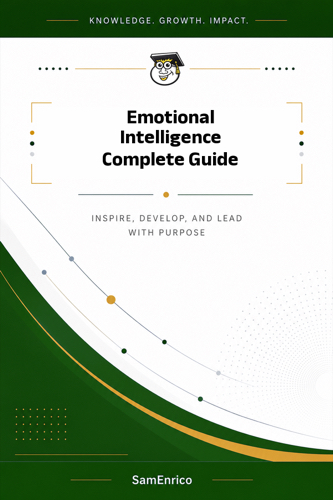
Emotional Intelligence Complete Guide eBook
Comprehensive EQ development covering all competen
by Warren Tracy
Comprehensive EQ development covering all competencies.
Formats
Free sample
Chapter 1: The IQ Trap--–- Sarah had done everything right. Graduated top of her class from a prestigious engineering program. Landed a coveted role at a Fortune 500 tech firm. Scored in the 94th percentile on logical reasoning tests. Her IQ was, by any measure, exceptional.And yet, six years into her career, she was stuck.Her manager called her "brilliant but difficult." Her peers respected her mind but avoided her company.
She had been passed over for promotion three times – each time losing to someone with less technical expertise but better people skills. In her annual review, the feedback was maddeningly vague: "Sarah, you need to work on your interpersonal effectiveness." When she pressed for specifics, her manager sighed and said, "When you're under pressure, people feel dismissed."Sarah didn't feel dismissive. She felt right. And being right, in her mind, should have been enough.Across town, Marcus – a mid-level manager with a solid but unspectacular academic record – had just been promoted to regional director. His IQ scores were average.
He struggled with complex financial modeling. He sometimes forgot technical details that Sarah would have memorized instantly. But Marcus had something Sarah didn't: people trusted him. When crises erupted, his team rallied around him. When he made mistakes, colleagues forgave them.
When he spoke, people listened – not because he was the smartest person in the room, but because he made them feel seen.Sarah and Marcus represent a pattern that organizational psychologists have documented for decades. IQ predicts academic success and the ability to learn complex technical material. But once you're actually in the workplace – navigating politics, managing stress, leading teams, influencing peers – IQ's predictive power collapses. Something else takes over.That something else is emotional intelligence.This book is the complete guide to mastering that something else. Over the next twelve chapters, you will learn not just what emotional intelligence is, but how to develop every one of its 54 competencies systematically.
You will take a diagnostic assessment to establish your baseline. You will build a personalized 90-day development plan. And you will join the millions of professionals who have discovered that EQ – not IQ – is the true differentiator between stagnation and success.But first, we need to understand why IQ has deceived us for so long – and why emotional intelligence is the key you've been missing.The Great Deception: How IQ Sold Us a Limited Story For nearly a century, we have been obsessed with intelligence quotients. The Stanford-Binet test. The Wechsler scales.
The SAT, GRE, LSAT, GMAT – all of them built on the same fundamental assumption: that the ability to reason abstractly, manipulate symbols, and solve logic problems is the primary driver of life outcomes.This assumption was not malicious. It was convenient. IQ is relatively stable across a person's lifetime. It can be measured with reasonable reliability. And early studies did show correlations between IQ and academic performance, job performance in highly technical roles, and even longevity.But convenient is not the same as true.In the 1990s, researchers began noticing something puzzling.
Longitudinal studies that tracked people from childhood into adulthood revealed that IQ explained only about 20-25% of the variance in career success, life satisfaction, and relationship quality. That meant 75-80% of what actually matters in life was left completely unexplained by IQ.Consider what that means: if you lined up a hundred people and ranked them by IQ, that ranking would predict virtually nothing about who would be happiest, who would have the strongest marriages, who would rise to leadership positions, or even who would perform best in most jobs.Something else was doing the heavy lifting.That something else was not a single trait but a constellation of abilities. The ability to recognize your own emotional states. The capacity to manage impulses and delay gratification. The skill of reading other people's feelings and intentions.
The competence to navigate conflict without destroying relationships. The resilience to bounce back from failure.Psychologists gave this constellation many names over the years – "social intelligence," "personal intelligence," "practical intelligence." But it was Daniel Goleman's 1995 book Emotional Intelligence that crystallized the concept for a mass audience. Goleman synthesized decades of research to show that EQ – emotional quotient – often mattered more than IQ in determining who succeeded and who floundered.Since then, over 500 organizations – including Fortune 500 companies, government agencies, and non-profits – have conducted internal studies on the relationship between EQ and job performance. The results are remarkably consistent.The Data That Changed Everything Let me give you the numbers, because they matter.A comprehensive meta-analysis published in the Journal of Organizational Behavior examined 59 independent studies across 20 different industries. The researchers found that emotional intelligence was a significant predictor of job performance across all job types – but the strength of the relationship varied by role.For jobs requiring high levels of collaboration, negotiation, leadership, or customer interaction – which is to say, most jobs above entry level – EQ was 2.3 times more important than IQ.
In leadership roles specifically, EQ accounted for nearly 90% of what distinguished star performers from average ones.Let that sink in. Ninety percent.The same pattern appears in education. A study of medical school applicants found that IQ scores predicted performance on the first-year basic science exams – but not clinical performance with patients. The doctors patients rated as most compassionate, communicative, and effective were not the ones with the highest MCAT scores. They were the ones with the highest EQ.In sales, a multi-year study of insurance agents found that agents with high EQ outsold their low-EQ counterparts by an average of 42% annually – even when the low-EQ agents had significantly higher IQ scores and more years of industry experience.In customer service, a major telecommunications company found that high-EQ representatives resolved customer complaints in half the time, with double the customer satisfaction scores, and were 60% less likely to quit within the first year.In leadership, a study of 286 executives across 15 global companies found that the top-performing executives scored significantly higher on emotional intelligence competencies than their average-performing peers – and the gap widened at higher levels of leadership.
At the C-suite level, EQ differences explained nearly all of the variance between star performers and those who plateaued or failed.This is not a niche finding. It has been replicated across industries, cultures, and job types. The Consortium for Research on Emotional Intelligence in Organizations, based at Rutgers University, has compiled evidence from more than 500 organizations showing that EQ training produces measurable improvements in productivity, retention, customer satisfaction, and profitability.So if EQ is so important, why don't we teach it in schools? Why don't we assess for it in hiring? Why do we still glorify the brilliant jerk who can't manage a team?The answer is simple but uncomfortable: EQ is harder to measure than IQ.
It is also harder to develop. And for decades, many people – including many psychologists – believed EQ was largely innate. You either had it or you didn't.That belief is wrong.Neuroplasticity: Why Your EQ Can Change The most important scientific discovery for anyone reading this book is neuroplasticity: the brain's lifelong ability to reorganize itself by forming new neural connections. For much of the 20th century, scientists believed the adult brain was fixed –…
This is the end of the free sample. Get the eBook to keep going. Buy now
About this book
Details
- Author
- Warren Tracy
- Publisher
- SamEnrico
- Language
- English
- Genre
- Non-Fiction, Self-Help, Complete EQ
- Released
- 2026-06-10
- Pages (approx.)
- 158
- Available as
- eBook, Audiobook

Read better in the ZLOADR app
Your eBooks on your phone or tablet. Sign in with your SamEnrico account and start reading.
More by Warren Tracy
 The Daily Loci Practice PlanWarren Tracy$11.99
 Spain Remote Tax GuideWarren Tracy$11.99
 Seasonal Affective SleepWarren Tracy$11.99
 Mindfulness Meditation for Imposter SyndromeWarren Tracy$11.99
 Bipolar College Student GuideWarren Tracy$11.99
 Unfair Advantage StatementWarren Tracy$12.99
 Gut Microbiome Testing GuideWarren Tracy$11.99
 Public Speaking Loci CourseWarren Tracy$11.99
 Alpha Lipoic Acid GuideWarren Tracy$11.99
 The Deep Silence: The Great Pacific Garbage Patch's Predatory EcosystemWarren Tracy$11.99
 The Billionaire’s Bargain: How a Tech Mogul Reshaped Global EducationWarren Tracy$11.99
 Enkidu's Last Stand: The Wild Man Who Tamed a GodWarren Tracy$11.99
You may also like
 Hong Kong Handover 1997Dunn Johnnie$11.99
 Zumba For Postnatal Recovery CourseNeal Christian$11.99
 Zumba for BeginnersLadner Nikia$11.99
 YouTube Comment Mining GuideHumes Pandora$12.99
 Worry Box MeditationCarlin Rudy$11.99
 Workplace Stress MeditationNguyen Lynn$11.99
 Workplace Stress and Sleep RepairHawley Ivory$11.99
 Workplace Perfectionism CureDelaney Jeffry$11.99
 Workplace Injustice Anger GuideWallen Isabelle$11.99
 Work Addiction and Burnout LinkGreenwood Ester$11.99
 Women in Yoga and WellnessBeattie Galina$11.99
 Women in Stand Up ComedyChun Evangeline$11.99