
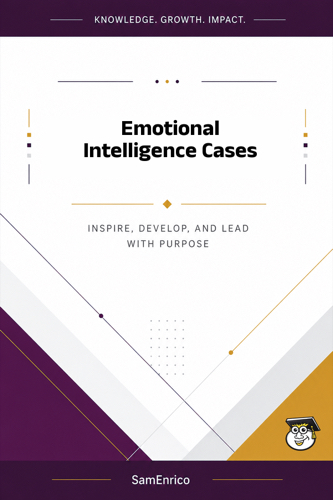
Free sample
Chapter 1: The Six-Second Window--–- Maya Chen had spent eighteen months positioning herself for the partner promotion. She had delivered record-breaking quarterly results, mentored three junior associates who were now billing independently, and personally brought in the firm’s largest healthcare client. Her 360-degree reviews praised her strategic thinking, her work ethic, and her ability to manage complex stakeholder relationships. On paper, she was the obvious choice.The moment that unraveled everything lasted less than four seconds.It happened during a quarterly review meeting. Maya was presenting her team’s data on a new market entry strategy—a slide deck she had refined over two weeks, numbers triple-checked against external audits.
Halfway through her explanation of a projected revenue curve, a junior colleague named Paul interrupted her.“Where did you get that baseline assumption?” he asked, leaning back in his chair. “Because our internal forecast from last quarter showed something completely different.”Maya felt heat rush to her face before she consciously registered the question. Her jaw tightened. Her field of vision narrowed. The room, which had been filled with sixteen of her colleagues and three senior partners, suddenly felt like a cage.
She heard her own voice before she could stop it.“That’s the dumbest question I’ve heard all week.”Silence. Paul’s face drained of color. A partner at the head of the table set down his pen with an audible click. Someone coughed. Maya watched herself from outside her body, powerless to rewind the last four seconds.The meeting continued.
The presentation finished. But the damage was done. Maya’s promotion was delayed six months. She was required to complete an “executive presence” coaching program. And for the next year, whenever her name came up in partner meetings, someone would say, “She’s brilliant, but she has an anger issue.”What happened to Maya Chen was not a character flaw, a moral failure, or evidence of a “bad temper.” It was a biological event—as predictable, as mechanical, and as non-optional as a knee jerking when tapped with a reflex hammer.
It was an amygdala hijack.The Biology of Losing Control To understand why Maya snapped, we have to go inside her skull.The human brain is not a single, unified organ making rational decisions. It is a layered structure, evolved over hundreds of millions of years, with older systems buried beneath newer ones. The oldest part—sometimes called the “reptilian brain”—handles basic survival: breathing, heart rate, fight or flight. Wrapped around that is the limbic system, which processes emotion and memory. And wrapped around that is the neocortex, the seat of language, planning, and rational thought.Here is the critical fact: the limbic system and the neocortex are connected by neural pathways, but those pathways are not equal.
The signals from the limbic system to the neocortex are fast, powerful, and direct. The signals from the neocortex back to the limbic system are slower, weaker, and indirect. Evolution prioritized speed over accuracy. When a predator is lunging at you, you do not have time to reason. You need to react.This design worked beautifully for our ancestors on the savanna.
It works disastrously in a conference room.Paul’s question—“Where did you get that baseline assumption?”—was not a physical threat. There was no predator, no falling rock, no rival tribe with spears. But Maya’s amygdala, the brain’s threat-detection center, does not distinguish between a challenge to her professional competence and a challenge to her physical survival. It interprets both as danger. And once the amygdala sounds the alarm, it can bypass the neocortex entirely, triggering a fight-or-flight response before the rational brain has any say in the matter.That is the amygdala hijack.
It is not a metaphor. It is a measurable neurological event. And it happens in under two seconds.The Architecture of a Hijack Let us walk through Maya’s hijack in slow motion.Second 0: Paul asks his question. Sound waves enter Maya’s ears. The auditory cortex processes the words as language.Second 0.5: The amygdala, which has been constantly monitoring incoming sensory data for signs of threat, flags the question as potentially dangerous.
Not because the words are inherently threatening, but because of what they represent: a public challenge, a potential loss of status, a rupture in the social hierarchy that evolution has wired us to care about as much as food and shelter.Second 1: The amygdala sends distress signals to the hypothalamus, which activates the sympathetic nervous system. Cortisol and adrenaline flood Maya’s bloodstream. Her heart rate spikes. Her breathing quickens. Blood rushes away from her digestive system and toward her large muscles, preparing her to fight or flee.
Her pupils dilate. Her peripheral vision narrows, focusing entirely on the perceived threat.Second 1.5: The amygdala has now hijacked Maya’s attention. The neocortex—the part of her brain that could have generated a thoughtful response like, “Great question, Paul. Let me walk you through our methodology”—is temporarily sidelined. The neural pathways from the amygdala to the neocortex are fast and strong.
The pathways back are not.Second 2: Maya speaks. Her words are not chosen. They are not strategic. They are purely reactive, generated by the most primitive parts of her brain. “That’s the dumbest question I’ve heard all week.”Second 2.5: The adrenaline surge begins to subside.
The neocortex, finally receiving the amygdala’s alarm signal, re-engages. Maya realizes what she has just done. But it is too late. The words are already in the room.Maya’s experience is not unusual. It is not a sign of weakness or poor character.
It is the way every human brain is built. The question is not whether you will ever experience an amygdala hijack—you will. The question is what you do before, during, and after the hijack to minimize the damage and build resilience for the next time.The Six-Second Rule Here is the most important number in this chapter: six.Research in affective neuroscience has shown that the chemical surge of an amygdala hijack—the cortisol and adrenaline rush that prepares your body for fight or flight—lasts approximately six seconds. After six seconds, the chemicals begin to metabolize. The prefrontal cortex can re-engage.
You can begin to think again.Six seconds is not a long time. You can hold your breath for six seconds. You can count to six. You can recite the alphabet from A to F. But in the middle of a hijack, six seconds can feel like six years.
The urge to speak, to react, to defend yourself is almost overwhelming.The skill of emotional intelligence is not the ability to prevent the hijack. You cannot prevent it. The amygdala is faster than the neocortex. It will always win the race. The skill is learning to install a pause—a six-second window—between the trigger and your response.
During that pause, the chemical surge begins to subside. The neocortex gets a vote. And you can choose a response instead of being hijacked by a reaction.This is not theory. It is neuroplasticity: the brain’s ability to rewire itself through repeated practice. Every time you successfully pause during a…
This is the end of the free sample. Get the eBook to keep going. Buy now
About this book
Details
- Author
- Jefferies Tenisha
- Publisher
- SamEnrico
- Language
- English
- Genre
- Non-Fiction, Self-Help / Case Studies
- Released
- 2026-06-07
- Pages (approx.)
- 134
- Available as
- eBook, Audiobook

Read better in the ZLOADR app
Your eBooks on your phone or tablet. Sign in with your SamEnrico account and start reading.
More by Jefferies Tenisha
 Pregame Hypnosis RoutineJefferies Tenisha$11.99
 The Thyroid Micronutrient GuideJefferies Tenisha$11.99
 Subsequent Pregnancy AnxietyJefferies Tenisha$11.99
 Child Illness Loss JourneyJefferies Tenisha$11.99
 Burnout Prevention for ScientistsJefferies Tenisha$11.99
 Bullet Hole Glass AnalysisJefferies Tenisha$11.99
 Mnemonics With AnkiJefferies Tenisha$11.99
 The Samurai of the Andes: The Untold Story of Peru's First Sumo WrestlerJefferies Tenisha$11.99
 The Quantum Scholars of Timbuktu: Unveiling the Cosmic Equations of the SaharaJefferies Tenisha$11.99
 How to Produce Flatware ChestsJefferies Tenisha$11.99
 Irish Terrier: Fiery & LoyalJefferies Tenisha$11.99
 How to Produce ScannersJefferies Tenisha$11.99
You may also like
 Hong Kong Handover 1997Dunn Johnnie$11.99
 Zumba For Postnatal Recovery CourseNeal Christian$11.99
 Zumba for BeginnersLadner Nikia$11.99
 YouTube Comment Mining GuideHumes Pandora$12.99
 Worry Box MeditationCarlin Rudy$11.99
 Workplace Stress MeditationNguyen Lynn$11.99
 Workplace Stress and Sleep RepairHawley Ivory$11.99
 Workplace Perfectionism CureDelaney Jeffry$11.99
 Workplace Injustice Anger GuideWallen Isabelle$11.99
 Work Addiction and Burnout LinkGreenwood Ester$11.99
 Women in Yoga and WellnessBeattie Galina$11.99
 Women in Stand Up ComedyChun Evangeline$11.99