
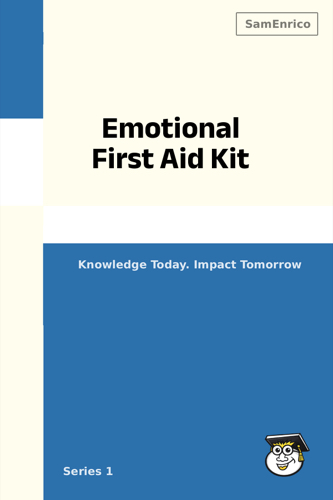
Non-FictionHealth & WellnessEmotional First Aid
Emotional First Aid Kit eBook
Creates a personalized toolkit of immediate interv
by Weis Jannet
Creates a personalized toolkit of immediate interventions for low mood and anxiety spikes.
Formats
Free sample
Chapter 1: The Emotional Symptom Checker--You are about to learn the single most important skill in emotional first aid: knowing exactly what is wrong before you try to fix it. This sounds obvious, but most people skip this step entirely. They feel bad—a vague, shapeless sense of distress—and they reach for whatever tool is closest. They breathe deeply when they should be grounding. They try to think positively when they need cold water on their face.
They call a friend when they need to be alone. The result is not just ineffective; it is actively frustrating. You try something that worked last week, it does nothing today, and you conclude that you are broken. You are not broken. You were just using the wrong tool for the wrong state.This chapter is your diagnostic manual.
By the end, you will be able to identify—within seconds—which of the five states of distress you are experiencing. You will know exactly which chapter to turn to and which tool to use. And you will understand why precision matters more than effort.The Five States of Distress After analyzing thousands of case reports and synthesizing the leading evidence-based frameworks (CBT, DBT, behavioral activation, and acceptance and commitment therapy), five distinct states of emotional distress emerge. Each has a unique signature of physical sensations, thought patterns, and behavioral urges. Each requires a different intervention.
And crucially, each can be misidentified as another.Let us walk through them one by one.State One: Panic Panic is high physiological arousal driven by fear. Your body believes it is under immediate threat. The amygdala—your brain's smoke alarm—has detected a tiger. The fact that the tiger is actually a work email or a crowded train or a memory of something that happened five years ago does not matter to your nervous system. The response is the same.The physical signature of panic includes a racing or pounding heart, shortness of breath or a feeling of being smothered, chest pain or discomfort, trembling or shaking, sweating, chills or heat sensations, numbness or tingling in the extremities, and a feeling of choking or a lump in the throat.
The cognitive signature includes a fear of dying, a fear of going crazy or losing control, a sense of unreality (derealization) or being detached from yourself (depersonalization), and catastrophic interpretations of bodily sensations ("This is a heart attack," "I am about to pass out," "I cannot breathe").The behavioral urge in panic is almost always escape. You want to run, leave the situation, get to a bathroom, get to your car, get anywhere else. This urge is powerful because it is evolutionarily ancient. Running from a tiger kept your ancestors alive. Running from a panic attack, however, tends to reinforce it.
Escape teaches your brain that the situation was genuinely dangerous, making the next panic attack more likely.Panic is often confused with a heart attack, asthma attack, or other medical emergency. If you are unsure, seek medical attention. But if you have had panic attacks before and recognize the pattern, you are in State One.Intervention for Panic: You need to cool down your nervous system quickly and physiologically. You cannot think your way out of panic because your prefrontal cortex—the logic center—has gone offline. Chapter 3 provides the Cold Water Protocol, which uses the mammalian dive reflex to force your parasympathetic nervous system to activate.State Two: Irritability Irritability is also high physiological arousal, but the emotion is rage or agitation rather than fear.
Your body is in fight mode rather than flight mode. The physical signature is similar to panic—racing heart, muscle tension, sweating, feeling hot or flushed—but with a different cognitive and behavioral signature.The cognitive signature of irritability includes thoughts of frustration, injustice, or being wronged. "This is unfair." "Why is this happening to me?" "Everyone is so stupid." "I cannot deal with this right now." You may feel a strong sense of urgency, but it is urgency to act out, not to escape. The behavioral urge is to snap, yell, throw something, slam a door, break something, or say something you will regret later.Irritability is often mislabeled as "being in a bad mood" or "having a short fuse." But crucially, irritability is distinct from panic because the urge is outward-directed (fight) rather than escape-directed (flight). The intervention, however, is surprisingly similar: you need to cool down your nervous system.
The Cold Water Protocol in Chapter 3 works just as well for irritability as it does for panic. Cold water on the face or ice pack on the back of the neck activates the same dive reflex and forces the parasympathetic nervous system to engage.A word of caution: irritability can be a symptom of low blood sugar, sleep deprivation, or caffeine overload. Before applying the protocol, check your basics. Have you eaten in the last four hours? Have you slept less than six hours?
Have you had more than two cups of coffee? If yes, address those first.State Three: Rumination Rumination is the repetitive, looping negative thinking that does not lead to solutions but just causes suffering. Unlike panic or irritability, rumination is cognitive rather than physiological. Your body may be calm. Your heart rate may be normal.
But your mind is trapped in a spiral.The physical signature of rumination is often subtle or absent. You might notice tension in your jaw or shoulders, furrowed brows, or shallow breathing. But the defining feature is cognitive. The cognitive signature includes repetitive thoughts about a problem without making progress, replaying past conversations or mistakes, worrying about the future in vague or catastrophic terms, "Why?" questions that have no answer ("Why did that happen?" "Why am I like this?"), and "What if?" questions that multiply endlessly ("What if I fail?" "What if they are angry?" "What if I never feel better?").The behavioral urge in rumination is to withdraw, to stop engaging with the external world so you can "figure it out." You might stop a conversation mid-sentence because you are lost in thought. You might stare at a screen without seeing it.
You might lie in bed turning the same problem over and over, getting no closer to a solution.Rumination is often confused with productive problem-solving. The distinction is critical. Problem-solving has a clear direction: you identify a specific problem, generate possible solutions, choose one, take action, and evaluate the result. Rumination has no direction. It circles the same ground endlessly.
If you have been thinking about the same issue for twenty minutes without any new insight or action, you are ruminating, not solving.Intervention for Rumination depends on timing. If you are ruminating right now, in this moment, turn to Chapter 5 and use the Thought Record. This ninety-second tool interrupts the loop by forcing you to externalize the thought and examine it. If you ruminate chronically throughout the day—every day, for weeks—turn to Chapter 5 and use the Worry Chair Technique, which contains rumination to a fifteen-minute daily window.State Four: Numbness Numbness is the opposite of panic. Where panic is high arousal, numbness is low arousal.
Where panic is too much feeling, numbness is too little. Your nervous system has shut down as a protective response…
This is the end of the free sample. Get the eBook to keep going. Buy now
About this book
Details
- Author
- Weis Jannet
- Publisher
- SamEnrico
- Language
- English
- Genre
- Non-Fiction, Health & Wellness, Emotional First Aid
- Released
- 2026-06-11
- Pages (approx.)
- 150
- Available as
- eBook, Audiobook

Read better in the ZLOADR app
Your eBooks on your phone or tablet. Sign in with your SamEnrico account and start reading.
More by Weis Jannet
 Personal Branding for Insurance AgentsWeis Jannet$11.99
 Retirement Housing Utility Cost GuideWeis Jannet$11.99
 Sitting Bull Life StoryWeis Jannet$11.99
 Dry Cleaning Chemical RisksWeis Jannet$11.99
 Online Parent Loss ForumWeis Jannet$11.99
 Aggressive to Assertive GuideWeis Jannet$11.99
 Remote Work Mental Health GuideWeis Jannet$11.99
 The Sapphire Serpent: A Heist in the Heart of the RajWeis Jannet$11.99
 The Day the Sky Fell: The 1970 Bhola Cyclone and the Birth of Climate Disaster AwarenessWeis Jannet$11.99
 A Collector's Handbook to the Mercedes-benz Mercedes Benz 280sWeis Jannet$11.99
 Layoff Appeal Response GuideWeis Jannet$12.99
 Payment and Refund TermsWeis Jannet$12.99
You may also like
 Hong Kong Handover 1997Dunn Johnnie$11.99
 Zumba For Postnatal Recovery CourseNeal Christian$11.99
 Zumba for BeginnersLadner Nikia$11.99
 YouTube Comment Mining GuideHumes Pandora$12.99
 Worry Box MeditationCarlin Rudy$11.99
 Workplace Stress MeditationNguyen Lynn$11.99
 Workplace Stress and Sleep RepairHawley Ivory$11.99
 Workplace Perfectionism CureDelaney Jeffry$11.99
 Workplace Injustice Anger GuideWallen Isabelle$11.99
 Work Addiction and Burnout LinkGreenwood Ester$11.99
 Women in Yoga and WellnessBeattie Galina$11.99
 Women in Stand Up ComedyChun Evangeline$11.99