
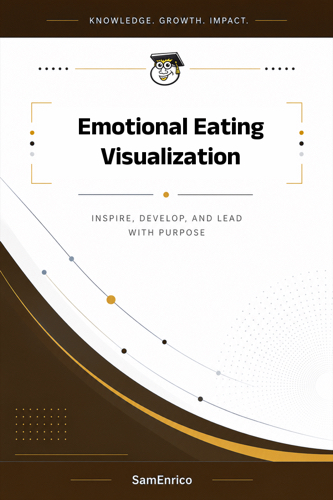
Non-FictionHealth & WellnessVisualization
Emotional Eating Visualization eBook
Use guided imagery to handle food urges.
Use guided imagery to handle food urges.
Formats
Free sample
Chapter 1: The Willpower Lie--–- You do not have a willpower problem.Let me say that again, because everything in your life has probably told you the opposite. Every diet you’ve ever tried, every morning you swore “today will be different,” every night you stood in front of an open refrigerator wondering how you got there again — all of it has been whispering the same false story: You just don’t have enough self-control.That story is wrong.It is not just wrong. It is dangerous. Because believing you have a willpower problem leads you to solve the wrong problem. You buy apps that block your access to delivery services.
You hide the cookies in the back of the pantry behind the canned beans. You make rules: no eating after 8 PM, no carbs, no sugar, no joy. And then, inevitably, you break the rules. And what do you tell yourself then?See? I told you.
No willpower.This chapter is going to dismantle that belief. Not gently. Not with soft language about “maybe someday.” We are going to take the concept of willpower, hold it up to the light of research, and watch it dissolve. Because only when you stop trying to be “stronger” can you actually become free.The Research That Changed Everything In the late 1990s, a psychologist named Roy Baumeister conducted a series of experiments that became the foundation of modern willpower theory. He called it “ego depletion.” The basic finding was this: people who resisted eating fresh-baked cookies (and instead ate radishes) gave up faster on a subsequent puzzle than people who hadn’t had to resist anything.
Baumeister concluded that willpower is a finite resource, like a muscle that gets tired with use.That finding became gospel. It was cited in best-selling books, corporate training programs, and weight loss clinics around the world. The implication was clear: if willpower is a limited resource, you need to conserve it. You need to structure your environment so you don’t have to resist temptation. You need to make rules and stick to them before you run out of steam.There was just one problem.Later studies failed to replicate Baumeister’s findings.
A massive meta-analysis in 2016 — pooling data from thousands of participants — found little to no evidence for ego depletion. Other researchers proposed a different model: willpower isn’t a finite resource; it’s a belief. People who believe willpower is limited act like it is. People who believe willpower is abundant don’t get “depleted.”But here’s what the replication crisis missed, and what matters for you, right now, reading this page: the entire conversation about willpower — whether it’s finite or infinite, whether it depletes or expands — is asking the wrong question.The right question is not How much willpower do you have?The right question is Why are you fighting at all?The Diet-Binge Cycle Let me tell you about a woman named Sarah. (Not her real name, but her story is real, and it might sound familiar.)Sarah started her first diet at fourteen.
She lost twelve pounds. She felt powerful, in control, beautiful. Then she went to a birthday party and ate a slice of cake. One slice. And something happened inside her that she could not explain.
The slice became two slices. Two slices became a spoonful of frosting直接从 the cake. She went home and finished a box of cookies her mother had hidden in the laundry room.She told herself she had no willpower.What Sarah did not know — what no one had told her — was that her “failure” was not a failure of character. It was a predictable, almost mechanical response to what she had done before the birthday party. She had spent two weeks eating 1,200 calories a day.
She had forbidden herself from eating sugar, bread, pasta, and anything that tasted like celebration. She had created what psychologists call psychological scarcity.When you forbid a food, you make it special. When you make it special, you think about it constantly. When you think about it constantly, you eventually eat it. And when you eat it after a period of deprivation, your brain releases far more dopamine than it would if you ate that same food without the prior restriction.
The relief is enormous. The relief feels like freedom. And then the shame crashes in, and you restrict again, and the cycle continues.This is not a willpower problem. This is a scarcity problem.The White Bear In 1987, a Harvard psychologist named Daniel Wegner asked participants to do a very simple thing: do not think about a white bear.You already know what happened. Everyone thought about the white bear.
Constantly. And when Wegner released them from the instruction — when he finally said, “Okay, now you can think about the white bear” — they thought about it even more than a control group who had never been asked to suppress it.This is called ironic rebound theory. The more you try to suppress a thought, the more it returns. And here is the cruel twist: trying to suppress the thought takes mental energy. It makes you tired.
And when you’re tired, the thought breaks through even more easily.Now replace “white bear” with “chocolate cake.”Every time you tell yourself “I cannot eat that,” you are engaging in thought suppression. Your brain has to work to keep the cake out of consciousness. And the cake, like the white bear, becomes more and more magnetic the harder you push it away. Eventually, you get tired. Eventually, you eat the cake.
And then you tell yourself you have no willpower.But you never had a willpower problem. You had a suppression problem. And suppression is a losing game.What Dieting Actually Does to Your Brain Let’s get specific about the neurobiology.When you restrict calories — any calories, for any reason — your body responds as if it is entering a famine. This is not a metaphor. Your hypothalamus, the ancient part of your brain that regulates hunger and survival, does not know the difference between a voluntary diet and an involuntary starvation.
It only knows that less food is coming in than energy is going out.Your hypothalamus responds by:Increasing the production of ghrelin, the hunger hormone, which makes you feel physically hungry even when you don’t need calories Decreasing the production of leptin, the satiety hormone, which makes it harder to feel full Increasing the activity of neuropeptide Y, a neurotransmitter that specifically drives cravings for carbohydrates and sugar But that’s just the beginning.Your brain’s reward system — the mesolimbic pathway, which runs from your ventral tegmental area to your nucleus accumbens — also changes during restriction. Normally, this pathway releases dopamine in anticipation of a reward. But when you’re restricting, the baseline level of dopamine drops. That means you need a stronger stimulus to get the same feeling of pleasure. A normal meal doesn’t do it anymore.
You need something more: sugar, fat, salt, texture, volume.This is why the first bite of a forbidden food after a period of restriction feels almost orgasmic. It’s not because you have no willpower. It’s because…
This is the end of the free sample. Get the eBook to keep going. Buy now
About this book
Details
- Author
- Satterfield Olinda
- Publisher
- SamEnrico
- Language
- English
- Genre
- Non-Fiction, Health & Wellness, Visualization
- Released
- 2026-06-10
- Pages (approx.)
- 151
- Available as
- eBook, Audiobook

Read better in the ZLOADR app
Your eBooks on your phone or tablet. Sign in with your SamEnrico account and start reading.
More by Satterfield Olinda
 The Handshake GuideSatterfield Olinda$11.99
 The Pain Desensitization GuideSatterfield Olinda$11.99
 Self Hypnosis For ClimbersSatterfield Olinda$11.99
 White House Staff Pressure GuideSatterfield Olinda$11.99
 Jester’s Last Laugh: The Ballad of the Bloody Puppet MasterSatterfield Olinda$11.99
 How to Start a Cycles (non-motorised) Business (Beginners Guide)Satterfield Olinda$11.99
 Ghana Dropshipping from ChinaSatterfield Olinda$12.99
 Presenting Data for Non-Technical AudiencesSatterfield Olinda$12.99
 Pic Test Development EngineerSatterfield Olinda$11.99
 Understanding Factor Xiii DeficiencySatterfield Olinda$17.99
You may also like
 Hong Kong Handover 1997Dunn Johnnie$11.99
 Zumba For Postnatal Recovery CourseNeal Christian$11.99
 Zumba for BeginnersLadner Nikia$11.99
 YouTube Comment Mining GuideHumes Pandora$12.99
 Worry Box MeditationCarlin Rudy$11.99
 Workplace Stress MeditationNguyen Lynn$11.99
 Workplace Stress and Sleep RepairHawley Ivory$11.99
 Workplace Perfectionism CureDelaney Jeffry$11.99
 Workplace Injustice Anger GuideWallen Isabelle$11.99
 Work Addiction and Burnout LinkGreenwood Ester$11.99
 Women in Yoga and WellnessBeattie Galina$11.99
 Women in Stand Up ComedyChun Evangeline$11.99