
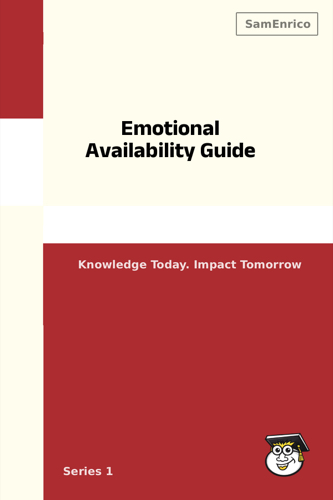
Non-FictionSelf-HelpEmotional Intimacy
Emotional Availability Guide eBook
Increases capacity for intimacy without fear.
by Hyde Merle
Increases capacity for intimacy without fear.
Formats
Free sample
Chapter 1: The Ghost in the Nursery--Your last breakup did not happen because you chose the wrong person. It happened because your nervous system recognized that person as home – and home, for you, was never a place of safety. It was a place where love arrived unpredictably, where warmth disappeared without warning, and where you learned, before you had language, that emotional proximity comes with a cost.This is not your fault. But it is your responsibility.The phrase "emotional unavailability" has become a casual insult we throw at exes – "He was emotionally unavailable," "She couldn't commit" – as if it were a personality flaw unique to a small subset of broken people. This is wrong.
Emotional unavailability is not a character defect. It is a survival strategy that you learned, probably before the age of seven, in response to an environment that did not reliably meet your emotional needs. And the people you keep choosing? They are not random. They are mirror reflections of the unhealed parts of yourself.This chapter will show you why you keep ending up in the same painful dynamics, how your childhood wiring became your adult programming, and why the person who feels "boring" might actually be the safest person you've ever met.
By the end, you will have a new map for understanding your attachment patterns – not as a life sentence, but as a starting point for reprogramming.The Radical Reframe: You Are Not Broken, You Were Trained Let's start with a question that might make you uncomfortable: What if the problem is not that you keep choosing unavailable people, but that you are, in your own way, unavailable too?Most people pick up this book because they are exhausted by a pattern. They date someone who pulls away, they chase, they exhaust themselves trying to earn love, and then they collapse when it doesn't work. Or they date someone who wants too much too fast, they feel suffocated, they pull away, and then they wonder why they feel so lonely. In both cases, the common denominator is not the partner. It is the strategy you learned for surviving emotional proximity.This is the radical reframe of this chapter and this entire book: Emotional unavailability is not a personality flaw.
It is a learned survival strategy that can be unlearned.Think about what you learned about love before you were five years old. Not what you were told – what you experienced. When you cried, did someone come? When you were scared, did someone hold you? When you were angry, were you allowed to be angry, or were you sent to your room to "calm down" alone?
When you needed attention, did you have to scream for it, or did it arrive reliably?Your answers to these questions became the architecture of your adult relationships. Not because you consciously decided, "I will now repeat my childhood," but because your nervous system – the ancient part of your brain that doesn't speak English – learned one thing: this is how love works. And it has been running that program ever since.Attachment Theory: The Map, Not the Destination In the 1950s and 1960s, psychologists John Bowlby and Mary Ainsworth changed how we understand human relationships. They studied infants and their caregivers and discovered something that seems obvious now but was revolutionary then: human beings are biologically wired for connection. An infant separated from its caregiver does not calmly wait.
It panics. It cries. It searches. And when the caregiver returns, the infant's response tells you everything about what it has learned to expect.Bowlby called this attachment theory. Ainsworth developed a research method called the "Strange Situation" – a laboratory procedure where a caregiver leaves a child with a stranger and then returns.
The child's response upon reunion became the basis for understanding attachment patterns that last a lifetime.Here is what they found, translated into adult relationships:Secure Attachment: The Goal State About 50-60% of people in Western populations have what researchers call secure attachment. As children, they had caregivers who were reliably responsive – not perfect, not always available, but good enough. When these children were distressed, someone came. When they were scared, someone held them. When they explored, someone watched from a safe distance.As adults, securely attached people tend to:Believe they are worthy of love Trust that others will generally be there when needed Communicate needs directly without excessive anxiety or avoidance Recover from conflict without catastrophic thinking Feel comfortable with both intimacy and independence Secure attachment is not perfection.
Secure people still get jealous, still fight, still have bad days. But they have a baseline expectation that relationships are fundamentally safe. When a conflict arises, they do not assume abandonment. When their partner needs space, they do not assume rejection.If you have secure attachment, you probably are not reading this book. Or if you are, you are reading it out of curiosity or to help someone else.
Most readers of this book have something else.Anxious Attachment: The Pursuer About 20% of people have anxious attachment (also called preoccupied attachment). As children, these individuals had caregivers who were inconsistent – sometimes warm and responsive, sometimes cold or absent. The child learned that love is unreliable. Sometimes crying brought comfort; sometimes it brought punishment or indifference. So the child learned to protest – to cry louder, to cling, to refuse to be put down – because intermittent attention is better than no attention.As adults, anxiously attached people tend to:Fear abandonment intensely, often irrationally Read neutral cues as threatening ("They didn't text back for two hours – they must hate me")Engage in protest behaviors: calling repeatedly, people-pleasing, threatening to leave to test commitment Feel that they are "too much" or "too needy"Attract avoidant partners (more on this in a moment)Experience relationships as a constant negotiation for safety The anxious mantra is: "I need you to need me, because if you don't need me, you will leave.
And if you leave, I will die." This is not drama. This is a nervous system that learned, in childhood, that abandonment is lethal. For an infant, it is. The problem is that the adult brain hasn't updated the software.Avoidant Attachment: The Withdrawer Another 20-25% of people have avoidant attachment (also called dismissive-avoidant attachment). As children, these individuals had caregivers who were consistently rejecting or minimizing of emotional needs.
"Don't cry." "You're fine." "Stop being so sensitive." The child learned that emotional expression is punished and that the only safe strategy is to shut down – to stop needing, because needing leads to pain.As adults, avoidantly attached people tend to:Value independence above connection Minimize or dismiss emotions (their own and others')Withdraw when a partner gets "too close"Have difficulty remembering childhood (a protective memory suppression)Attract anxious partners (because anxious pursuit feels "safe" in its predictability)Experience relationships as a threat to autonomy The avoidant mantra is: "If I need you, you will control me. And if you control me, I will disappear." This is why avoidant people often describe feeling "suffocated" or "trapped" by normal expressions of intimacy. A partner's request for more time together is experienced as a demand for surrender.Disorganized Attachment: The Chaotic Flip About 5-10% of people have…
This is the end of the free sample. Get the eBook to keep going. Buy now
About this book
Details
- Author
- Hyde Merle
- Publisher
- SamEnrico
- Language
- English
- Genre
- Non-Fiction, Self-Help, Emotional Intimacy
- Released
- 2026-06-09
- Pages (approx.)
- 131
- Available as
- eBook, Audiobook

Read better in the ZLOADR app
Your eBooks on your phone or tablet. Sign in with your SamEnrico account and start reading.
More by Hyde Merle
 Cash Runway CalculatorHyde Merle$11.99
 Persuasion for Political CampaignsHyde Merle$11.99
 The Hamstring Flexibility GuideHyde Merle$11.99
 The Rhodesian Double Cross: The Spy Who Betrayed a RevolutionHyde Merle$11.99
 Medical Admin AssistantHyde Merle$11.99
 How to Start a Bovine Hides and Skins Production From Knackers Business (Beginners Guide)Hyde Merle$11.99
 LinkedIn Headline for RecruitersHyde Merle$12.99
 Learn to Play the KomungoHyde Merle$11.99
You may also like
 Hong Kong Handover 1997Dunn Johnnie$11.99
 Zumba For Postnatal Recovery CourseNeal Christian$11.99
 Zumba for BeginnersLadner Nikia$11.99
 YouTube Comment Mining GuideHumes Pandora$12.99
 Worry Box MeditationCarlin Rudy$11.99
 Workplace Stress MeditationNguyen Lynn$11.99
 Workplace Stress and Sleep RepairHawley Ivory$11.99
 Workplace Perfectionism CureDelaney Jeffry$11.99
 Workplace Injustice Anger GuideWallen Isabelle$11.99
 Work Addiction and Burnout LinkGreenwood Ester$11.99
 Women in Yoga and WellnessBeattie Galina$11.99
 Women in Stand Up ComedyChun Evangeline$11.99