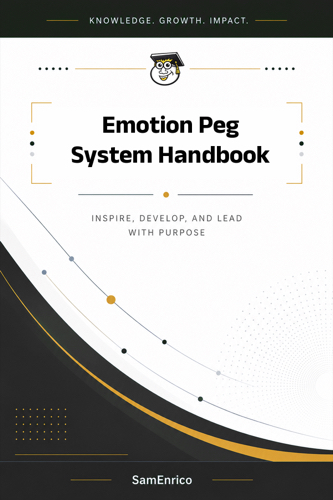
Emotion Peg System Handbook eBook
Attaches emotional states to pegs for even stronge
Attaches emotional states to pegs for even stronger memory encoding.
Formats
Free sample
Chapter 1: The Five-Second Humiliation--You are standing at a coffee machine in an office you have worked at for three years. Your boss approaches with a smiling woman in a blue blazer. “Great to finally introduce you two,” your boss says. “This is Sarah, our new VP of Marketing. Sarah, this is—” and then your boss says your name.
You shake Sarah’s hand. She says something about synergy and quarterly goals. You nod. You smile. You make a joke about the coffee being terrible.
Everyone laughs.Ninety seconds later, you are walking back to your desk and you realize something horrific.You have already forgotten her name.Not only that—you cannot remember a single detail about her face. Was she tall? Short? Glasses? No glasses?
You replay the interaction and find only a blur. The only thing you remember with perfect clarity is the feeling of your own panic when you realized, three seconds too late, that you should have been paying attention.This is the five-second humiliation. It happens to everyone. It happens to CEOs, to professors, to parents at school pickup, to newlyweds meeting their partner’s extended family for the second time. It happens to you.
It happened to me. And for most of your life, you have been told that this is simply how memory works—that some people are “good with names” and some people are not, that forgetfulness is a personality trait like being left-handed or preferring tea over coffee.That is a lie.The Five-Second Humiliation is not evidence of a bad memory. It is evidence of an untrained one. And the difference between those two things is the difference between believing you are broken and discovering that you have been using the wrong tool for your entire life.Let me prove it to you right now.Think back to the most embarrassing moment of your life. Not a small embarrassment—the big one.
The time you called your teacher “Mom.” The time you waved at someone who was waving at the person behind you. The time you gave a presentation and your voice cracked on the very first word. The time you sent a text message to the wrong person and wanted to dissolve into the floor.Do you remember it?Of course you do. You remember not just the facts but the sensations. The heat in your cheeks.
The way the room seemed to get louder or quieter. What people were wearing. What time of day it was. You might even remember the smell of the room—coffee, chalk dust, rain on carpet. That memory is years old, maybe decades, and yet it sits in your mind like it happened yesterday.Now try to remember what you ate for lunch three days ago.Unless you are a professional food critic or someone who eats the exact same sandwich every day, that memory is gone.
Erased. You might recall that you ate something, but the details—the taste, the temperature, the napkin color, the conversation you had while eating—are not there.Why? Why does your brain hold a grudge for a decade but forget a meal in seventy-two hours?The answer is not about time. It is about emotion.The Amygdala Does Not Care About Your Grocery List Deep inside your brain, tucked behind your temples and shaped like a small almond, sits a structure called the amygdala. Its job, in the simplest terms, is to answer one question: Is this important for survival?When the amygdala detects something that might help you live (food, safety, social bonding) or something that might kill you (a predator, a falling rock, public humiliation), it triggers a cascade of neurochemicals.
Cortisol. Adrenaline. Norepinephrine. These chemicals flood your hippocampus, the brain region responsible for forming new memories, and effectively shout: Save this now. Do not delete.
This one matters.This is called the Amygdala Hijack. The term sounds dramatic because it is. Your emotional brain literally overrides your rational brain’s filtering systems to stamp certain experiences as “permanent file.”That embarrassing moment you just recalled? Amygdala hijack. The car accident you narrowly avoided last year?
Amygdala hijack. The first time someone said “I love you” and meant it? Amygdala hijack.Your lunch from three days ago? The amygdala yawned and went back to sleep. No threat, no reward, no social danger, no intense pleasure.
Just calories. Discard.Here is what most people never realize: the amygdala does not care whether the emotion is positive or negative. It only cares about intensity. Terror and ecstasy are equally good at stamping memories. Rage and awe work just as well as fear and lust.
The amygdala is not a moral judge. It is a volume knob. Turn up the emotional volume on any experience, and the hippocampus will save it.This is where memory grandmasters—people who can memorize the order of ten shuffled decks of cards in under an hour, or recite pi to ten thousand digits—depart from the rest of humanity. They have not been gifted with superhuman amygdalas. They have simply learned to turn up the volume on demand.
They can take a boring shopping list, a dry set of historical dates, or a stranger’s forgettable name and artificially inject enough emotional intensity to make the amygdala pay attention.They do this not through trauma but through technique. And that technique is what this entire book will teach you.The Hippocampus Hook: Why Emotion Is the Save Button Let me introduce you to a concept we will use throughout this book: the Hippocampus Hook.Imagine your short-term memory as a whiteboard. You write things on it—a phone number, a name, a deadline—but within seconds or minutes, the information starts to fade. Someone else walks into the room and erases the board to write their own information. This is why you can repeat a phone number back to someone immediately after hearing it but cannot remember it five minutes later while you are looking for your phone.The hippocampus is the part of your brain that decides what moves from the whiteboard (short-term memory) into the filing cabinet (long-term memory).
But the hippocampus does not make this decision randomly. It takes orders from the amygdala. When the amygdala signals “important,” the hippocampus hooks that memory and pulls it into long-term storage. When the amygdala signals “boring,” the hippocampus lets the information evaporate.Emotion is the hook. No emotion, no hook.
No hook, no memory.This is not philosophy. This is biology. Neuroscientists have demonstrated through f MRI studies that emotional events activate the amygdala, which then enhances hippocampal activity, which then strengthens the neural connections that constitute a memory. The more emotionally intense the event, the stronger the connection. This is why war veterans remember specific battles with excruciating detail but cannot remember what they had for breakfast.
This is why you remember your wedding day but not the Tuesday two weeks before it.And this is why every memory system that works—every single one—relies on emotion, whether it admits it or not.The traditional peg system, which you may have heard of, claims to work through rhyming and visualization. One is…
This is the end of the free sample. Get the eBook to keep going. Buy now
About this book
Details
- Author
- Coppola Velia
- Publisher
- SamEnrico
- Language
- English
- Genre
- Non-Fiction, Self-Help, Emotional Memory
- Released
- 2026-06-12
- Pages (approx.)
- 138
- Available as
- eBook, Audiobook

Read better in the ZLOADR app
Your eBooks on your phone or tablet. Sign in with your SamEnrico account and start reading.
More by Coppola Velia
 Payment Collection GuideCoppola Velia$11.99
 Low Carb Emotional Eating FixCoppola Velia$11.99
 PTSD Nightmare Processing GuideCoppola Velia$11.99
 Post Event Information BiasCoppola Velia$11.99
 Great Smoky Unsolved CasesCoppola Velia$11.99
 Herbal Cigarette SubstitutesCoppola Velia$11.99
 Electrolyte Balance HandbookCoppola Velia$11.99
 The Silent Revolution: The 1991 Women's World Cup and the Fight for RecognitionCoppola Velia$11.99
 The Phantom of the Oscars: How Australia’s First Oscar Winner Was Almost StolenCoppola Velia$11.99
 How to Produce Soy SauceCoppola Velia$11.99
 A Collector's Handbook to the Crossley Ten SportsCoppola Velia$11.99
 Teaming Agreements for Government BidsCoppola Velia$12.99