
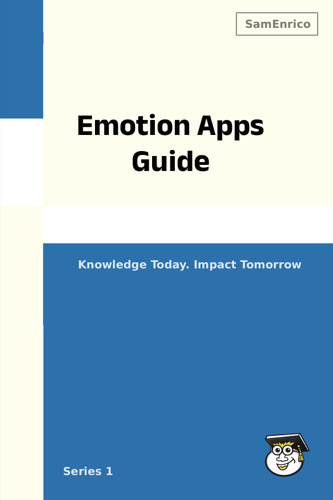
Free sample
Chapter 1: The Training Wheels Lie--We have been sold a story about emotion apps that is quietly, dangerously wrong.The story goes like this: download an app, tap a few mood icons, follow the breathing exercises, and you will feel better. The app will track your patterns. The app will teach you skills. The app will be there at 2 AM when your mind is racing and your chest is tight and you cannot remember the last time you slept through the night. The app will save you.This story is seductive because it offers something traditional therapy often cannot: convenience, affordability, anonymity, and the illusion of control.
You do not need to find a therapist who takes your insurance. You do not need to sit in a waiting room. You do not need to say difficult words out loud to another human being. You just need your phone, which is already in your hand.But the story is also a lie. Not a malicious lie, necessarily.
Most emotion app developers genuinely want to help people. The lie is one of omission, and it goes like this: an emotion app is not a therapist. It will never be a therapist. And treating it like one will not only fail to help you—it may actually make things worse.I learned this the hard way.The Night I Threw My Phone Across the Room Let me tell you about the worst panic attack of my life. I was thirty-one years old, six months into a new job that I secretly suspected I was unqualified for, and three weeks into a relationship that I was desperately trying not to sabotage with my usual anxious attachment patterns.
It was 1:47 AM. I was lying in bed in my dark apartment, convinced that I was having a heart attack.My chest felt like someone had placed a cinder block on it. My left arm was tingling. I could not catch my breath. Every time I tried to inhale, my throat seemed to close.
I had googled "heart attack symptoms" three times in the past hour, and each time, the search results confirmed my worst fear: yes, chest pain, yes, arm tingling, yes, shortness of breath. Call 911 immediately.But I did not call 911. Because some quiet, exhausted part of me knew—or at least suspected—that this was not a heart attack. This was the twentieth panic attack I had experienced in the past year. I had been to the emergency room twice.
I had worn a heart monitor for forty-eight hours. I had seen a cardiologist who told me, with gentle exasperation, that my heart was "annoyingly healthy."So at 1:47 AM, alone in my apartment, I did what any reasonable person in 2024 would do. I opened my phone and searched for help.I had downloaded several emotion apps over the previous year. There was a mood tracker that I used for three weeks and then abandoned. There was a meditation app that I opened exactly four times, each time feeling more irritated than the last.
And there was a CBT app—let us call it "Calm Mind"—that promised to help users "rewire anxious thoughts" in just five minutes a day.I opened Calm Mind. The app greeted me with a cheerful blue interface and a pop-up notification: "You've been away for 12 days. Let's pick up where you left off!"I tapped through to the panic protocol. The app asked me a series of questions:"What evidence do you have that something bad is going to happen?""What is a more balanced way of looking at this situation?""On a scale of 1 to 10, how likely is your feared outcome to actually occur?"I stared at my phone. My chest was still on fire.
My hands were shaking so badly that I could barely type. And the app was asking me to calmly evaluate evidence.I tried to answer. I really did. I typed: "I don't know. I feel like I'm dying." The app responded with a pre-written message: "It sounds like you're feeling anxious.
Remember that thoughts are not facts. Can you identify any cognitive distortions in what you just wrote?"That was the moment I threw my phone across the room. Not gently. Not with controlled frustration. I wound up like a baseball pitcher and hurled that phone into my bedroom wall.
It hit with a satisfying crack, skidded across the floor, and landed face-down on the carpet.I sat in the dark, breathing hard, phoneless, and eventually—after about fifteen minutes—the panic attack passed. It always passed. They always passed. But in that moment, I felt something worse than panic. I felt betrayed.
Not by the app, exactly. The app was just lines of code. I felt betrayed by the story I had been told about what apps could do for me.The App Is Not a Therapist Here is what I did not understand that night, and what this entire book is designed to teach you: emotion apps are training wheels, not ambulances. They are practice tools, not practitioners. They are useful for building skills when you are already stable, but they are catastrophically useless—sometimes actively harmful—when you are in crisis.Let me be very clear about what I mean.A human therapist can do things that no app can do.
A therapist can notice when you are dissociating—when your eyes go unfocused and your voice becomes flat and you are no longer fully present in your body. A therapist can recognize when a seemingly small statement ("I just feel like everyone would be better off without me") is actually a window into suicidal ideation. A therapist can understand context: the sarcasm in your voice, the family history you mentioned three sessions ago, the trauma anniversary that falls on this exact week. A therapist can sit with you in silence when words fail. A therapist can cry with you.
A therapist can hold the weight of your story without needing to "fix" it immediately.An app cannot do any of these things.An app can detect keywords. An app can offer pre-written responses. An app can gamify cognitive restructuring. An app can send you push notifications that say "You matter!" But an app cannot detect sarcasm. An app cannot remember that your father used the exact same phrase you just typed, and that the phrase has a different meaning in your family than it does in the general population.
An app cannot recognize that you are dissociating because it cannot see your face. An app cannot call emergency services if you stop responding. An app cannot sit with you in the messy, non-linear, heartbreakingly human process of healing.This does not mean apps are useless. They are not. I have since learned to use emotion apps effectively, and they have become valuable tools in my mental health toolkit.
But they are tools, not therapists. Using them as the latter is like using a screwdriver as a hammer: it might work in a pinch, but you are going to damage both the screwdriver and the wall.The Three Categories of Help To understand when and how to use emotion apps, we need…
This is the end of the free sample. Get the eBook to keep going. Buy now
About this book
Details
- Author
- Putnam Sterling
- Publisher
- SamEnrico
- Language
- English
- Genre
- Non-Fiction, Self-Help
- Released
- 2026-06-09
- Pages (approx.)
- 136
- Available as
- eBook, Audiobook

Read better in the ZLOADR app
Your eBooks on your phone or tablet. Sign in with your SamEnrico account and start reading.
More by Putnam Sterling
 IKEA Effect In BusinessPutnam Sterling$11.99
 Organization of African UnityPutnam Sterling$11.99
 Central India CampaignPutnam Sterling$11.99
 Anger And Bullying ChildrenPutnam Sterling$11.99
 Trauma Impact Relationship GuidePutnam Sterling$11.99
 The Assertiveness Elevator PitchPutnam Sterling$11.99
 Persuasive Crisis Response PlanPutnam Sterling$11.99
 Marc Andreessen BrowserPutnam Sterling$11.99
 The Velvet Coup: How a Secret Society Almost Toppled the White HousePutnam Sterling$11.99
 Dancing on the Edge of Scandal: The Radical Moves of Modern Dance's Forgotten RebelPutnam Sterling$11.99
 The 1971 Dollar Bill Heist: When Counterfeiters Almost Broke the U.S.Putnam Sterling$11.99
 The Mineral Guide to PericlasePutnam Sterling$11.99
You may also like
 Workplace Stress MeditationNguyen Lynn$11.99
 Volcano Monitoring ScientistCox Alexis$11.99
 The Tech Professional NetAguiar Nevada$11.99
 The Morning Metta RitualCanales Anya$11.99
 The Chunking Memory TechniqueClanton Hyacinth$11.99
 The Beginner Mistake FixAmmons Cassondra$11.99
 Surrendering to What IsGrimm Reatha$11.99
 Self Hypnosis for Fear of FireBillups Eli$11.99
 Road Rage for Professional DriversBrackett Janise$11.99
 Psychiatric Ward Nurse StressDunning Wyatt$11.99
 Observation vs Evaluation NVCTimmons Alda$11.99
 Networking for Nonprofit ProfessionalsPoole Jesse$11.99