
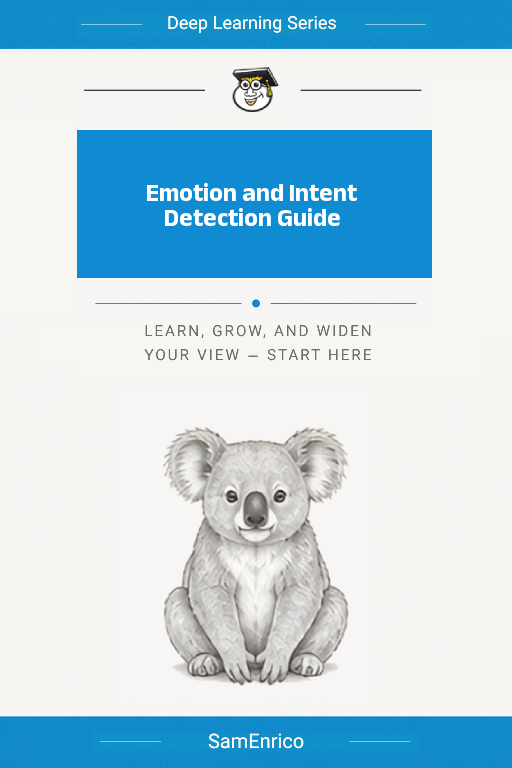
Non-FictionAI OperatorEmotion AIIntent Analysis
Emotion and Intent Detection Guide eBook
Go beyond positive-negative to detect anger, joy,
by Slater Paz
Go beyond positive-negative to detect anger, joy, disappointment, and purchase intent. Prioritize high-emotion mentions for immediate response.
Formats
Free sample
Chapter 1: The Polarity Trap--–- In 2019, a major airline’s customer experience dashboard showed a 94% “positive” sentiment score for a transatlantic flight that had sat on a tarmac for six hours. The algorithm had counted 1,247 tweets containing the word “thanks” as positive signals. What it failed to detect was that 98% of those “thanks” were followed by “a lot” or preceded by “really helpful” in sarcastic quotation marks. Three months later, 18% of that flight’s passengers had switched to a competitor. The airline’s sentiment dashboard had never flashed a single warning.
The Polarity Trap had claimed another victim.This chapter dismantles the standard industry reliance on binary sentiment scoring—positive/negative, thumbs up/down, or the ubiquitous 1-to-5-star rating. It opens with the provocative claim that a four-star review containing urgent language about a product failing at a critical moment is demonstrably more valuable than a five-star review that says nothing more than “It’s fine.” The core argument is simple but radical: polarity misses everything that matters. It misses context, culture, urgency, and—most critically—the specific emotion that drives customer behavior. By the end of this chapter, you will understand why your current sentiment system is probably lying to you, and you will have taken the first step toward a more accurate, more profitable way of listening to your customers.The $1.4 Billion Illusion The global sentiment analysis industry generated approximately $1.4 billion in revenue last year. That figure is projected to triple by 2030.
Companies are spending millions on tools that claim to tell them whether their customers are happy or unhappy. But here is the uncomfortable truth that vendors do not advertise: binary sentiment analysis has never been validated as a predictor of customer behavior. Not once. Not in any peer-reviewed study across marketing, psychology, or computer science.What has been validated? The relationship between specific emotions and specific behaviors.
Anger predicts public complaints and brand switching. Disappointment predicts silent churn. Joy predicts sharing and repurchase. Fear predicts avoidance and information-seeking. But binary systems cannot tell anger from disappointment—both register as “negative.” They cannot tell joy from relief—both register as “positive.” And they completely miss emotions like anticipation, which is neutral in polarity but predicts purchase intent better than any positive signal.Consider the practical implications.
A customer writes: “I’m so frustrated I could scream.” A binary system marks this as negative. A customer writes: “I’m slightly annoyed but whatever.” Also negative. These two messages receive the same polarity score, yet the first requires an immediate de-escalation call within 60 minutes, while the second requires almost nothing. By treating them as identical, binary systems waste resources on low-risk negatives while under-responding to high-risk ones. This is not a minor inefficiency.
This is a fundamental design flaw.The Anatomy of False Positives and False Negatives Every classification system makes two types of errors: false positives (calling something positive that is not) and false negatives (missing something positive that is there). Binary sentiment systems make both errors at alarming rates, but the most damaging errors are not the ones you might think.False Positive Example: A customer tweets, “Great job, really, truly amazing how you managed to mess this up.” The word “great” triggers a positive classification. The algorithm misses the sarcasm entirely. Your team sees a green thumbs-up and moves on. Meanwhile, that customer is rage-typing a second message.
This happens because sarcasm requires detecting a mismatch between literal meaning and emotional valence—something binary models are structurally incapable of doing without additional context.False Negative Example: A customer writes, “I’m not sure if this is worth the money, but I guess it’s fine.” Polarity systems mark this as neutral or slightly negative. In reality, this is a high-risk disappointment signal. The customer is one more mediocre interaction away from leaving forever. But because they didn’t use the word “bad,” your system ignores them.The Most Expensive Error: A customer writes, “How fast is shipping? I need this by Friday.” Polarity systems often classify questions as neutral.
But this message contains high purchase intent. The customer has already decided to buy; they are only removing final barriers. A binary system sees neutral. A human reading carefully sees a green light for immediate sales follow-up. The revenue loss from these missed signals is staggering.A 2023 study of e-commerce customer service tickets found that binary sentiment systems misclassified 34% of high-urgency complaints as neutral or mildly negative, and 41% of purchase-intent signals as neutral or mildly positive.
In other words, nearly four out of ten of your most valuable customer signals are being routed to the wrong queue or ignored entirely.Why Three Stars Should Terrify You Most companies have been trained to watch for one-star reviews and celebrate five-star reviews. Everything in between is treated as noise. This is exactly backward.A five-star review that says “It’s fine” contains almost no actionable information. The customer is satisfied enough to click five stars but not engaged enough to write a sentence. They are not an evangelist.
They will not recommend you to friends unless asked. They are a transaction, not a relationship.A four-star review that says “Product worked well but shipping took three days longer than promised” contains explicit, actionable intelligence. The customer took time to write specifics. They wanted something and received something slightly different. They are engaged.
They are telling you exactly what to fix. And they are still in the relationship—the four stars mean they haven’t given up.A three-star review should terrify you more than a one-star review. One-star reviewers are often outliers: the product arrived damaged, the customer was having a bad day, the use case was unusual. Three-star reviewers are your core customers. They are the ones who expected something, received something close but not exact, and are now hovering exactly at the threshold of churn.
They are not angry enough to demand a refund. They are not disappointed enough to write a long complaint. They are simply… unimpressed. And unimpressed customers leave quietly, without warning, often for a competitor that is only marginally better.Here is the data that keeps customer experience leaders awake at night: customers who leave three-star reviews are 2.7 times more likely to churn within six months than customers who leave five-star reviews. But they are also 1.4 times more likely to become loyal evangelists if their issue is resolved proactively.
The three-star review is a fork in the road. Binary sentiment systems cannot see the fork.The Three Things Polarity Cannot See Binary systems fail because they collapse a multidimensional reality into a single dimension. To understand why this matters, we need to examine three specific things that polarity cannot see.Thing One: Context Language is not a code where words map directly to meanings. Language is a performance that depends on shared context, relationships, and cultural scripts. The same words can mean opposite things depending on who says them, to whom, and in what situation.Consider the phrase “Thanks a lot.” In a service recovery email from a long-time customer, typed without capitalization or punctuation, this probably means genuine gratitude.
In a tweet from a customer who just posted a complaint two minutes earlier, typed in all caps with multiple…
This is the end of the free sample. Get the eBook to keep going. Buy now
About this book
Details
- Author
- Slater Paz
- Publisher
- SamEnrico
- Language
- English
- Genre
- Non-Fiction, AI Operator, Emotion AI, Intent Analysis
- Released
- 2026-06-01
- Pages (approx.)
- 138
- Available as
- eBook, Audiobook

Read better in the ZLOADR app
Your eBooks on your phone or tablet. Sign in with your SamEnrico account and start reading.
More by Slater Paz
 Writing Platform Comparison GuideSlater Paz$11.99
 Gambling Employment Risk GuideSlater Paz$11.99
 Financial Stress And Tax Anxiety GuideSlater Paz$11.99
 Cultural Trauma Dream ThemesSlater Paz$11.99
 Henry Ford BiographySlater Paz$11.99
 Imposter Syndrome And Childhood TraumaSlater Paz$11.99
 The Parent as Therapist ChildSlater Paz$11.99
 The Booster Shot ScheduleSlater Paz$11.99
 Secondary Infertility After LossSlater Paz$11.99
 Caesar and Pompey: The Blood Feud That Shattered RomeSlater Paz$11.99
 The Last Dive: The Unsinkable Truth of the USS ScorpionSlater Paz$11.99
 The Great Space Potato Rescue: How Scientists Saved a Cosmic Spud!Slater Paz$11.99
You may also like
 Hong Kong Handover 1997Dunn Johnnie$11.99
 Zumba For Postnatal Recovery CourseNeal Christian$11.99
 Zumba for BeginnersLadner Nikia$11.99
 YouTube Comment Mining GuideHumes Pandora$12.99
 Worry Box MeditationCarlin Rudy$11.99
 Workplace Stress MeditationNguyen Lynn$11.99
 Workplace Stress and Sleep RepairHawley Ivory$11.99
 Workplace Perfectionism CureDelaney Jeffry$11.99
 Workplace Injustice Anger GuideWallen Isabelle$11.99
 Work Addiction and Burnout LinkGreenwood Ester$11.99
 Women in Yoga and WellnessBeattie Galina$11.99
 Women in Stand Up ComedyChun Evangeline$11.99