

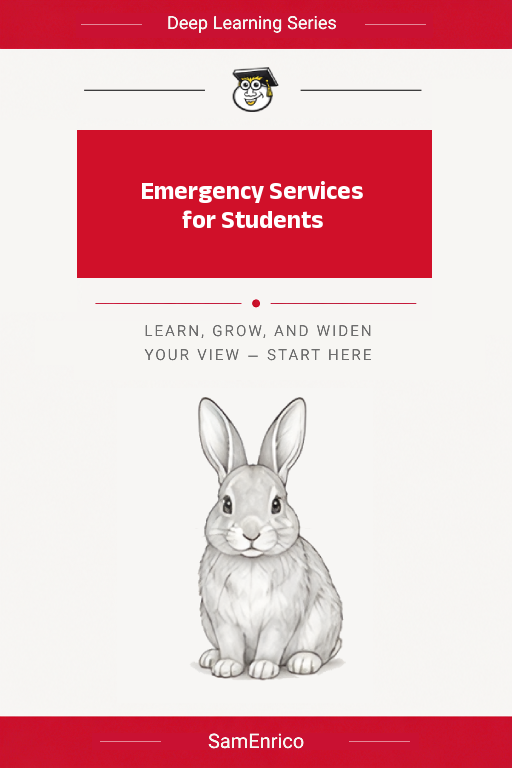
Non-FictionStudent's ShortcutEmergency
Emergency Services for Students eBook
Accesses police (155), ambulance (112), and fire (
Be the first to reviewAccesses police (155), ambulance (112), and fire (110) in Turkey plus university health centers and international student support.
Formats
Free sample
Chapter 1: The Three Numbers...--–- The dormitory hallway smells like burnt toast and anxiety. It is 3:47 AM on a Tuesday, and you have been in Istanbul for exactly eleven days. Your Turkish consists of "merhaba," "teşekkürler," and a desperate prayer that the cafeteria staff will understand when you point at the food instead of trying to name it. Your roommate, a friendly but perpetually disorganized engineering student from Bursa, is not in his bed. He is on the floor, curled on his side, making a sound you have never heard before—a wet, rattling gasp followed by silence.
Too long of a silence. Your phone is in your hand, the screen glowing blue in the dark room, but your thumb hovers frozen over the keypad. What number do you call? The answer to that question, in this exact moment, could be the difference between a story you tell for the rest of your life and a tragedy you never stop reliving.This is not a hypothetical scenario designed to scare you. It is a composite of actual calls placed by international students in Turkey over the past five years, documented in emergency dispatch logs and university incident reports.
The details change—the city might be Ankara instead of Istanbul, the time might be 2 PM instead of 3 AM, the emergency might be a fire instead of a medical crisis—but the core problem remains terrifyingly consistent: international students freeze because they do not know the emergency number. They hesitate because they are not sure which number to call. They waste precious seconds searching online, flipping through orientation packets, or calling their program coordinator at 3 AM. And in an emergency, seconds are not just seconds. They are the difference between life and death.This chapter exists to ensure that you never freeze.
By the time you finish reading these pages, the number 112 will be burned into your memory as deeply as your own birthday. You will understand exactly what happens when you make that call, what the dispatcher will ask, and how to answer even if you speak almost no Turkish. You will know when to call 112, when to go directly to a hospital or police station instead, and what to do if the call fails. More importantly, you will have practiced these steps so thoroughly that in a crisis, your fingers will dial the correct number before your conscious mind has even finished registering the emergency. That is not an exaggeration.
That is the goal of this chapter and this book: to make emergency response automatic.The Most Important Thirty Seconds of This Book Before we explore the history of Turkey's emergency system, before we break down the dispatch protocols and response times, before we discuss the nuances of language barriers and cultural expectations, you need to do something. Right now. Not after you finish this chapter. Not later tonight when you are settling into bed. Now.Open your phone.
Go to your contacts. Create a new contact. Name it "EMERGENCY – TURKEY – 112." Save the number as 112. Yes, you can save 112 as a contact. Yes, it will dial correctly.
Some phones will not let you save three-digit numbers; if yours is one of them, save it as "112 Emergency" with the full number 00112 or +90112 (the international format). Test it. Make sure it works. Now, go to your phone's emergency settings—the feature that allows you to call for help even when your phone is locked. On i Phones, this is accessed by pressing the side button five times.
On Android phones, the location varies by manufacturer, but it is usually under Settings > Safety & Emergency. Add 112 as your emergency number. This means that even if you are unconscious and a stranger picks up your locked phone, they can call for help without knowing your passcode.Done? Good. That single action has already put you ahead of ninety percent of international students.
But memorizing the number is not enough. You need to understand the system behind it.The Truth About 155, 110, and 112If you have done any research about emergency services in Turkey before picking up this book, you have probably encountered conflicting information. Some websites say call 155 for police. Others say call 112 for everything. Older guidebooks might list 110 for fire, 155 for police, and a different number for ambulance depending on the city.
This confusion is not your fault. It is the result of a system that has been undergoing a major transformation over the past decade, and not all information sources have kept up.Here is the simple, current, authoritative truth: In Turkey, 112 is the universal emergency number for police, ambulance, and fire services. You dial 112 for any emergency, and a trained dispatcher will route your call to the appropriate service. You do not need to decide whether you need police or an ambulance or the fire department. You do not need to remember three different numbers.
You need to remember three digits: one-one-two.The numbers 155 (police) and 110 (fire) are legacy numbers. They still work in most parts of Turkey, but they are being phased out. If you dial 155 today in Istanbul, it will likely redirect to the same 112 dispatch center. If you dial 110 in Ankara, the same thing will happen. But this redirection is not guaranteed in every location, and relying on legacy numbers creates unnecessary risk.
Use 112. Always. Every time.Why did Turkey make this change? The answer lies in a fundamental principle of emergency response: simplicity saves lives. When the European Union mandated 112 as the universal emergency number across all member states, Turkey—as a candidate country and later as a strategic partner—aligned its system accordingly.
But the unification went beyond just adopting a common number. Between 2015 and 2022, Turkey invested millions of dollars in building a single, integrated dispatch infrastructure that connects all 81 provinces. Today, when you call 112, your call is answered in a centralized center where dispatchers can see the location of every available ambulance, police car, and fire truck on a single screen. They can coordinate responses across services in real time. A car accident with injuries and a fire risk?
One call activates the ambulance, the police for traffic control, and the fire department simultaneously. That coordination saves minutes. Minutes save lives.What Happens When You Call 112: The Seven-Step Process Knowing what to expect when you call 112 will reduce your anxiety and help you cooperate more effectively with the dispatcher. Do not skim this section. Read it carefully.
Then read it again. The steps are standardized across Turkey, so what you learn here applies whether you are in a dormitory in Istanbul, a classroom in Ankara, or a study abroad excursion in Cappadocia.Step One: The Call Routes The moment you press "call," your phone connects to the nearest cell tower. The tower identifies your location at a very basic level—generally within a few hundred meters to a few kilometers, depending on population density. This location information is transmitted to the 112 dispatch center along with your call. Do not rely on this automatic location data to save you.
In dense urban areas like Istanbul, a cell tower can cover a circle of several city blocks. In rural areas, it can cover several kilometers. The…
This is the end of the free sample. Get the eBook to keep going. Buy now
About this book
Details
- Author
- Mahaffey Lupe
- Publisher
- SamEnrico
- Language
- English
- Genre
- Non-Fiction, Student's Shortcut, Emergency
- Released
- 2026-06-01
- Pages (approx.)
- 160
- Available as
- eBook, Audiobook
Reader reviews
No reviews yet — be the first to share what you thought.
Write a review
Reviews are from readers with a SamEnrico account. Please keep them about the book.
Sign in to write a review
Read better in the ZLOADR app
Your eBooks on your phone or tablet. Sign in with your SamEnrico account and start reading.
More by Mahaffey Lupe
 Stair Climbing LongevityMahaffey Lupe$11.99
 Mindful Walking For Weight LossMahaffey Lupe$11.99
 ABCDE For Remote WorkersMahaffey Lupe$11.99
 Coros Apex 2 Sleep GuideMahaffey Lupe$11.99
 The Black Dahlia Lesley Dillon TheoryMahaffey Lupe$11.99
 The Ghosts of Shiroyama: Saigō Takamori's Last StandMahaffey Lupe$11.99
 How to Become a Ornamental-metal-worker HelperMahaffey Lupe$11.99
 Understanding Rhabdomyosarcoma, AlveolarMahaffey Lupe$17.99
 Maintenance Team LeadMahaffey Lupe$11.99
 Background Check Remote GuideMahaffey Lupe$12.99
You may also like
 Hong Kong Handover 1997Dunn Johnnie$11.99
 Zumba For Postnatal Recovery CourseNeal Christian$11.99
 Zumba for BeginnersLadner Nikia$11.99
 YouTube Comment Mining GuideHumes Pandora$12.99
 Worry Box MeditationCarlin Rudy$11.99
 Workplace Stress MeditationNguyen Lynn$11.99
 Workplace Stress and Sleep RepairHawley Ivory$11.99
 Workplace Perfectionism CureDelaney Jeffry$11.99
 Workplace Injustice Anger GuideWallen Isabelle$11.99
 Work Addiction and Burnout LinkGreenwood Ester$11.99
 Women in Yoga and WellnessBeattie Galina$11.99
 Women in Stand Up ComedyChun Evangeline$11.99