

EMDR and Dream Processing eBook
Use bilateral stimulation during waking dream reca
by Read Mari
Use bilateral stimulation during waking dream recall.
Formats
Free sample
Chapter 1: The Architecture of Pain...--–- Every morning at 3:47 a.m., without fail, the same sequence of images played behind Karen’s closed eyelids. A hallway. A door that wouldn't lock. A faceless figure advancing. She would wake with her heart slamming against her ribs, the sheets twisted around her legs, and absolutely no memory of why this particular dream had been visiting her for seventeen years.
She had tried dream diaries, therapy, medication, even a sleep clinic. Nothing stopped the 3:47 a.m. visitor. What Karen didn’t know—what most people don’t know—is that her nightmare was not a random malfunction of a tired brain. It was a failed healing attempt.
And the hallway, the door, the faceless figure? They were not symbols to be interpreted. They were data. Raw, unprocessed, neurologically stuck data that her brain had been trying, and failing, to file away every single night for nearly two decades.This is a book about why that happens, and more importantly, how to finally finish the job that your sleeping brain started.Before we can understand how to process dreams using bilateral stimulation—the alternating left-right eye movements, taps, or tones that form the engine of EMDR therapy—we have to answer a more fundamental question. Why do dreams exist in the first place?
And why do some dreams, particularly the disturbing ones, repeat like a scratched record while others fade into the oblivion of forgotten sleep?The answer lies not in the mystical or the symbolic, but in the hard, elegant architecture of the human brain’s memory system. Specifically, it lies in a model of psychological healing that most people have never heard of, yet one that explains more about our daily emotional struggles than a decade of traditional talk therapy. That model is called the Adaptive Information Processing model, or AIP. And once you understand it, you will never look at a nightmare—or a bad memory, or a moment of unexplained anxiety—the same way again.The Brain’s Natural Healing Mechanism Imagine, for a moment, that your body is cut by a piece of glass. You don't have to consciously instruct your skin to clot, to form scar tissue, or to push out debris.
Your body knows what to do. The healing process is automatic, built-in, and remarkably efficient. You might clean the wound and bandage it, but the actual biological work of healing happens beneath your awareness, driven by millions of years of evolutionary programming.Francine Shapiro, the psychologist who developed EMDR therapy in the late 1980s, proposed that the brain has an analogous system for psychological injury. She called this the Adaptive Information Processing system. The AIP model suggests that the human brain is naturally wired to take disturbing experiences and process them toward what she called "adaptive resolution"—a state in which the memory is stored with the correct emotion (sadness rather than terror), the correct time-stamp (it happened then, not now), and a useful belief about oneself (I survived, rather than I am broken).When this system works correctly, a difficult experience becomes just another chapter in your life story.
You can recall it without reliving it. You can talk about it without being flooded by it. The memory has been filed away, like a letter placed in the correct drawer, accessible when needed but not intruding into every moment of your waking life.This is not wishful thinking. This is neuroscience. When a memory is successfully processed, it moves from implicit storage—fragmented, sensory, emotional, and timeless—to explicit, narrative memory with a beginning, middle, and end.
Your hippocampus, a seahorse-shaped structure deep in your brain, literally rewires itself to integrate the experience into your broader life narrative. The amygdala, your brain's alarm system, stops firing as if the threat is still present. Your prefrontal cortex, the seat of rational thought, is able to put the event in its proper context.But here is the critical point that most people—and even many therapists—fail to understand: this processing system does not only work during waking hours. It works primarily during sleep.When Processing Fails: The Stuck Memory The AIP model becomes truly powerful when we look at what happens when the system breaks down. Because sometimes, the cut does not heal.
Sometimes, the psychological wound becomes infected.When a traumatic event or even a persistently disturbing experience occurs, the brain's information processing system can become overwhelmed. This happens for several reasons. The event might be so intensely frightening that the amygdala hijacks the entire brain, flooding it with stress hormones that prevent normal memory consolidation. The event might occur during a developmental period when the brain's processing capacity is not yet fully online—which is why childhood trauma is so particularly sticky. Or the event might simply be repeated so many times that the system gets stuck in a loop, like a washing machine that can't move past the spin cycle.When processing fails, the memory does not disappear.
It does not fade. Instead, it gets stored in what Shapiro called a "state-specific form." This means the memory is trapped in the exact neurological state in which it was originally encoded. It remains frozen in time, complete with the original images, the original body sensations, the original emotions, and the original—often self-blaming or catastrophizing—beliefs.This is why a veteran might hear a car backfire and suddenly find himself back in a combat zone, his heart racing, his palms sweating, his body convinced that death is imminent. It is not that he is weak. It is not that he is overreacting.
It is that his brain has stored the combat memory in a raw, unprocessed form that cannot distinguish between "that happened then" and "this is happening now." The neural networks that hold that memory are isolated, unintegrated, and easily triggered by any sensory input that vaguely resembles the original event.Here is the detail that most people miss, and it is the central insight of this entire book: these stuck memories do not just sit there passively. They actively try to process themselves. And they do this primarily through dreams.Dreams as Failed EMDR Sessions Let us return to Karen, the woman with the 3:47 a.m. nightmare. For seventeen years, her brain had been attempting to process whatever original event created that hallway, that door, that faceless figure.
Every single night, during REM sleep, her brain would activate the same neural networks, run the same sequence of images, and attempt to move that stuck memory toward adaptive resolution.And every single night, it failed.Why? The answer is both surprising and liberating. The answer lies in the neurobiology of REM sleep itself.During REM sleep—the stage of sleep in which most vivid dreaming occurs—your brain is in a paradoxical state. Activity in the limbic system, your emotional brain, is extremely high. The visual cortex is firing as if you are actually seeing the images in your dream.
The amygdala, your fear center, is active. At the same time, activity in your dorsolateral prefrontal cortex—the part of your brain responsible for self-awareness, rational thought, time orientation, and what psychologists call…
This is the end of the free sample. Get the eBook to keep going. Buy now
About this book
Details
- Author
- Read Mari
- Publisher
- SamEnrico
- Language
- English
- Genre
- Non-Fiction, Self-Help, EMDR
- Released
- 2026-06-07
- Pages (approx.)
- 145
- Available as
- eBook, Audiobook

Read better in the ZLOADR app
Your eBooks on your phone or tablet. Sign in with your SamEnrico account and start reading.
More by Read Mari
 The Small Talk Pro WorkbookRead Mari$11.99
 Stress and Nervous System RegulationRead Mari$11.99
 MBSR for Flying AnxietyRead Mari$11.99
 The Forgotten Maestro: How Li Juren Brought Broadway to ShanghaiRead Mari$11.99
 How to Produce Battery AccessoriesRead Mari$11.99
 Remote Account Verification TipsRead Mari$12.99
 How to Start a Boiler Insurance Business (Beginners Guide)Read Mari$11.99
 Hypobaric Chamber Operation (Altitude)Read Mari$11.99
You may also like
 EMDR Protocol for Self WorthAdam Basil$11.99
 EMDR for Sex Addiction TraumaCasillas Charity$11.99
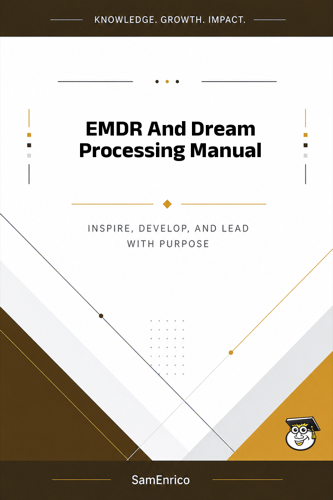 EMDR And Dream Processing ManualVillanueva Freeman$11.99
 EMDR for Complicated GriefPresley Carita$11.99
 EMDR and Dream Processing GuideCrespo Jacinta$11.99
 EMDR for Sexual AddictionHerrington Garth$11.99
 EMDR and Nightmares GuideBillingsley Fe$11.99
 Rescripting Nightmares In EMDRKearns Amal$11.99
 EMDR Trigger Processing GuideBrenner Caryn$11.99
 EMDR for Numbness GuideBustamante Marti$11.99
 EMDR for Sex AddictionHeim Whitley$11.99
 The EMDR Informed GuideLyons Eric$11.99