
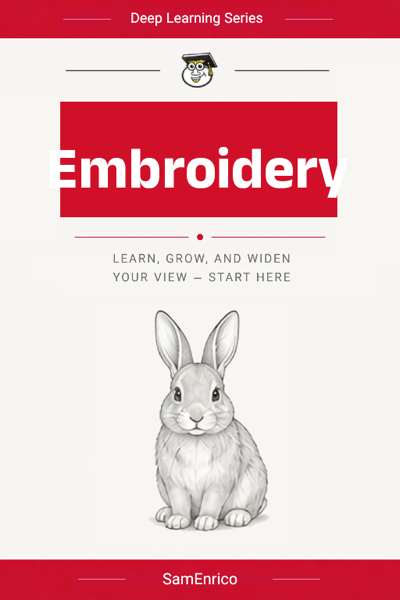
Non-FictionInformativeEducational
Embroidery eBook
A Coursebook on Embroidery
A Coursebook on Embroidery
Formats
Free sample
Chapter 1: The First Stitch...--–- The needle hovered above the fabric, trembling slightly between your thumb and forefinger. You have probably felt this moment before—the quiet hesitation before the first puncture, the small fear of getting it wrong, the unspoken question: What if this doesn't turn out the way I imagine?That hesitation is not weakness. It is respect. Every embroiderer, from the novice threading their first needle to the Royal School of Needlework instructor with forty years of experience, has felt that exact pause. The needle is a tool of intention, and the first stitch is always an act of faith.This book exists because embroidery has been misrepresented for too long.
Walk into any craft store, and you will find embroidery relegated to a corner—a few hoops, a rack of floss, some stamped kits featuring predictable flowers or sentimental phrases. Walk into any bookstore, and you will find stitch dictionaries that read like telephone directories: hundreds of stitches presented without context, without a sense of why one stitch belongs in one place and another in a completely different situation. These resources teach you how to make a stitch. They rarely teach you why to choose it.The Complete Stitch takes a different approach. This is not an encyclopedia.
This is a coursebook—a structured, progressive journey from absolute beginner to confident designer. By the time you finish these twelve chapters, you will not only know dozens of stitches. You will understand how to combine them. You will see color and texture differently. And most importantly, you will be able to look at a blank piece of fabric and know exactly where to place the first stitch.But before we get there, we need to talk about something that most embroidery books rush past in their eagerness to get to the pretty pictures: the materials, the tools, and—most critically—the mindset that separates frustration from flow.Why Embroidery?
Why Now?In an age of instant digital gratification, embroidery offers something increasingly rare: the permission to be slow. The average embroiderer completes between twenty and forty stitches per minute, depending on the complexity of the technique. A single square inch of dense satin stitch can take fifteen minutes. A small hoop—four inches in diameter—might represent four to six hours of focused work.This is not a bug. It is the entire point.Hand embroidery has experienced a remarkable renaissance over the past decade, driven by three cultural shifts.
First, the rise of the "slow stitch" movement has positioned embroidery as a form of mindfulness practice—a way to quiet the mind through repetitive, focused action. Second, the visibility of embroidery on social media platforms has created a vibrant global community where practitioners share work, techniques, and encouragement across continents. Third, and perhaps most significantly, embroidery has been reclaimed as a legitimate artistic medium, exhibited in galleries and museums alongside painting and sculpture.But the practical benefits matter too. Research from the Journal of Public Health suggests that repetitive textile crafts—including embroidery, knitting, and crochet—activate the parasympathetic nervous system, reducing cortisol levels and inducing a state similar to meditation. The rhythmic action of needle pulling thread, the visual feedback of pattern emerging from blank fabric, the tactile satisfaction of fiber sliding through cloth—these sensory inputs create what psychologist Mihaly Csikszentmihalyi famously called "flow state."You do not need to understand the science to benefit from it.
You simply need to stitch.The Three-Tier Toolkit: From $25 to Professional One of the most common barriers to starting embroidery is the mistaken belief that it requires a significant financial investment. It does not. The difference between a beginner's setup and a professional's collection is not about quality at the low end—it is about specialization and depth. A $25 kit will produce work indistinguishable from a $250 kit in the hands of the same skilled stitcher.Let us break down exactly what you need at each level.Tier One: The Starter Kit (Under $25)This is everything you need to complete the first five chapters of this book. Every item is available at chain craft stores or online for under $25 total.Fabric: A fat quarter of medium-weight, 100% cotton fabric in a light, solid color.
Cream, off-white, or pale gray are ideal because they show your stitches clearly without competing for attention. Avoid fabric with stretch (jersey, knit) or extremely loose weaves (burlap, loose linen) until you have mastered tension control.Needles: One pack of crewel needles in sizes 5, 7, and 9. Crewel needles have a sharp point and a long eye, making them versatile for most surface embroidery. You will primarily use size 7 for general work. The sharp point is essential—tapestry needles with blunt tips are for counted thread work, which we cover in Chapter 8.Thread: Six skeins of standard six-strand cotton embroidery floss in colors you find beautiful.
Do not overthink this. Choose two colors you love, one neutral, and three that complement them. You can complete every project in the first half of this book with six colors. DMC, Anchor, and Cosmo are reliable brands available worldwide.Hoop: One 6-inch wooden or plastic embroidery hoop. Wooden hoops with a brass tightening screw are traditional and hold tension well.
Plastic hoops with a ridge are lighter but sometimes slip. Six inches is the Goldilocks size—large enough for meaningful projects, small enough to hold comfortably in one hand.Scissors: One small pair of embroidery scissors with sharp, pointed tips. These are sometimes called "snips" or "stork scissors." They do not need to be expensive—a $5 pair from a craft store will serve you well for years. The key characteristics are sharpness (they should cut floss cleanly, not fray it) and size (blades under two inches for precise trimming).Needle Threader: One small wire needle threader. This costs less than a dollar and will save you more frustration than any other tool in your kit.
Use it without shame. Professional embroiderers use threaders constantly.Optional but recommended: A small, zippered pouch or tin to keep your needles, threader, and scissors together. Lost needles are dangerous; lost scissors are expensive.Tier Two: The Intermediate Kit ($50–$100)After completing Chapters 1 through 6, you will have developed preferences. The intermediate kit allows you to follow those preferences.Additional fabrics: Linen (for its irregular, organic texture), even-weave cotton (for counted work), and a small piece of silk (for special projects). Each fabric behaves differently—linen requires looser tension, silk demands sharper needles to avoid snags, even-weave rewards precision.Needle variety: Tapestry needles (blunt tip) for counted thread work, milliner's needles (same diameter along the entire shaft) for French knots and bullions, and beading needles (very fine with a small eye) for beadwork in Chapter 10.Thread expansion: Pearl cotton (a non-divisible twisted thread with a glossy finish), wool crewel thread (for texture and loft), and metallic threads (for sparkle, though they require specific handling techniques covered in Chapter 10).Additional hoops: A 4-inch hoop for small motifs and a 10-inch hoop for larger compositions.
Different projects demand different working areas.Lighting: A daylight lamp or clip-on magnifier with built-in light. Embroidery is detail work, and good lighting prevents eye strain and improves stitch accuracy.Storage solution: A thread organizer…
This is the end of the free sample. Get the eBook to keep going. Buy now
About this book
Details
- Author
- Casteel Jodee
- Publisher
- SamEnrico
- Language
- English
- Genre
- Non-Fiction, Informative, Educational
- Released
- 2026-06-02
- Pages (approx.)
- 152
- Available as
- eBook, Audiobook

Read better in the ZLOADR app
Your eBooks on your phone or tablet. Sign in with your SamEnrico account and start reading.
More by Casteel Jodee
 Texting Emotion DetectionCasteel Jodee$11.99
 Canva Brand Mood Music GuideCasteel Jodee$11.99
 Church Bulletin Board AdsCasteel Jodee$11.99
 Tobacco Withdrawal Symptom ReliefCasteel Jodee$11.99
 The Fire Mountains of the Kingdom of Kongo: How African Engineers Tamed VolcanoesCasteel Jodee$11.99
 AI for Referral Letter GenerationCasteel Jodee$12.99
 Learn to Play the ShawmCasteel Jodee$11.99
 How to Start a Clog Business (Beginners Guide)Casteel Jodee$11.99
You may also like
 Hong Kong Handover 1997Dunn Johnnie$11.99
 Zumba For Postnatal Recovery CourseNeal Christian$11.99
 Zumba for BeginnersLadner Nikia$11.99
 YouTube Comment Mining GuideHumes Pandora$12.99
 Worry Box MeditationCarlin Rudy$11.99
 Workplace Stress MeditationNguyen Lynn$11.99
 Workplace Stress and Sleep RepairHawley Ivory$11.99
 Workplace Perfectionism CureDelaney Jeffry$11.99
 Workplace Injustice Anger GuideWallen Isabelle$11.99
 Work Addiction and Burnout LinkGreenwood Ester$11.99
 Women in Yoga and WellnessBeattie Galina$11.99
 Women in Stand Up ComedyChun Evangeline$11.99