
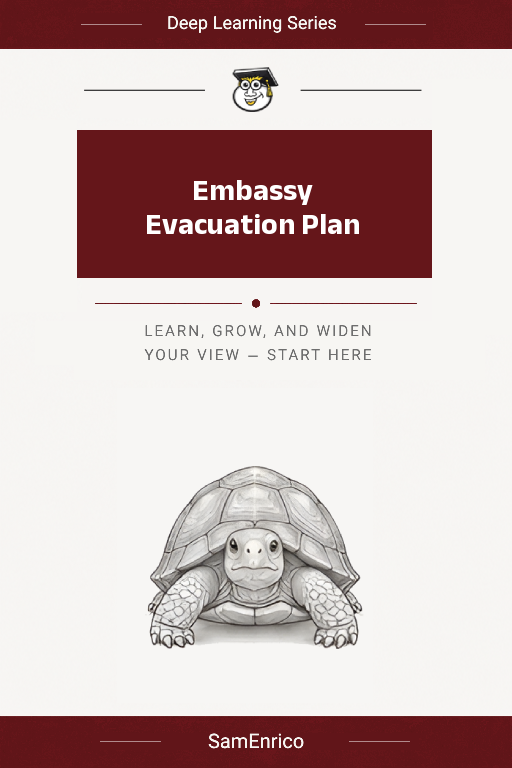
Embassy Evacuation Plan eBook
Coordinate with embassy to evacuate key personnel
by Baer Dario
Coordinate with embassy to evacuate key personnel during coups, revolutions, or civil wars.
Formats
Free sample
Chapter 1: The Graveyard Spiral--The first rocket landed at 4:47 on a Tuesday afternoon.Alex Mendoza felt it through the soles of his boots before he heard it—a deep, percussive thump that vibrated up through the concrete floor of the Regional Security Office. Then came the sound: a cracking, tearing roar that meant the rocket had hit something structural, not just open ground. His desk coffee cup rattled against its saucer. On the wall, a framed photograph of his daughter tilted three degrees to the left and stayed there."Report," he said into his shoulder mic, already moving toward the blast window.The voice of Sergeant Davis, the Marine Guard stationed at the main gate, came back broken and breathless. "Indirect fire, origin unknown.
At least one impact inside the compound—the motor pool is burning. No casualties reported yet, sir, but we have secondary explosions from fuel stores."Mendoza reached the window and looked out at a scene that had changed completely in the five seconds since the last time he had looked. The motor pool was indeed on fire—a black column of smoke rising from what had been six armored SUVs an hour ago. Personnel were running in conflicting directions, some toward the embassy building, some away from it, some simply running without apparent目的地. The local guard force, a contract company he had never fully trusted, had abandoned their posts at the perimeter.
He could see their empty checkpoint from here, the gate standing open like a missing tooth.He pulled out his satellite phone. Dead. He tried his cell phone. No signal. The rocket had taken out the cell tower on the eastern edge of the city, the one he had noted in his Threat Horizon Checklist six months ago as "vulnerable but likely not a priority target." He had been wrong about the priority.He had been wrong about a lot of things.The Truth About Evacuations Most people believe that embassy evacuations fail during the extraction—the helicopters, the convoy, the last flight out.
They imagine the climactic scene: gunfire, shouting, a door closing just as a desperate evacuee reaches the ramp. This is what movies have taught us, and it is almost entirely wrong.The truth is harder to accept and far more damning. Most evacuation failures begin not with gunfire but with the failure to read subtle signs of political decay. They begin weeks or months before the first rocket lands, in meetings where someone says "it's probably nothing" and everyone else nods because nodding is easier than confronting the possibility that their careers, their colleagues, and their families are all sitting on top of a fault line that is about to crack.This chapter is about those signs. It is about the Graveyard Spiral—a term borrowed from aviation that describes what happens when a pilot loses situational awareness and begins a slow, undetected descent toward the ground.
The spiral feels like controlled flight right up until the moment it doesn't. Embassies do the same thing. They debate whether a crisis is "real" while the indicators pile up like unread intelligence reports. They hesitate because drawing down early might offend the host government or signal a lack of confidence. They wait for certainty in an environment where certainty is a luxury that no longer exists.By the time the rocket lands, the only question is whether you recognized the spiral early enough to pull up.The Anatomy of Political Decay To understand when to evacuate, you must first understand what you are evacuating from.
Coups, revolutions, and civil wars are not sudden events. They appear sudden only to those who were not paying attention. In reality, they follow predictable patterns of decay that can be observed, documented, and acted upon if you know what to look for.The Defection of Mid-Level Military Officers The first reliable indicator of a coup in progress is not the movement of tanks but the silence of mid-level officers. In the weeks before a coup, colonels and majors who would normally be visible at embassy functions, intelligence-sharing meetings, and routine security coordination calls begin to disappear. Their phones go unanswered.
Their offices, when visited, are staffed by confused subordinates who say the officer is "on leave" or "attending training."This is the sound of loyalty shifting. Mid-level officers are the operational backbone of any military. They execute orders, manage troops, and control the physical assets—the tanks, the checkpoints, the ammunition depots. When they begin to disengage from the embassy, it is because they have been told to do so by someone planning to use those assets against the existing government.The Afghanistan 2021 evacuation offers a textbook case of this indicator being missed. In the months following the Doha Agreement, U.S.
intelligence noted a gradual but consistent reduction in contact with Afghan National Army corps commanders. The official explanation was "operational security" and "reduced U.S. footprint." The actual explanation was that those commanders were already negotiating their defection to the Taliban, and contact with the Americans had become a liability. By the time the Taliban entered Kabul, the entire chain of command had evaporated—not because the soldiers had fled, but because their leaders had already switched sides.The Sudden Silence of Key Intelligence Assets The second indicator is harder to detect but more reliable when present. Intelligence assets—human sources, signal intercepts, even open-source monitoring—generate a baseline of noise.
There are regular reports, routine chatter, predictable patterns of communication. When a coup is being planned, that noise does not simply continue. It changes.Specifically, certain assets go silent. Not all assets—that would be too obvious—but the ones with access to the planners. A source inside the presidential guard stops reporting.
A signal intercept from the military intelligence directorate becomes garbled or encrypted in a new, unbreakable way. A journalist who has always been reliable suddenly has no comment on troop movements.This silence is not absence. It is action. Someone has decided that the embassy cannot know what is coming, and they have the authority to enforce that decision.The Sudan 2023 crisis demonstrated the danger of misreading this silence. In the weeks before the Rapid Support Forces (RSF) and the Sudanese Armed Forces turned on each other, multiple intelligence assets went quiet simultaneously.
Competing assessments within the U.S. intelligence community argued about whether the silence meant coordination (a unified government preparing to act against a common enemy) or conspiracy (two factions preparing to act against each other). The debate paralyzed decision-making. By the time the shooting started, the embassy was so far behind the curve that the evacuation became a race against the collapse of the entire country.The Appearance of Armed Militias in Identical Civilian Clothing The third indicator is visible to anyone who drives through the city. Armed militias, when they are not yet ready to declare themselves, wear civilian clothing.
But they wear it in a specific way: identical or nearly identical clothing, suggesting centralized supply and coordination. A group of men in blue jeans and white t-shirts might be nothing. A group of men in identical blue jeans, identical white t-shirts, and identical new sneakers is…
This is the end of the free sample. Get the eBook to keep going. Buy now
About this book
Details
- Author
- Baer Dario
- Publisher
- SamEnrico
- Language
- English
- Genre
- Non-Fiction, Crisis Management, Embassy Relations
- Released
- 2026-05-29
- Pages (approx.)
- 151
- Available as
- eBook, Audiobook

Read better in the ZLOADR app
Your eBooks on your phone or tablet. Sign in with your SamEnrico account and start reading.
More by Baer Dario
 HOAs and Retirement DownsizingBaer Dario$11.99
 Sheppard Family Blood EvidenceBaer Dario$11.99
 Reading Goal Challenge GuideBaer Dario$11.99
 Rosa Parks Quiet CourageBaer Dario$11.99
 Nap and Light TherapyBaer Dario$11.99
 The Student Success JournalBaer Dario$11.99
 Pet Loss and Other PetsBaer Dario$11.99
 Entrepreneur Morning RitualsBaer Dario$11.99
 The Poisoned Kimonos: Japan's Silent Serial Killer and the Science That Caught HerBaer Dario$11.99
 The Symphony of the Savannah: How Black Composers Orchestrated the WildBaer Dario$11.99
 How to Start a Cooker (electric) Business (Beginners Guide)Baer Dario$11.99
 How to Produce Kitchen Utensil SetsBaer Dario$11.99