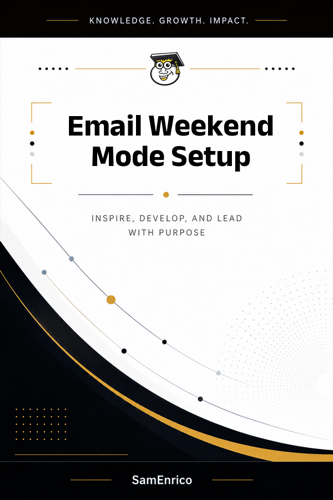
Email Weekend Mode Setup eBook
Schedule emails to send on Monday when you work on
by Burns Guy
Schedule emails to send on Monday when you work on weekends.
Formats
Free sample
Chapter 1: The Weekend Tax...--–- Sarah’s Sunday had started with promise. At 10:00 AM, she had poured a second cup of coffee, opened her laptop, and told herself the same thing she said every weekend: “I’ll just check email real quick. Ten minutes, max.”Three hours later, she had answered thirty-four messages, cried once in the bathroom, and snapped at her daughter for asking what was for dinner. Her husband had stopped asking when she would be done. Her neck ached.
Her eyes burned. And the worst part? On Monday morning, her boss pulled her aside and said, “Great work on those Sunday replies. Really shows dedication.”Sarah smiled. Inside, she wanted to throw her laptop through the window.If you are reading this book, you have been Sarah.
Maybe not the crying part. Maybe not the snapped response at a loved one. But you know the feeling: the slow, creeping dread of opening your inbox on a day that was supposed to be yours. The way one innocent “quick check” becomes a three-hour descent into obligation, anxiety, and the strange guilt of not working when you could be working.This is not a failure of your willpower. This is not because you are bad at boundaries or weak or undisciplined.
This is because you are paying a tax that no one told you existed — a hidden cost extracted from your weekends, your relationships, and your peace of mind, all for the privilege of answering emails that could have waited until Monday.I call this the Weekend Tax.The Hidden Cost of “Just One Quick Check”Let us define the Weekend Tax precisely. It is not simply the number of hours you spend working on Saturday and Sunday. That would be easy to measure and relatively easy to solve. The Weekend Tax is the fracturing of your rest — the way a single email check interrupts your brain’s ability to recover, even if you only spend ten minutes on it.Here is what most people get wrong about weekend work: they think the cost is linear. One hour of email equals one hour of lost rest.
If that were true, you could simply work one hour less on Sunday and feel fine.But the research tells a different story. A study published in the Journal of Occupational Health Psychology found that employees who checked email on weekends reported significantly higher levels of emotional exhaustion and work-family conflict — even when they spent less than thirty minutes total. The problem was not the duration. It was the interruption.Think of your weekend rest like deep sleep. If you are woken up once in the middle of the night, you might feel tired the next day, but you can recover.
If you are woken up every hour, you never enter REM sleep. You wake up exhausted, even though you were “in bed” for eight hours.The Weekend Tax works the same way. Each time you check email, your brain exits rest mode and enters task mode. Cortisol rises. Your sympathetic nervous system — the “fight or flight” network — activates.
You start scanning for threats, problems, demands. Even if you find nothing urgent, the activation has already happened. You have been startled awake. And then you close your laptop, try to watch a movie with your family, and wonder why you feel so irritable.You are not irritable because you are a bad person. You are irritable because your brain is still in “threat detection” mode, and your child asking about popcorn feels like another demand on your depleted attention.The Anxiety Loop: Why You Check, Then Check Again There is a second component to the Weekend Tax that makes it even more insidious: the Anxiety Loop.Here is how it works.
You open your email on Saturday morning. You see 1,462 unread messages. Your heart rate increases. Your palms might sweat. This is not an exaggeration — researchers have measured cortisol spikes in people viewing their email inboxes, comparable to the stress response of watching a horror film.The high number of unread messages signals danger.
Your ancient brain, which evolved to worry about saber-toothed tigers, cannot distinguish between “unread email from marketing” and “unread warning about a genuine emergency.” It treats all unread items as potential threats.So you scan. You delete some. You reply to others. You flag a few for later. By the end of your session, your unread count is down to 1,200.
You feel a small sense of relief. You close your laptop.But here is the trap: your brain now knows that checking email reduces the threat level. It rewards you with a tiny hit of dopamine — the same neurotransmitter involved in addiction. Not because email is addictive in a clinical sense, but because the variable reward schedule (sometimes there is an urgent problem, sometimes there is nothing) is the exact pattern that creates compulsive checking behavior.So you check again an hour later. And again.
Each time, you get a small reward. Each time, the Weekend Tax compounds.This is the Anxiety Loop: stress spikes from unread email → checking reduces stress → brain learns to check more often → weekend fractures into dozens of micro-interruptions → you never truly rest.The 11-Hour Lie Let me share a number that might shock you. The average professional spends approximately 11 hours per week on email. That is not my estimate. That comes from the Mc Kinsey Global Institute and has been replicated by dozens of workplace studies.Eleven hours per week is more than a full workday.
It is 572 hours per year. It is the equivalent of fourteen 40-hour workweeks spent entirely on email.Now here is the part that matters for this book: weekend checks add two to three hours to that total. But they do not simply add time. They fracture the 48 hours you have to recover from the workweek.Let me walk you through a typical weekend email pattern that I have seen in hundreds of professionals I have advised.Saturday morning, 9:00 AM: “Just a quick check.” Twenty minutes. You reply to a few easy ones.Saturday afternoon, 1:30 PM: While waiting for lunch to heat up, you glance at your phone.
Another fifteen minutes.Saturday evening, 8:00 PM: You are watching a movie. Your phone buzzes with a work email. You pause the movie and answer. Twenty minutes.Sunday morning, 10:00 AM: “I should clear the deck before Monday.” Forty-five minutes.Sunday afternoon, 3:00 PM: A colleague emails about a “quick question.” You answer, then get pulled into a thread. Thirty minutes.Sunday evening, 8:00 PM: The Sunday scaries hit.
You check email to “prepare” for Monday. Twenty minutes.Total weekend email time: approximately three hours.Now here is the question: would you trade three hours of your weekend for a sense of peace? Most people would say yes. But the problem is that you did trade three hours — and you did not get peace. You got three hours of fractured, anxious, half-attention work, plus a lingering sense that you never truly left the office.This is the 11-Hour Lie.
It is not that the number is wrong. It is that the number hides the true cost. The true cost is not the hours. It…
This is the end of the free sample. Get the eBook to keep going. Buy now
About this book
Details
- Author
- Burns Guy
- Publisher
- SamEnrico
- Language
- English
- Genre
- Non-Fiction, Business Brief, Boundaries
- Released
- 2026-06-06
- Pages (approx.)
- 130
- Available as
- eBook, Audiobook

Read better in the ZLOADR app
Your eBooks on your phone or tablet. Sign in with your SamEnrico account and start reading.
More by Burns Guy
 Mavis Staples Freedom SingerBurns Guy$11.99
 Sales Tax for StartupsBurns Guy$11.99
 Evidence File Imposter CureBurns Guy$11.99
 Healthcare Shift BlockingBurns Guy$11.99
 Graduate Talent Export PatternsBurns Guy$11.99
 Sleep For Focus PerformanceBurns Guy$11.99
 Graded Exposure GuideBurns Guy$11.99
 The Silent Spy: Marcel Marceau and the Resistance's Secret WeaponBurns Guy$11.99
 The Last Oracle of Delphi: A Trial of Prophecy and PowerBurns Guy$11.99
 Exploring Pencil: Graphite Drawing & ShadingBurns Guy$11.99
 How to Produce Door HardwareBurns Guy$11.99
 Broccoli: When to Cut Main HeadBurns Guy$11.99