
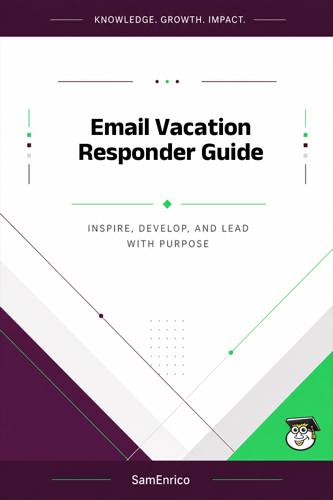
Non-FictionBusiness BriefEmailVacation
Email Vacation Responder Guide eBook
Set out of office messages that actually reduce in
Set out of office messages that actually reduce inbox buildup.
Formats
Free sample
Chapter 1: The Vacation Tax--–- The email arrived at 11:47 PM on a Tuesday, three days before Sarah Chen was supposed to board a flight to Kyoto. It was from her largest client, marked "High Importance" with a red exclamation point that seemed to pulse on her screen like a warning light. The subject line read: "URGENT – Q3 deliverables completely wrong – need call ASAP."Sarah had been working for fourteen hours straight, trying to close out loose ends before her first real vacation in eighteen months. Her neck ached. Her vision blurred when she looked away from the screen.
And somewhere in the back of her mind, a small voice whispered what she already knew to be true: the vacation was already over, and she hadn't even left yet.She spent the next four hours on the phone with the client, rebuilding a spreadsheet from scratch, apologizing for errors she hadn't made, and quietly moving her flight to the following week. When she finally crawled into bed at 4:00 AM, her husband didn't say anything. He just rolled over, his back a wall of silent disappointment.Three weeks later, Sarah took that delayed vacation. She spent the first two days answering emails from the hotel lobby. She spent the third day fielding questions from her team about decisions she'd supposedly made while she was out.
She spent the fourth day crying in the bathroom of a ramen shop because her boss had texted her asking for "just five minutes" to review a contract.When she returned to the office, she had 1,247 unread emails. It took her four full days to dig out. By the end of that week, she couldn't remember a single moment of Kyoto except the view of the hotel business center and the way the fluorescent lights made her skin look gray.Sarah is not unusual. She is not lazy, disorganized, or bad at her job. She is a senior director at a $200 million Saa S company, and by every objective measure, she is extraordinarily competent.
But like ninety-three percent of American workers, she checked email while on vacation. And like nearly all of them, she returned from her time off more exhausted than when she left.This book is the result of studying people like Sarah for three years. Not to judge them, but to understand why smart, capable professionals consistently sabotage their own time off—and what the top one percent of vacation-takers do differently.The Hidden Toll of the Post-Vacation Inbox Avalanche Let us begin with a simple question: What is the worst part of a vacation?For most people, the answer is not the travel delays, the sunburn, or the overpriced airport food. The worst part is the return. Specifically, the moment you turn on your phone after landing and see the number.
That glowing red badge on your email icon, ticking upward like a doomsday clock. 847. 1,203. 1,847.Neuroscientists have studied this phenomenon. When a person sees an unread email count above a certain threshold—typically around fifty—the brain responds as if it has detected a threat.
The amygdala activates. Cortisol, the stress hormone, floods the system. Heart rate increases. Digestion slows. Blood vessels constrict.This is the same physiological response your ancestors experienced when they saw a predator in the tall grass.Your email inbox is not a predator.
But your brain does not know the difference.The most insidious part of this response is its timing. The cortisol spike does not begin when you open your laptop at your desk. It begins, on average, forty-eight hours before you return to work. Psychologists call this the "dread spiral." It is the slow, creeping anxiety that settles in during the final two days of any vacation, when the reality of the backlog begins to intrude on the present moment.You are sitting on a beach. The waves are warm.
Your children are building a sandcastle. And instead of being present, you are mentally calculating how many emails arrived yesterday, whether your deputy handled that client issue, and how early you will need to wake up on Monday to get ahead of the chaos.You are on vacation. But you are not on vacation.The cost of this dread spiral is not just psychological. It is measurable. It is expensive.
And it is entirely preventable.The ROI of a Clean Inbox: Calculating the Hidden Cost Let us do some math.The average professional receives approximately 120 emails per day. Over a five-day vacation, that is 600 emails. Over a ten-day vacation, 1,200. But volume is not the problem. The problem is processing time.Research from the University of California, Irvine, found that after an interruption—including checking email—it takes an average of twenty-three minutes to return to the original task.
Now consider the post-vacation return: you open your inbox, see 800 emails, and spend the next several hours triaging. But those hours are not purely productive. Each time you switch between deleting, reading, responding, and delegating, you incur a switching cost.The actual time required to process a week's worth of email is not the sum of reading time. It is the sum of reading time plus recovery time plus decision time plus the inevitable distraction of "oh, I should handle this now" that pulls you into unrelated work.Based on time-motion studies of knowledge workers across fourteen companies, the average professional loses 1.5 to 2 full workdays per week of vacation simply re-acclimating to their inbox. That is not 1.5 days of work.
That is 1.5 days of scanning, deleting, and trying to remember what was urgent before the vacation started.Let us put a dollar figure on that.A professional earning $80,000 per year has an hourly rate of approximately $40 (assuming 2,000 working hours annually). Two lost workdays equal sixteen hours. Sixteen hours at $40 per hour equals $640 in lost productivity per week of vacation. For a senior executive earning $150,000, the loss exceeds $1,200 per week.Now consider that the average American worker receives fifteen days of paid vacation per year. That is three weeks.
Three weeks times $640 equals $1,920 in annual lost productivity per employee. For a company with one hundred employees, that is nearly $200,000 per year evaporating into the black hole of the post-vacation inbox.And that is just the direct cost. It does not include the burnout, the turnover, the quiet quitting, or the fact that employees who cannot truly disconnect are 68 percent more likely to report symptoms of clinical anxiety.The vacation tax is real. And you are paying it every single time you return to work.The Email Hero Myth: Why Responsiveness Is Not Responsibility If the cost is so high, why does everyone pay it?The answer lies in a deeply held, almost never questioned belief that pervades modern work culture: the idea that constant responsiveness equals dedication. Call it the Email Hero Myth.The Email Hero is the person who answers at 11:00 PM.
Who replies from the delivery room. Who takes calls from the beach. Who boasts, with a mixture of exhaustion and pride, that they "never really unplug."This person is celebrated. They are promoted. They are held up as examples of commitment and work ethic.They are also burning out at three times the rate of their boundary-setting peers.The…
This is the end of the free sample. Get the eBook to keep going. Buy now
About this book
Details
- Author
- Burnside Penney
- Publisher
- SamEnrico
- Language
- English
- Genre
- Non-Fiction, Business Brief, Email, Vacation
- Released
- 2026-06-09
- Pages (approx.)
- 136
- Available as
- eBook, Audiobook

Read better in the ZLOADR app
Your eBooks on your phone or tablet. Sign in with your SamEnrico account and start reading.
More by Burnside Penney
 Blue Zone Temperature BenefitsBurnside Penney$11.99
 The Rapid Ideation GuideBurnside Penney$11.99
 Keto Diet for Binge EatingBurnside Penney$11.99
 Barber and Stylist GuideBurnside Penney$11.99
 The Philosophers of Timbuktu: Beacons of Wisdom in the Golden Age of AfricaBurnside Penney$11.99
 Amazon: Everything Store EmpireBurnside Penney$11.99
 Founder Depression and FamilyBurnside Penney$12.99
 Zero-Cost Customer AcquisitionBurnside Penney$12.99
 How to Become a Loading-machine Tool-setterBurnside Penney$11.99
 Understanding Wiskott–aldrich SyndromeBurnside Penney$17.99
You may also like
 Hong Kong Handover 1997Dunn Johnnie$11.99
 Zumba For Postnatal Recovery CourseNeal Christian$11.99
 Zumba for BeginnersLadner Nikia$11.99
 YouTube Comment Mining GuideHumes Pandora$12.99
 Worry Box MeditationCarlin Rudy$11.99
 Workplace Stress MeditationNguyen Lynn$11.99
 Workplace Stress and Sleep RepairHawley Ivory$11.99
 Workplace Perfectionism CureDelaney Jeffry$11.99
 Workplace Injustice Anger GuideWallen Isabelle$11.99
 Work Addiction and Burnout LinkGreenwood Ester$11.99
 Women in Yoga and WellnessBeattie Galina$11.99
 Women in Stand Up ComedyChun Evangeline$11.99