
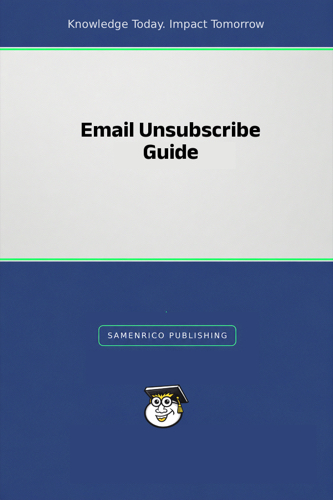
Non-FictionBusiness BriefDigital Cleanup
Email Unsubscribe Guide eBook
Eliminate newsletter and promotional clutter perma
Eliminate newsletter and promotional clutter permanently.
Formats
Free sample
Chapter 1: The Attention Heist--–- Every morning, before you have brushed your teeth, before you have had your first sip of coffee, before you have even fully woken up, you are already being robbed.The thief does not wear a mask. It does not carry a weapon. It does not break a window or pick a lock. It sends you an email. Then another.
Then fifty more. By the time you sit down at your desk, the heist is well underway. And the most disturbing part? You invited the thief in. You gave it your email address.
You clicked "Subscribe." And now, every single day, it takes from you the one thing you can never get back: your attention.This chapter is not about email management. It is not about folder structures or productivity hacks. This chapter is about understanding the heist, recognizing the players, and finally seeing the invisible transaction that has been happening under your nose for years. Because you cannot win a game you do not understand. And right now, you are losing.The Free Product Paradox Let us start with a simple question: Why is email free?Your Gmail account costs you nothing.
Your Outlook account costs you nothing. Your i Cloud email costs you nothing. For decades, you have signed up for email addresses without reaching for your wallet. This feels normal. It feels generous.
It feels like the natural order of the internet.It is none of those things.Email is not free. You are paying for it every single day with something far more valuable than money: your attention. And attention, as economists and neuroscientists now agree, is the single most valuable resource of the twenty-first century.Consider this. In 1971, when Ray Tomlinson sent the first email, the average person received fewer than five messages per day. By 2000, that number had climbed to fifty.
By 2024, the average office worker receives 120 to 150 emails daily. That is not a typo. One hundred and fifty emails. Every single day. For forty years of working life, that is more than two million emails.Each of those emails is a tiny request.
A tiny tug at your attention. A tiny demand that you read, consider, and decide. And here is the dark secret that email providers and marketers do not want you to understand: they have built an entire economic system on the back of those tiny tugs.Here is how it works. You sign up for a "free" newsletter about productivity, cooking, investing, or parenting. The newsletter operator pays nothing to send you that email.
Their email service provider—Mailchimp, Convert Kit, Substack, or any of a hundred others—charges them a small fee based on the number of subscribers. But the real value is not in the email itself. The real value is in your open. The real value is in your click. The real value is in the three seconds of your attention that you donate every time you glance at a subject line.Those three seconds are then aggregated, analyzed, packaged, and sold.
Advertisers pay premium rates for access to audiences that open emails. Sponsors pay more for newsletters with high engagement. Data brokers purchase information about which subject lines made you click. Your attention, fragmented into milliseconds, becomes a commodity traded on markets you cannot see.And the email providers? Google, Microsoft, Apple?
They are not charities. They are not public utilities. They are advertising companies that happen to offer email as a loss leader to keep you inside their ecosystems. Gmail has 1.8 billion active users. Each of those users represents a stream of attention data that Google monetizes through ads, through search behavior, through the simple fact that you are logged in while you read.
You are not the customer. You are the product. You have always been the product. And every promotional email in your inbox is a tiny extraction machine, mining your attention one open at a time.The Hidden Transaction Let us make this explicit. Every time you receive a promotional email, a transaction occurs.
You may not have agreed to it consciously. You may not have signed a contract. But the transaction happens nonetheless.On one side of the transaction, a company gives you something of very low value: a discount code you will probably forget, an article you will probably skim, an update you will probably ignore. On the other side of the transaction, you give them something of very high value: a slice of your attention, a data point about your behavior, a confirmation that your email address is active and monitored.This is not a fair trade.Think about the last promotional email you actually opened. Not the one from your bank or your child's school—those are transactional.
Think about the newsletter you subscribed to six months ago, the one from that clothing brand, the one from that podcast host, the one from that software company. When was the last time that email delivered value equal to the attention it demanded? When was the last time you thought, "I am genuinely glad I spent those seven seconds reading this"?Now think about the last time you felt overwhelmed by your inbox. The last time you opened your phone, saw 847 unread messages, and felt a wave of exhaustion before you had even read one. The last time you spent forty-five minutes deleting, archiving, and marking as read, only to realize that tomorrow there would be another hundred waiting for you.That exhaustion is not a personal failing.
It is the natural result of an economic system designed to extract as much of your attention as possible, for as little cost to the extractor as possible. You are not bad at email. Email is bad at you. It is designed to be bad at you.Dark Patterns Decoded Now that you understand the transaction, let us examine the tactics. The companies that fill your inbox are not clumsy.
They are not amateur. They employ teams of behavioral psychologists, user experience designers, and data scientists whose sole job is to keep you subscribed. Their techniques have names. They are called dark patterns, and they are everywhere.The Grey Text Gambit Scroll to the bottom of almost any promotional email. Look for the unsubscribe link.
What color is it? If you answered "grey," you are correct. Grey text on a white background is difficult to see. Grey text on a light grey background is almost invisible. This is not an accident.
The designers chose that color because they want you to give up looking. They want you to think, "It is probably somewhere," and then close the email without unsubscribing. You have just been manipulated.The Login Loop Some companies take this further. You click the unsubscribe link, expecting a one-click confirmation. Instead, you are taken to a web page that requires you to log in to your account.
You cannot remember your password. You click "Forgot Password." They send you a reset link. You reset your password. You log in. You navigate through three menus.
Finally, you find the unsubscribe button. By the time you get there, you have spent five minutes on a task that should…
This is the end of the free sample. Get the eBook to keep going. Buy now
About this book
Details
- Author
- Corley Delsie
- Publisher
- SamEnrico
- Language
- English
- Genre
- Non-Fiction, Business Brief, Digital Cleanup
- Released
- 2026-06-10
- Pages (approx.)
- 152
- Available as
- eBook, Audiobook

Read better in the ZLOADR app
Your eBooks on your phone or tablet. Sign in with your SamEnrico account and start reading.
More by Corley Delsie
 Remote Work Time Boxing TechniqueCorley Delsie$11.99
 Plant Based PCOS Management HandbookCorley Delsie$11.99
 The IT Band Relief StretchCorley Delsie$11.99
 Rutherford Hayes Stolen ElectionCorley Delsie$11.99
 Silent Echoes: The Unseen War of Radio PropagandaCorley Delsie$11.99
 The Frozen Promise: Love and Loss in the Race for the South PoleCorley Delsie$11.99
 Understanding Cushing's SymphalangismCorley Delsie$17.99
 Tax Deduction IP FeesCorley Delsie$12.99
 Multilingual Sales ScriptsCorley Delsie$12.99
 Aerobatic FlightCorley Delsie$11.99
You may also like
 Hong Kong Handover 1997Dunn Johnnie$11.99
 Zumba For Postnatal Recovery CourseNeal Christian$11.99
 Zumba for BeginnersLadner Nikia$11.99
 YouTube Comment Mining GuideHumes Pandora$12.99
 Worry Box MeditationCarlin Rudy$11.99
 Workplace Stress MeditationNguyen Lynn$11.99
 Workplace Stress and Sleep RepairHawley Ivory$11.99
 Workplace Perfectionism CureDelaney Jeffry$11.99
 Workplace Injustice Anger GuideWallen Isabelle$11.99
 Work Addiction and Burnout LinkGreenwood Ester$11.99
 Women in Yoga and WellnessBeattie Galina$11.99
 Women in Stand Up ComedyChun Evangeline$11.99