
Non-FictionBusiness BriefEmailSnooze
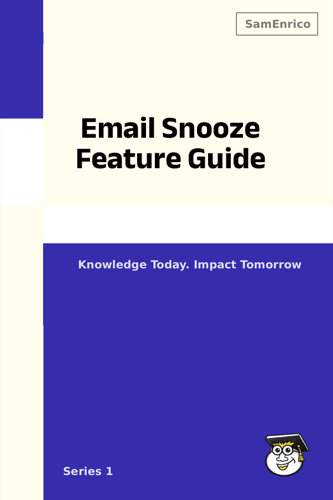
Email Snooze Feature Guide eBook
Delay emails to reappear when you have time to add
Delay emails to reappear when you have time to address them.
Formats
Free sample
Chapter 1: The Email Trap--You are reading this book for one of three reasons. Either you have 47,000 unread emails staring back at you like a judgmental audience, or you have zero unread emails but a gnawing anxiety that you have forgotten something important, or you have given up entirely and simply ignore your inbox until someone calls you on the phone. All three conditions are symptoms of the same disease: a broken relationship with email that no amount of willpower, late nights, or expensive productivity courses has been able to fix.The average knowledge worker spends 28 percent of their workweek on email. That is nearly eleven hours every week, or 550 hours per year, or the equivalent of fourteen full forty-hour workweeks. You spend more time managing email than most people spend on vacation.
And what do you have to show for it? A perpetually overflowing inbox, a smartphone that buzzes with false urgency every few minutes, and a quiet, unshakable belief that you are somehow failing at a task that should be simple.Here is the truth that no productivity guru has been willing to say out loud: email is not broken. You are not broken. The way we have been taught to manage email is broken.For the past two decades, the dominant philosophy of email management has been a seductive but ultimately destructive idea called Inbox Zero. Popularized by productivity expert Merlin Mann in the mid-2000s, Inbox Zero promised a simple, elegant solution to email overwhelm: process every message until your inbox contains zero emails.
The promise was clarity, control, and peace of mind. The reality has been something else entirely.The Inbox Zero Lie Let me ask you a question. When was the last time you achieved Inbox Zero? If you are like most people, you can probably remember the exact date because it felt like a minor miracle. You stayed late on a Friday, archived or deleted everything in sight, and took a deep breath.
Then Monday morning arrived, and within two hours, your inbox was back to its previous chaotic state. The feeling of accomplishment evaporated, replaced by the familiar weight of digital obligation.This is not a failure of your discipline. This is a failure of the philosophy itself. Inbox Zero treats the inbox as a problem to be solved, when in reality, the inbox is a river to be managed. You cannot empty a river.
You can only learn to swim in it.The fundamental flaw of Inbox Zero is that it conflates two separate goals: processing email and responding to email. When you achieve Inbox Zero by archiving or deleting everything, you have processed your email, but you have not actually done anything. The emails that required action are now hidden in an archive folder, out of sight but not out of mind. You have not reduced your obligations. You have simply hidden them from view.This creates a psychological trap that researchers at the University of California, Irvine have documented extensively.
When you archive an email that requires action, your brain does not forget about it. Instead, the task becomes an "open loop"—a incomplete commitment that your brain continues to monitor in the background, consuming cognitive resources even when you are not consciously thinking about it. Open loops are exhausting. They are the reason you can clear your inbox at 5:00 PM and still feel tired and anxious on your drive home. Your brain knows you have unfinished business, even if you have hidden the evidence.The Perpetual Presence Problem There is a deeper problem with the way we approach email, one that predates Inbox Zero and will outlast it.
We have begun treating email like instant messaging.Think about the last time you sent a message on Slack, Teams, or Whats App. You expected a response within minutes, maybe hours. Now think about the last time you sent an email. Did you expect a response any less quickly? Probably not.
The lines have blurred. We now treat every communication channel as demanding immediate attention, and email—once the refuge of asynchronous, thoughtful correspondence—has become just another source of interruption.This is what I call the Perpetual Presence Problem. We have internalized the expectation that we must always be available, always responsive, always "on." The notification badge on your email app has become a moral obligation. When you see it, you feel a pang of guilt, a sense that you are neglecting your duties by not clicking it immediately.This expectation is neither natural nor sustainable. Before email, correspondence traveled at the speed of paper mail.
A letter might take days to arrive and weeks to receive a response. No one expected instant answers. No one felt guilty for not checking the mail every hour. But somewhere along the way, the existence of the technology created the expectation of its constant use.The cost of this perpetual presence is staggering. A study by Gloria Mark at the University of California, Irvine found that the average knowledge worker checks email seventy-seven times per day.
Seventy-seven times. That is once every six and a half minutes, assuming an eight-hour workday. And each time you check, you are not simply glancing at your inbox. You are interrupting whatever you were doing, shifting your attention away from deep work, and forcing your brain to rebuild focus from scratch.The Context Switch Tax Here is where the math becomes devastating. Psychologists have known for decades that the human brain is not designed for multitasking.
What we call multitasking is actually rapid task-switching, and each switch carries a cost. When you stop writing a report to check an email, your brain must disengage from the report, shift attention to the email, process the email, decide what to do about it, and then shift attention back to the report. That transition costs an average of twenty-three minutes and fifteen seconds of productive time.Let me repeat that number because it is essential to everything in this book. Twenty-three minutes and fifteen seconds. That is not the time you spend reading the email.
That is the additional time your brain needs to fully re-engage with the original task after the interruption.Now multiply that by seventy-seven email checks per day. Even if only half of those checks lead to a full context switch, you are losing nearly fifteen hours of productive time every single week. Fifteen hours. That is nearly two full workdays. You are losing two days of work every week simply because you cannot stop checking your email.And here is the cruelest part of the Context Switch Tax: you feel it, but you cannot see it.
The fifteen lost hours do not appear on any timesheet or report. They are invisible, scattered in two-minute increments across your day. You finish the day feeling exhausted, having accomplished less than you hoped, with no clear understanding of where the time went. The email is the thief, and you have invited it into your home.The Email Cliff Metaphor I want you to imagine something. Imagine you are standing at the edge of a cliff.
Below you is a pile of every email you have ever received that requires some action from you. Some of…
This is the end of the free sample. Get the eBook to keep going. Buy now
About this book
Details
- Author
- Dillman Agustina
- Publisher
- SamEnrico
- Language
- English
- Genre
- Non-Fiction, Business Brief, Email, Snooze
- Released
- 2026-06-10
- Pages (approx.)
- 128
- Available as
- eBook, Audiobook

Read better in the ZLOADR app
Your eBooks on your phone or tablet. Sign in with your SamEnrico account and start reading.
More by Dillman Agustina
 Sex Drive Revival After MenopauseDillman Agustina$11.99
 Anxiety Career Break GuideDillman Agustina$11.99
 Teen Gap Year Self EsteemDillman Agustina$11.99
 The Joyful Morning RoutineDillman Agustina$11.99
 The Lion and the Rose: The Golden Age of BurgundyDillman Agustina$11.99
 Convert LLC to C CorpDillman Agustina$12.99
 Freelance Bookkeeping for AgenciesDillman Agustina$12.99
 Understanding Yersinia Pseudotuberculosis InfectionDillman Agustina$17.99
 The Pandemic DiariesDillman Agustina$11.99
 Ultimate Handbook Guide to Brazzaville : (Republic of the Congo) Travel GuideDillman Agustina$11.99
You may also like
 Hong Kong Handover 1997Dunn Johnnie$11.99
 Zumba For Postnatal Recovery CourseNeal Christian$11.99
 Zumba for BeginnersLadner Nikia$11.99
 YouTube Comment Mining GuideHumes Pandora$12.99
 Worry Box MeditationCarlin Rudy$11.99
 Workplace Stress MeditationNguyen Lynn$11.99
 Workplace Stress and Sleep RepairHawley Ivory$11.99
 Workplace Perfectionism CureDelaney Jeffry$11.99
 Workplace Injustice Anger GuideWallen Isabelle$11.99
 Work Addiction and Burnout LinkGreenwood Ester$11.99
 Women in Yoga and WellnessBeattie Galina$11.99
 Women in Stand Up ComedyChun Evangeline$11.99