
Non-FictionSelf-HelpDigital Wellness
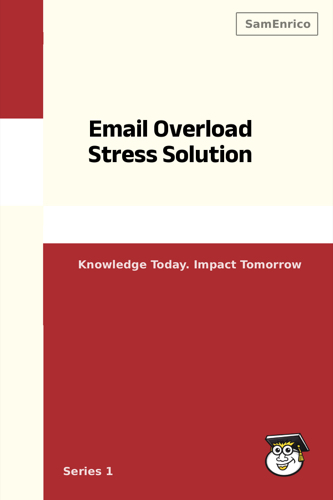
Email Overload Stress Solution eBook
Provides inbox management systems and boundaries t
Provides inbox management systems and boundaries to reduce digital communication anxiety.
Formats
Free sample
Chapter 1: The Guilt Machine--You are not lazy. You are not disorganized. You are not bad at your job.If you feel a small knot in your stomach every time you open your email, if the little red badge on your phone feels like an accusation, if you have ever lied and said “I didn’t see your message” when you actually did see it but couldn’t face it—this chapter is for you.The problem is not you. The problem is the machine.For the past twenty years, we have been sold a story. The story says that email is a productivity tool, that a responsive person is a good person, and that the only way to stay on top of your work is to check your inbox constantly and reply quickly.
This story is a lie. It is a lie designed by the architects of attention extraction, reinforced by workplace culture, and internalized by millions of people who now believe that their worth as professionals is measured by how quickly they clear the red badge.This chapter dismantles that story. We will look under the hood of your inbox and discover that it is not a to-do list at all. It is a guilt machine. And guilt is not a productivity system.The Dopamine Loop That Owns You Let us begin with the biology of your bad habit.Every time you hear a ding, feel a buzz, or see that little red number appear on your email icon, your brain releases a small amount of dopamine.
Dopamine is often called the “pleasure chemical,” but that is not quite right. Dopamine is the anticipation chemical. It is released not when you receive a reward, but when you are about to receive one. The ding is a promise. The red badge is a lottery ticket.
Maybe this email is important. Maybe it is praise from your boss. Maybe it is the answer you have been waiting for.Your brain cannot tell the difference between a genuinely important message and a marketing newsletter. It just knows that a notification has arrived, and that means a potential reward is coming. So it gives you a hit of dopamine to motivate you to check.Here is the cruel trick: most of the time, the email is not important.
It is a shipping confirmation. It is someone CCing you on a thread you did not need to see. It is a colleague asking a question they could have answered themselves. So you feel a small drop in mood—disappointment, irritation, or just the flat feeling of “that was a waste of time.” But because the next ding might be important, you keep checking.This is called a variable reward schedule. It is the same mechanism that makes slot machines addictive.
You do not know when the big win is coming, so you keep pulling the lever. You do not know when the important email is coming, so you keep checking your inbox. The average knowledge worker now checks email seventy-seven times per day. Seventy-seven times. That is once every six and a half minutes of a typical workday.Let that number sit with you for a moment.Seventy-seven times per day, you interrupt whatever you are doing—thinking, writing, solving, creating—to see if someone has sent you something.
Seventy-seven times per day, you allow an external, unpredictable, mostly irrelevant signal to hijack your attention. And then you wonder why you feel exhausted at 3 PM.The dopamine loop explains the compulsion. It does not explain the anxiety. For that, we need to look at a different kind of science.Attention Residue and the Myth of Multitasking You probably believe that you can multitask. You cannot.What you call multitasking is actually something much more expensive: task-switching.
When you stop writing a report to glance at an email, you are not doing two things at once. You are doing one thing, then another thing, then back to the first thing. Each switch costs you time, accuracy, and mental energy.But the real cost is not the seconds it takes to move your cursor from one window to another. The real cost is something called attention residue.Dr. Sophie Leroy, a professor at the University of Washington, discovered this phenomenon in a series of experiments.
She asked participants to work on a complex task, then interrupted them with a second task, then asked them to return to the first task. What she found was striking: even after people switched back to the original task, a portion of their attention remained stuck on the second task. Their brains were still processing what they had just seen, still wondering if they needed to act on it, still holding onto the unfinished business.Leroy called this “attention residue.” And it is devastating for cognitive performance.When you have attention residue, your working memory is partially occupied. You have less capacity for complex reasoning, less ability to hold multiple variables in your mind, less patience for difficult problems. The effect is measurable: glancing at an email while working on a cognitively demanding task lowers your effective IQ by up to ten points.Ten points.
That is the difference between being in the top third of cognitive performers and being average. That is the difference between seeing a solution quickly and struggling for twenty minutes. That is the difference between a good day and a day where you feel foggy and slow.And here is the real kicker: you do not even have to open the email to suffer attention residue. Studies using eye-tracking technology have shown that simply seeing a notification pop up—without clicking it, without reading the message, without doing anything about it—is enough to fragment your attention. Your brain sees the notification, registers it as an open loop, and allocates a sliver of cognitive resources to monitoring that loop.
You are now slightly dumber than you were five seconds ago, and you have not even done anything.This is why the common advice to “just check email quickly between tasks” is not just unhelpful. It is actively harmful. A “quick check” is not quick. It leaves a wake of attention residue that poisons your next hour of work.Time Confetti: How Your Day Gets Shredded Let us put these two mechanisms together—dopamine-driven checking and attention residue—and look at what they do to your day.The average person does not check email seventy-seven times by sitting down and opening their inbox for ten minutes seventy-seven times. That would be absurd.
Instead, they check in tiny increments. They glance at their phone while waiting for coffee. They peek at their inbox while a document loads. They open an email, read two lines, get interrupted by a thought about something else, and close it without responding. They check again five minutes later, then again, then again.These tiny fragments of attention are not free.
Each one costs you a few seconds of switching time and a few minutes of attention residue. But the cumulative cost is enormous.I call this “time confetti.”Imagine taking your day—eight hours, four hundred eighty minutes—and shredding it into tiny pieces. A two-minute piece…
This is the end of the free sample. Get the eBook to keep going. Buy now
About this book
Details
- Author
- Barney Marietta
- Publisher
- SamEnrico
- Language
- English
- Genre
- Non-Fiction, Self-Help, Digital Wellness
- Released
- 2026-06-09
- Pages (approx.)
- 141
- Available as
- eBook, Audiobook

Read better in the ZLOADR app
Your eBooks on your phone or tablet. Sign in with your SamEnrico account and start reading.
More by Barney Marietta
 Senior Ageism Rejection GuideBarney Marietta$11.99
 Loneliness for Foster YouthBarney Marietta$11.99
 Academic Stress and Motivation LossBarney Marietta$11.99
 The Letters of the Lonely: Victorian Love Scams and the Birth of the Con ArtistBarney Marietta$11.99
 How to Produce Back and Lumbar Support CushionsBarney Marietta$11.99
 Lagos Market Pop Up GuideBarney Marietta$12.99
 Vendor ManagerBarney Marietta$11.99
 How to Start a Belting Made of Plastic Business (Beginners Guide)Barney Marietta$11.99
You may also like
 Hong Kong Handover 1997Dunn Johnnie$11.99
 Zumba For Postnatal Recovery CourseNeal Christian$11.99
 Zumba for BeginnersLadner Nikia$11.99
 YouTube Comment Mining GuideHumes Pandora$12.99
 Worry Box MeditationCarlin Rudy$11.99
 Workplace Stress MeditationNguyen Lynn$11.99
 Workplace Stress and Sleep RepairHawley Ivory$11.99
 Workplace Perfectionism CureDelaney Jeffry$11.99
 Workplace Injustice Anger GuideWallen Isabelle$11.99
 Work Addiction and Burnout LinkGreenwood Ester$11.99
 Women in Yoga and WellnessBeattie Galina$11.99
 Women in Stand Up ComedyChun Evangeline$11.99