
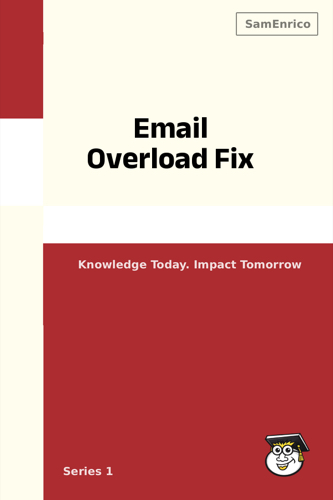
Email Overload Fix eBook
Process inbox efficiently and reduce communication
Process inbox efficiently and reduce communication stress.
Formats
Free sample
Chapter 1: The $600 Billion Habit--–- The average professional will spend the equivalent of five full years of their life managing email. This is not an exaggeration or a motivational meme designed to shock you into buying a productivity course. This is a conservative calculation based on data from the Radicati Group, which estimates that the typical office worker receives and sends over 120 emails per day and spends nearly 28 percent of their workweek inside the inbox. If you retire at sixty-five after starting your career at twenty-two, that forty-three-year stretch contains roughly 5,600 waking work hours per year. Twenty-eight percent of that is 1,568 hours annually.
Multiply by forty-three years, and you arrive at approximately 67,400 hours. Divide by 2,080 (a standard work year), and you get 32.4 full years. The math is staggering, and it is also wrong in the most important direction—it underestimates the true cost, because it fails to account for the cognitive destruction caused by every single interruption.The email industry, if such a thing can be called an industry, has convinced us that this is normal. Billions of dollars are spent each year on "productivity tools" that promise to tame the inbox, while the inbox itself is designed by the world's most sophisticated engineering teams to keep you coming back. The notification badge on your phone was not an accident.
The "unread count" displayed in bold red typeface was tested in thousands of user sessions to maximize the anxiety response. The default setting that checks for new mail every fifteen minutes was chosen because it creates a perfect variable reward schedule—frequent enough to form a habit, unpredictable enough to prevent extinction.This book is not another collection of email tips. It is a systematic deconstruction of the single most destructive force in modern knowledge work, followed by a twelve-step reconstruction of your relationship with digital communication. By the time you finish this chapter, you will understand why every email you have ever sent or received has cost you more than you thought. By the time you finish this book, you will have reduced that cost by at least seventy percent, recovered hours of deep focus each week, and eliminated the low-grade anxiety that has become the ambient soundtrack of professional life.The Invisible Tax Let us begin with a simple experiment you can conduct right now, without leaving your chair.
Open your email application. Look at the total number of messages in your inbox. Not the unread count—the total. Many professionals have inboxes containing tens of thousands of messages. Some have crossed into six figures.
Now ask yourself a question: when did you last search for an email older than thirty days and actually find it in less than fifteen seconds? For most people, the answer is never, or nearly never. Yet those emails are kept, indexed, stored, and backed up. They consume server space, energy, and your psychological bandwidth in ways you do not consciously perceive.This is the invisible tax. The average professional's inbox has become a landfill masquerading as an archive.
Every message that remains in your inbox past the moment you have either acted on it or decided it requires no action becomes what the psychologist Sophie Leroy calls "attention residue." In her landmark 2009 study published in the Journal of Applied Psychology, Leroy demonstrated that when people switch from one task to another, a portion of their attention remains stuck on the first task. This residue is not merely distracting—it measurably reduces performance on the second task by an average of 20 to 30 percent. And here is the nightmare: you do not need to actually switch tasks to create attention residue. You only need to glance at an email and decide not to open it.Consider what that means for your typical morning. You arrive at your desk at 8:45 AM with a clear intention: finish the quarterly report by 11 AM.
At 8:47, a notification appears. You glance at the subject line. It is from a colleague asking about a meeting time. You decide to answer later. At 8:52, another notification.
This one is a newsletter you subscribed to three years ago. You delete it. At 8:58, a third notification—your boss, asking for a quick update on a different project. You open it, read it, and decide you need fifteen minutes to prepare the response. You leave it marked unread.
At 9:05, you finally start the quarterly report. According to Leroy's research, you have already lost between 20 and 30 percent of your cognitive capacity before typing a single word of the report. You have not answered a single email. You have not completed a single task. But you have paid the invisible tax.The Myth of the Quick Check The most dangerous phrase in the English language, at least as it pertains to email, is "I'll just quickly check." This phrase appears harmless, even responsible.
It suggests efficiency, responsiveness, good citizenship. It is none of those things. "Quickly checking" email is the cognitive equivalent of checking your tire pressure while driving on the highway. It is not a small interruption—it is a catastrophic one.Let us examine the data. A study conducted by Gloria Mark at the University of California, Irvine, tracked knowledge workers in their natural environments and found that the average employee checks email 77 times per day.
That is roughly once every six and a half minutes. But the more alarming finding was the recovery time: after an email interruption, it takes an average of 23 minutes and 15 seconds to return to the original task at full cognitive capacity. Not to switch to a new task. To return to the task you were performing before the interruption. Those twenty-three minutes are not spent staring into space.
They are spent in a limbo state—half on the original task, half on the email you just saw, and the remainder scattered across whatever other mental detritus has been stirred up by the context switch.Now do the multiplication. Seventy-seven interruptions per day times twenty-three minutes of recovery time equals 1,771 minutes, or 29.5 hours per week. That is more than three full workdays. By this measure, the average knowledge worker is losing three days per week to email interruption recovery. These numbers are so absurd that they must be wrong, and indeed they are—they assume every interruption is an email interruption and every interruption requires a full recovery cycle.
Mark's study found that about 40 percent of interruptions are self-initiated (you check email on your own), and many recovery periods are shorter than the maximum. The corrected figure is still devastating: approximately 10 to 12 hours per week lost to email interruption recovery. One and a half full workdays, every single week, disappearing into the gap between inbox and attention.But the damage does not stop at lost time. There is a second-order effect that is even more troubling. When you work in a state of constant interruption, your brain adapts.
It begins to prefer interruption. The dopamine released during a notification—the same chemical that makes slot machines addictive—trains your neural pathways to seek out the next ping. Over time, you become literally addicted to the interruption. Your brain will generate anxiety when there is no interruption because the baseline dopamine level drops.…
This is the end of the free sample. Get the eBook to keep going. Buy now
About this book
Details
- Author
- Breedlove Denyse
- Publisher
- SamEnrico
- Language
- English
- Genre
- Non-Fiction, Self-Help, Communication
- Released
- 2026-06-06
- Pages (approx.)
- 140
- Available as
- eBook, Audiobook

Read better in the ZLOADR app
Your eBooks on your phone or tablet. Sign in with your SamEnrico account and start reading.
More by Breedlove Denyse
 Values And Mission Alignment Customer Experience HandbookBreedlove Denyse$11.99
 The SAD Cognitive Behavioral GuideBreedlove Denyse$11.99
 Mediterranean Brain HealthBreedlove Denyse$11.99
 TM for Mathematicians GuideBreedlove Denyse$11.99
 The Algorithm Whisperer: How a Forgotten Genius Cracked the Code of Human BehaviorBreedlove Denyse$11.99
 Exit Driven Business PlanBreedlove Denyse$12.99
 Remote SWOT Analysis GuideBreedlove Denyse$12.99
 Understanding Tricho Onychic DysplasiaBreedlove Denyse$17.99
 Asset Management ConsultantBreedlove Denyse$11.99
 How to Become a Pleat PatternmakerBreedlove Denyse$11.99
You may also like
 NVC Four Step FrameworkRountree Jude$11.99
 I Statements Practice GuideChan Erlene$11.99
 The Small Talk TransformationBittner Bart$11.99
 The Assertive Communication GuideSumpter Chantal$11.99
 Stress Induced Nagging CycleNix Lavada$11.99
 Social Intelligence WorkbookCochrane Cythia$11.99
 Mindful Listening CommunicationCleary Dian$11.99
 Improv Yes And HandbookRees Cheyenne$11.99
 Honking Anger Reduction GuideGurley Irmgard$11.99
 Difficult Conversation ResetRenner Jonah$11.99
 Breaking Yelling Cycles HandbookMclendon Latrice$11.99
 The Coworker Interruption ScriptWyman Nicolasa$11.99