
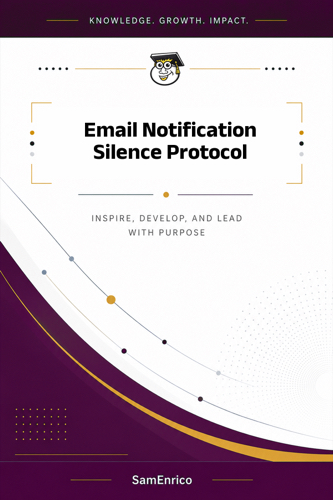
Non-FictionBusiness BriefFocus
Email Notification Silence Protocol eBook
Turn off all email notifications to reclaim focus
Turn off all email notifications to reclaim focus and check inbox on your schedule.
Formats
Free sample
Chapter 1: The 77-Hour Workweek...--–- It begins not with a bang, but with a ding.That single sound—brief, high-pitched, designed by committee to be just noticeable enough without being actively offensive—has reshaped the modern workplace more profoundly than any management theory, any productivity software, or any corporate restructuring. The ding is the heartbeat of the attention economy, and if you are reading this book, your heart has been marching to its rhythm for years. Perhaps you have noticed. Perhaps you have not. But your nervous system has.Consider your morning.
Not the idealized morning of your imagination—the one where you wake naturally, sip coffee while reading a physical newspaper, and arrive at work feeling centered and prepared. Consider your actual morning. The one where your eyes open and within sixty seconds—often within ten seconds—your hand has found your phone. The screen glows. The notifications are there, stacked like small, demanding children.
Email. Slack. Linked In. A news alert. Another email.
The badge icon on your mail app reads forty-seven, or seventy-one, or one hundred and twelve. And before you have sat up, before you have spoken a single word to the person beside you, you are already working. You are already responding. Not to anything urgent—most of its not urgent—but to the ding. The Pavlovian bell has rung, and you have salivated.This chapter dismantles the central delusion of the modern knowledge worker: that constant email checking equates to hard work.
It reveals the true cost of the ding, introduces the neurological mechanism that makes interruption so expensive, and makes a provocative claim that will serve as the foundation for everything that follows. That claim is simple, counterintuitive, and, once understood, impossible to unsee: Inbox Zero is a trap.The Quantitative Delusion: Why More Pings Feel Like More Productivity Let us begin with a number: seventy-seven.According to research conducted by the Radicati Group and cited extensively in productivity literature, the average knowledge worker checks email seventy-seven times per day. Some studies put the number higher; some put it slightly lower. But the consensus is clear: the typical professional glances at their inbox every twelve to fifteen minutes throughout the waking day. That is not an exaggeration.
That is the data.Now let us do the math. Seventy-seven checks per day, spread across a sixteen-hour waking day (eight hours of sleep leaves sixteen hours of potential checking), works out to approximately one check every twelve and a half minutes. But the distribution is not uniform. Checking clusters around transitions: waking up, starting work, returning from lunch, leaving the office, checking before bed. The rhythm of the ding has become the rhythm of your life.Here is the delusion.
When asked, most knowledge workers report feeling busy. They report feeling productive. They report feeling, in the words of one study participant, "like I am always working, even when I am not at work." The seventy-seven checks create a subjective experience of constant engagement. You are never not working. Your inbox is always with you, in your pocket, on your wrist, glowing from the corner of your desk.
The ding ensures that even when you are physically present elsewhere, your attention remains tethered to the office.But feeling busy is not the same as being productive. In fact, the two are often inversely related.The Switch Cost Effect: The Neurological Tax You Pay Every Time You Look Away The human brain is not designed for multitasking. Despite decades of self-help books promising to teach you how to multitask more effectively, the neuroscience is unambiguous: the brain does not perform two attention-demanding tasks simultaneously. What we call multitasking is actually rapid task-switching—the brain disengaging from one task, shifting context, engaging with a new task, then shifting back. And each shift carries a cost.This is called the Switch Cost Effect, and it is one of the most replicated findings in cognitive psychology.
Every time you shift your attention from one task to another, your brain pays a penalty. The penalty has two components: time (the minutes required to re-establish focus) and accuracy (the increased likelihood of errors during the transition).Let us quantify these costs.The time cost: According to research by Gloria Mark at the University of California, Irvine, the average knowledge worker requires approximately twenty-three minutes to fully regain deep focus after a single interruption. Twenty-three minutes. That is not a typo. When you glance at your phone to check a notification—even if you do not reply, even if you simply look—you have initiated a context switch.
Your brain begins to disengage from the deep work you were doing. By the time you look back at your screen, your mental context has partially dissolved. Rebuilding it takes time. Twenty-three minutes, on average.The accuracy cost: A separate line of research, most famously conducted by Glenn Wilson at the University of London, found that even the anticipation of an interruption can temporarily reduce functional IQ by up to ten points. Wilson's 2005 study placed participants in a room with a quietly buzzing phone.
They were told not to answer it. The mere presence of the phone—the knowledge that a notification might arrive at any moment—was sufficient to produce measurable cognitive impairment. Participants performed worse on reasoning tasks, memory tasks, and analytical problems. The effect was comparable to missing a full night of sleep or smoking cannabis.Ten IQ points. Twenty-three minutes.
These are not small numbers. They are catastrophic.Let us apply them to the seventy-seven-check day. If each interruption costs twenty-three minutes of recovery, and you experience seventy-seven interruptions per day, the total recovery cost is 1,771 minutes—over twenty-nine hours—per day. That is obviously impossible; you cannot recover more time than exists. The resolution is that not every check costs the full twenty-three minutes because many checks are clustered (you check email, then check again two minutes later, then again).
The recovery cost applies to the first interruption in a cluster, not each subsequent one. But even with clustering, the cost is staggering. Conservative estimates place the daily productivity loss from task-switching at two to three hours per knowledge worker. That is not a theory. That is a measured, replicated finding.The Inbox Zero Delusion: Why Empty Does Not Mean Free Now we arrive at the central provocation of this chapter.For years, productivity gurus have preached the gospel of Inbox Zero—the practice of processing your email inbox down to zero unread messages at regular intervals, typically once per day.
The promise is seductive: an empty inbox is a clear mind. Unread messages are unresolved obligations; archive them, delete them, respond to them, or defer them, but get them out of your inbox. The method has become so pervasive that many professionals feel genuine anxiety when they see a double-digit badge icon on their mail app.Inbox Zero is not wrong. But it is incomplete. And in its incompleteness, it is actively harmful.Here is the problem: Inbox Zero only addresses the visible queue.
It does not address the source of the queue. If you achieve Inbox Zero but your notifications are still enabled, you have simply…
This is the end of the free sample. Get the eBook to keep going. Buy now
About this book
Details
- Author
- Redden Emeline
- Publisher
- SamEnrico
- Language
- English
- Genre
- Non-Fiction, Business Brief, Focus
- Released
- 2026-06-06
- Pages (approx.)
- 125
- Available as
- eBook, Audiobook

Read better in the ZLOADR app
Your eBooks on your phone or tablet. Sign in with your SamEnrico account and start reading.
More by Redden Emeline
 Divorce and Reinvention After FiftyRedden Emeline$11.99
 Menopause Empowerment JournalRedden Emeline$11.99
 The Thought Leadership BrandRedden Emeline$11.99
 Weekly Wins and LossesRedden Emeline$11.99
 Rejection Resilience HypnosisRedden Emeline$11.99
 Color Coded Time BlockingRedden Emeline$11.99
 Love Letters from the Trenches: The Secret Romance of Vera Brittain and Roland LeightonRedden Emeline$11.99
 Titian: The Venetian Sun That Painted HeavenRedden Emeline$11.99
 Exploring Conte Crayon: Drawing & ToneRedden Emeline$11.99
 Chinese Supplier Design Ownership BlueprintRedden Emeline$12.99
 Exit Strategy SnapshotRedden Emeline$12.99
 How to Produce Disposable GlovesRedden Emeline$11.99
You may also like
 Hong Kong Handover 1997Dunn Johnnie$11.99
 Zumba For Postnatal Recovery CourseNeal Christian$11.99
 Zumba for BeginnersLadner Nikia$11.99
 YouTube Comment Mining GuideHumes Pandora$12.99
 Worry Box MeditationCarlin Rudy$11.99
 Workplace Stress MeditationNguyen Lynn$11.99
 Workplace Stress and Sleep RepairHawley Ivory$11.99
 Workplace Perfectionism CureDelaney Jeffry$11.99
 Workplace Injustice Anger GuideWallen Isabelle$11.99
 Work Addiction and Burnout LinkGreenwood Ester$11.99
 Women in Yoga and WellnessBeattie Galina$11.99
 Women in Stand Up ComedyChun Evangeline$11.99