
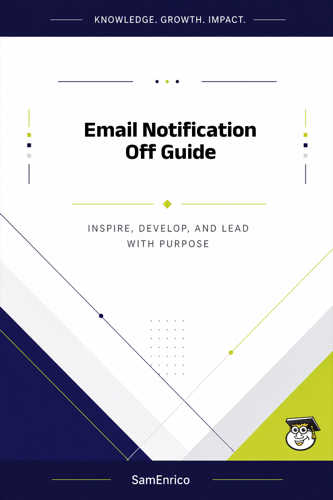
Non-FictionBusiness BriefEmailNotifications
Email Notification Off Guide eBook
Disable all pop ups and sounds to stop context swi
Disable all pop ups and sounds to stop context switching.
Formats
Free sample
Chapter 1: The Attention Heist--You are not lazy.Read that sentence again. Let it settle. For years, you have likely told yourself a different story—one where your inability to focus for more than eleven minutes (the current human average, down from twelve minutes in 2008 and twenty-one minutes in 1998) is a personal failing. You have called yourself undisciplined. Distractible.
Addicted to your phone. Maybe even weak-willed.All of that is wrong.The truth is far more uncomfortable, and also far more liberating. You are not fighting a battle against your own character. You are fighting a war against the most sophisticated, well-funded, psychologically engineered attention extraction system that has ever existed. And you are fighting it with a brain that evolved to notice rustling grass on the savanna, not to resist a trillion-dollar algorithm designed to hijack your dopamine receptors every four to twelve minutes.This chapter is called "The Attention Heist" because that is precisely what is happening.
Your attention is being stolen, packaged, and sold. And the primary tool of that theft—the mechanism that opens the door to your mind hundreds of times per day—is a tiny, seemingly harmless thing.The notification.The Ping That Changed the World In 2003, when the first Black Berry device introduced the "push email" feature, it was marketed as a productivity breakthrough. Finally, business professionals could receive their emails instantly, without having to press a "send/receive" button. The little red light that flashed when a new message arrived was called the "LED of hope" inside Research in Motion, the company that made Black Berry.By 2007, the first i Phone launched with no push notifications at all. Steve Jobs famously wanted the device to be "dumb" when sleeping—a blank slate that required intentional activation.
But by 2009, with the release of i OS 3.0, Apple capitulated. Push notifications arrived. And within eighteen months, every other smartphone manufacturer followed. The notification had gone from a productivity tool to an expectation to an addiction.Today, the average smartphone user receives between sixty-five and eighty notifications per day. That is not an estimate pulled from thin air.
A 2021 study published in the journal Computers in Human Behavior analyzed notification logs from over two hundred participants and found a mean of 63.4 notifications per day, with heavy users exceeding 140. A separate study by Asurion in 2022 found that the average American checks their phone 352 times per day—roughly once every three waking minutes.Pause and consider that number. Once every three minutes. Every three minutes of your waking life, you orient toward a screen.The Twenty-Minute Lie Here is where the story gets truly expensive.For decades, the productivity world has repeated a statistic: after a distraction, it takes an average of twenty minutes to return to the same depth of focus. That statistic comes from a 2004 study by Gloria Mark at the University of California, Irvine.
Dr. Mark and her team observed information workers in their natural environments and measured how long it took them to resume a task at the same level of cognitive engagement after an interruption.Twenty minutes.But here is what most people miss: that twenty minutes is not the only cost. During those twenty minutes, you are not working at zero capacity. You are working at reduced capacity. You are skimming, surface-reading, half-listening.
The quality of your work during the recovery period is significantly lower than before the interruption. When researchers calculated the total productivity loss from a single two-second interruption, they found that it could amount to twenty-five minutes of effective lost work time when you account for the degraded performance during the recovery window.A two-second notification costs twenty-five minutes.Now multiply that by your daily notification count. If you receive sixty notifications per day—below the average, remember—and each one costs twenty-five minutes of cumulative productivity loss, you are losing twenty-five hours per week. That is more than half of a standard full-time work week. You are not working forty hours.
You are effectively working fifteen, with twenty-five hours of fragmentation and recovery.This is not a rounding error. This is not a minor inefficiency. This is the single largest unaccounted tax on your time, your attention, and your life.The Anatomy of a Context Switch To understand why a notification is so destructive, you need to understand what happens inside your brain during a context switch.Your prefrontal cortex—the part of your brain just behind your forehead—is responsible for executive function. It is the CEO of your neural operations. It plans, prioritizes, inhibits impulses, and holds information in working memory.
And your working memory is shockingly small. The famous "seven plus or minus two" rule from cognitive psychology has been revised downward in recent years. Most researchers now believe that the average person can hold between two and four discrete pieces of information in active working memory at any given time.When you are deep in a task—say, writing a report, debugging code, analyzing a spreadsheet, or composing an email—your prefrontal cortex has assembled a temporary "neural assembly." This is a network of neurons firing in a specific pattern that represents the current state of your work. You know where you are, what you have already done, what you need to do next, and what resources you need to do it.Then your phone buzzes.At the moment of the buzz, your brain faces a choice. It can ignore the stimulus (rare) or orient toward it (common).
When it orients, the neural assembly for your task is not simply paused. It is actively suppressed. New neurons fire to process the notification. What is it? Who sent it?
Is it urgent? Do I need to respond? Should I remember to do something about it later?This process of suppression and reconfiguration is not instantaneous. It takes somewhere between one and five seconds, depending on the complexity of the interruption. But the real cost comes when you try to return to your original task.
Your brain must now reconstruct the neural assembly that was suppressed. This is not like hitting "play" on a video. It is like finding your place in a book after someone ripped out the page you were reading. You have to go backward, reestablish context, remember your next step, and rebuild momentum.Dr. Mark's research found that after an interruption, people take an average of twenty-three minutes and fifteen seconds to return to their original task.
But during that twenty-three minutes, they often switch to other tasks. They check email again. They glance at social media. They answer a chat message. The interruption breeds more interruptions.This is the cascade effect.
One notification does not cost you one interruption. It costs you a cascade of micro-distractions that can consume the better part of an hour.The Dopamine Hook Why do we keep checking our phones if the cost is so high? The answer lies in the brain's reward system.Dopamine is often described as the "pleasure chemical," but that is not quite accurate. Dopamine is the anticipation chemical. It is released not when you receive a reward, but when you expect to receive a reward.
The slot machine does not pay out every time, but the anticipation of the possible payout keeps you pulling the…
This is the end of the free sample. Get the eBook to keep going. Buy now
About this book
Details
- Author
- Karr Demetrius
- Publisher
- SamEnrico
- Language
- English
- Genre
- Non-Fiction, Business Brief, Email, Notifications
- Released
- 2026-06-10
- Pages (approx.)
- 135
- Available as
- eBook, Audiobook

Read better in the ZLOADR app
Your eBooks on your phone or tablet. Sign in with your SamEnrico account and start reading.
More by Karr Demetrius
 Blue Zone Alcohol Moderation PlanKarr Demetrius$11.99
 Teen Assertiveness Training GuideKarr Demetrius$11.99
 Social Media Bedtime BanKarr Demetrius$11.99
 The High Achiever Cold ShowerKarr Demetrius$11.99
 The Iron Compass: Vasco da Gama and the Birth of Global TradeKarr Demetrius$11.99
 Climate Crisis: The Hottest Year on RecordKarr Demetrius$11.99
 Understanding Worster-drought SyndromeKarr Demetrius$17.99
 Seasonal CAC StrategyKarr Demetrius$12.99
 UserTesting Platform GuideKarr Demetrius$12.99
 How to Start a Bars Made of Brass Business (Beginners Guide)Karr Demetrius$11.99
You may also like
 Hong Kong Handover 1997Dunn Johnnie$11.99
 Zumba For Postnatal Recovery CourseNeal Christian$11.99
 Zumba for BeginnersLadner Nikia$11.99
 YouTube Comment Mining GuideHumes Pandora$12.99
 Worry Box MeditationCarlin Rudy$11.99
 Workplace Stress MeditationNguyen Lynn$11.99
 Workplace Stress and Sleep RepairHawley Ivory$11.99
 Workplace Perfectionism CureDelaney Jeffry$11.99
 Workplace Injustice Anger GuideWallen Isabelle$11.99
 Work Addiction and Burnout LinkGreenwood Ester$11.99
 Women in Yoga and WellnessBeattie Galina$11.99
 Women in Stand Up ComedyChun Evangeline$11.99