
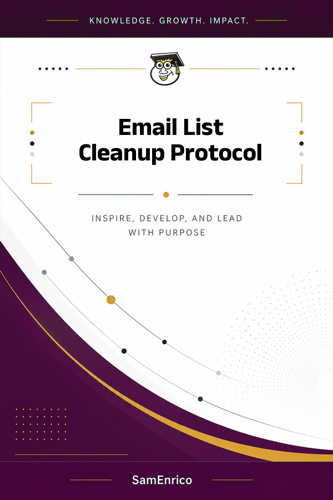
Non-FictionBusiness BriefList Hygiene
Email List Cleanup Protocol eBook
Remove unengaged subscribers quarterly to maintain
by Cohen Randal
Remove unengaged subscribers quarterly to maintain deliverability.
Formats
Free sample
Chapter 1: The Vanity Metric--–- The email arrived at 2:17 PM on a Tuesday. It was a routine promotional blast from a mid-sized e-commerce brand called Willow & Grace—organic skincare, pleasant aesthetic, nothing controversial. Within ninety minutes, something unusual happened. Their open rate, typically hovering around a respectable 22 percent, had plummeted to 3 percent. Their click-through rate was effectively zero.
And then the complaints started flooding in.Not complaints about the product. Complaints about the email itself. "Stop spamming me." "I never signed up for this." "Why am I receiving this garbage?" The brand's head of marketing, a thirty-four-year-old named Priya who had been with the company for three years, assumed it was a technical glitch. She contacted their email service provider, who ran diagnostics and found nothing wrong with the sending infrastructure. The emails had been delivered.
Every single one of them. The problem wasn't delivery. The problem was where they were delivered.Every single email from that campaign had landed in the spam folder.Priya was confused. Willow & Grace had a list of 187,000 subscribers. They had grown that list steadily over five years through website signups, trade show booths, and a popular free guide on combating dry skin.
By every conventional metric, they were successful. Their list size had increased 40 percent year over year. Their revenue from email marketing had grown from $340,000 annually to nearly $1.2 million. Priya had received a bonus just six months earlier for hitting their list growth targets. How could a list that was driving over a million dollars a year suddenly be treated like spam by Gmail, Yahoo, and Outlook?The answer, which Priya discovered over the next seventy-two hours of frantic research, was both simple and devastating.
Her list was full of dead weight. Of the 187,000 subscribers, only 31,000 had opened an email in the past ninety days. Another 52,000 hadn't opened anything in the past six months. The remaining 104,000 had either never opened a single email or had stopped engaging more than a year ago. Priya had been sending emails to over one hundred thousand people who had effectively already broken up with her brand.
And Gmail had noticed.This chapter is about why that happened, why it is happening to you, and why the way most marketers think about email lists is dangerously wrong.The Big Lie You Have Been Sold Let us name the lie explicitly. The lie is that a large email list is a valuable asset. Marketing gurus, agency pitch decks, and software companies have spent years promoting this idea. You see it everywhere: "Grow your list," "Build your audience," "The money is in the list." These statements are not technically false, but they are dangerously incomplete. The complete truth is this: an engaged email list is a valuable asset.
An unengaged email list is a liability that actively damages your business.The distinction matters more than most marketers realize because email providers have become extraordinarily sophisticated at detecting engagement or the lack thereof. In the early days of email marketing, around the late 1990s and early 2000s, inbox providers made decisions based almost entirely on technical signals. Did the email come from a properly configured server? Did it have valid SPF and DKIM records? Was the sending IP address on any blacklists?
If you passed those basic technical checks, your email was delivered to the inbox. Engagement barely mattered.Those days are over.Modern inbox providers—Gmail, Yahoo, Microsoft Outlook, and others—treat engagement as the primary signal of email quality. They track whether recipients open your emails, whether they click links, whether they delete your messages without reading, and most critically, whether they mark your emails as spam. They then aggregate these signals across your entire sending history to calculate a sender reputation score. That score determines, for every single email you send, whether it lands in the primary inbox, the promotions tab, the social tab, or the spam folder.Here is what most marketers do not understand.
When you send an email to a subscriber who has not opened any of your last ten emails, that subscriber is not merely ignoring you. They are actively hurting your sender reputation. Every email you send to an unengaged subscriber is a vote of no confidence in your sender score. Gmail interprets the lack of opens, the lack of clicks, and the absence of any positive signal as evidence that your content is unwanted. And Gmail applies that judgment not just to that specific recipient but to your entire sending domain.In other words, your dead subscribers are killing your deliverability for your live ones.The Anatomy of List Decay Every email list decays over time.
This is not a sign of failure; it is a natural feature of how human attention works. People change jobs, abandon personal email addresses, lose interest in topics, or simply become overwhelmed by the sheer volume of messages in their inboxes. The average email subscriber's attention half-life is somewhere between three and six months, meaning that roughly half of your engaged subscribers will become unengaged within that window if you do nothing to retain them.But here is what makes list decay dangerous. It is invisible in aggregate. When you look at your overall list size, you see a number that often continues to grow even as your engagement rate silently collapses.
New subscribers join at the top of the funnel while old subscribers go dormant at the bottom. The total number looks healthy—even impressive—while underneath the surface, your list is becoming a cemetery.Consider the mathematics of a typical email list. Imagine you add 1,000 new subscribers every month. Simultaneously, you lose engagement from 800 existing subscribers every month, though they remain on your list. After twelve months, your list has grown by 2,400 subscribers (12,000 new minus 9,600 dormant).
You celebrate the growth. But your engagement rate has fallen from a healthy 40 percent to just 16 percent. And your sender score is dropping with every email you send to those 9,600 dormant subscribers.This is the trap that Priya fell into at Willow & Grace. She had been measuring the wrong thing. Her dashboard showed list growth, revenue per email, and conversion rates.
What it did not show was the slow, steady accumulation of dead weight—over one hundred thousand subscribers who no longer wanted to hear from her brand but had never bothered to unsubscribe. They simply stopped opening. And each of those non-opens was a small but measurable vote against her sender reputation.The 180-Day Truth After her disastrous Tuesday campaign, Priya pulled a full engagement report. What she found was worse than she had imagined. Of the 187,000 subscribers on her list, only 31,000 had opened an email in the last ninety days.
Another 24,000 had opened something between ninety and one hundred eighty days ago. The remaining 132,000 had either never opened an email or had not opened one in over six months.That 132,000 figure represented over 70 percent of her list. She had been paying her email service provider for 187,000 subscribers, but only 31,000 were actually contributing to her business. Worse, the 132,000 dormant subscribers were actively damaging her deliverability. Every time she sent a campaign to her full list, Gmail saw hundreds of thousands of…
This is the end of the free sample. Get the eBook to keep going. Buy now
About this book
Details
- Author
- Cohen Randal
- Publisher
- SamEnrico
- Language
- English
- Genre
- Non-Fiction, Business Brief, List Hygiene
- Released
- 2026-06-08
- Pages (approx.)
- 152
- Available as
- eBook, Audiobook

Read better in the ZLOADR app
Your eBooks on your phone or tablet. Sign in with your SamEnrico account and start reading.
More by Cohen Randal
 Menopause And Adrenal FatigueCohen Randal$11.99
 Trust Repair After LyingCohen Randal$11.99
 Weekly Goals Review GuideCohen Randal$11.99
 Stress and Diarrhea GuideCohen Randal$11.99
 Emmanuelle Charpentier CRISPRCohen Randal$11.99
 Creative Confidence HypnosisCohen Randal$11.99
 Digital Minimalism For WorkCohen Randal$11.99
 Opium’s Shadow: The Forgotten Empire That Fueled the WorldCohen Randal$11.99
 The Bloodhound of Vienna: Tracking the Monster of the PraterCohen Randal$11.99
 How to Start a Hobby in CraftsCohen Randal$11.99
 Chinese Supplier Warranty Negotiation WorkbookCohen Randal$12.99
 Digital Payment Platform for Africans BlueprintCohen Randal$12.99
You may also like
 Hong Kong Handover 1997Dunn Johnnie$11.99
 Zumba For Postnatal Recovery CourseNeal Christian$11.99
 Zumba for BeginnersLadner Nikia$11.99
 YouTube Comment Mining GuideHumes Pandora$12.99
 Worry Box MeditationCarlin Rudy$11.99
 Workplace Stress MeditationNguyen Lynn$11.99
 Workplace Stress and Sleep RepairHawley Ivory$11.99
 Workplace Perfectionism CureDelaney Jeffry$11.99
 Workplace Injustice Anger GuideWallen Isabelle$11.99
 Work Addiction and Burnout LinkGreenwood Ester$11.99
 Women in Yoga and WellnessBeattie Galina$11.99
 Women in Stand Up ComedyChun Evangeline$11.99