

Non-FictionBusiness BriefCommunication
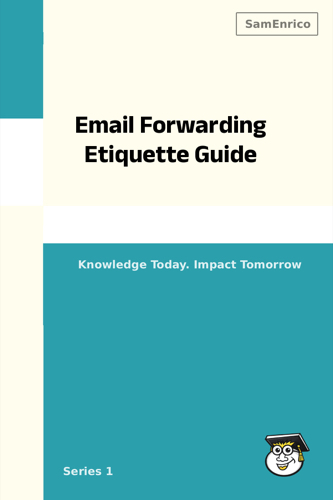
Email Forwarding Etiquette Guide eBook
Avoids forward chains by summarizing and adding co
Avoids forward chains by summarizing and adding context.
Formats
Free sample
Chapter 1: The Chain Letter Mentality--The email arrived at 4:47 PM on a Friday. The subject line read “Fwd: Fwd: Fwd: Important.” The body contained nothing but a ninety-seven-message thread, sixteen “Re: Re:” artifacts, four identical corporate signature blocks, and exactly one original sentence from the colleague who forwarded it: “FYI – thoughts?”For the recipient, that single forward triggered a twelve-minute journey through confusion, frustration, and ultimately resignation. She had to scroll past forty-three messages to find the original question. She had to infer which of the seventeen participants was actually relevant to her work. She had to guess whether “thoughts” meant “please approve,” “please advise,” or “please acknowledge receipt.” She spent twelve minutes doing work that the sender could have done in ninety seconds.By the time she replied with a tentative “What exactly do you need from me?” the sender had already left for the weekend.
The decision waited until Monday. The project was delayed by two days.This is not an outlier. This is Tuesday.The Hidden Cost of the Naked Forward Let us name the villain. A Naked Forward is any email that is sent to a new recipient without three essential components: a clear summary of what the thread contains, a statement of why this recipient is included, and an explicit action request. Naked Forwards are the digital equivalent of handing someone a box of unsorted puzzle pieces and walking away.The data on this problem is staggering.
Based on a synthesis of workplace communication studies from the past decade, the average knowledge worker spends 2.5 hours per week—125 hours per year—untangling forwarded email threads. That is more than three full work weeks. That is time not spent on strategy, creativity, relationship building, or deep work. That is time spent being a detective, a historian, a translator, and a project manager, all without a raise.But the raw time cost is only half the story. The other half is cognitive.
Every Naked Forward forces the recipient’s brain to perform what psychologists call task-switching penalty—the mental overhead of stopping one line of work, reorienting to a new problem, decoding incomplete information, and then attempting to return to the original task. Research suggests that a single interruption of this kind costs an average of twenty-three minutes of lost focus. Multiply that by five Naked Forwards per day, and you have erased more than half of a productive workday.The colleague who forwards a messy thread and writes “FYI” is not being malicious. In most cases, they believe they are being helpful. They believe they are keeping you informed.
They believe that “just looping you in” is an act of transparency. But intention does not equal impact. The impact is that they have transferred their own cognitive burden onto you.The Psychology of Mindless Forwarding Why do intelligent, well-meaning professionals forward emails without context? The answer lies not in laziness but in three psychological drivers that this chapter will dissect in detail.Driver One: Fear Fear is the silent engine of the Naked Forward. It sounds like this: “If I don’t forward this email, and something goes wrong, I will be held responsible for not sharing information.” This is CYA culture—Cover Your Assets—expressed in email form.
The fearful forwarder is not trying to help you. They are trying to protect themselves.Consider a mid-level manager who receives a complaint from a client. The complaint is vague, unactionable, and addressed to the wrong department. The manager could do the work of interpreting the complaint, routing it to the correct person, and summarizing what needs to happen. But that takes five minutes.
Or they could simply forward the raw complaint to three colleagues with the word “FYI” and be done in five seconds. If anything goes wrong, they can say, “I forwarded it immediately.”Fear-based forwarding is defensive communication disguised as collaboration. The forwarder’s primary goal is risk mitigation, not clarity. And because clarity is not the goal, the recipient suffers.Driver Two: Obligation Obligation sounds like this: “The email said ‘please forward to your team,’ so I will.” This is the mechanical forward. The sender has outsourced their thinking to a set of instructions, and the forwarder has outsourced their thinking to the same instructions.
Neither party is asking the essential question: Does this information actually need to move?Obligation-based forwarding is particularly common with internal newsletters, HR announcements, IT updates, and sales blasts. Someone, somewhere, created a distribution list and added a “please forward” note. And because the path of least resistance is to comply without question, the email spreads like a chain letter.The tragedy of obligation-based forwarding is that it is often performed by well-intentioned people who want to be helpful team players. They are not lazy. They are just not thinking.
And in the absence of thinking, the default behavior is to forward.Driver Three: Ambiguity Ambiguity sounds like this: “I’m not sure what this means, so I’ll pass the puzzle on.” This is the most interesting and most forgivable of the three drivers. The ambiguous forwarder has received a confusing email. They do not understand it. They are not sure what to do with it. So they send it to someone else, hoping that person will make sense of it.On the surface, this seems reasonable.
Perhaps the recipient has context that the forwarder lacks. Perhaps the recipient is the subject matter expert. But here is the problem: the ambiguous forwarder rarely includes a note explaining why they are confused or what kind of help they need. They simply dump the raw, unprocessed confusion into someone else’s inbox.Ambiguity-based forwarding is an act of learned helplessness. The forwarder has decided that understanding the email is not their responsibility.
They have outsourced the work of comprehension to another human being, often without that person’s consent.Cognitive Dumping vs. Cognitive Respect This book introduces two opposing concepts that will appear throughout every chapter. Understanding the difference between them is the single most important takeaway from this entire book.Cognitive Dumping is the act of sending raw, unprocessed information to another person’s brain without doing the mental work first. It is the Naked Forward. It is the fifty-email thread with no summary.
It is “FYI” and “Thoughts?” and “See below.” Cognitive dumping assumes that the recipient’s time is less valuable than the sender’s time. It is the default behavior of a mind that has not stopped to think.Cognitive Respect is the opposite. It is the act of processing information before sending it. It is summarizing. It is contextualizing.
It is stating the action required. Cognitive Respect assumes that the recipient’s time is equally valuable to the sender’s time. It is the behavior of a professional who understands that communication is not complete until the recipient understands.Here is a simple test to determine whether you are practicing Cognitive Dumping or Cognitive Respect. Before you forward an email, ask yourself: Am I adding value to this information, or am I just moving it? If you are adding value—summarizing, clarifying, highlighting, prioritizing—you are practicing Cognitive Respect.
If you are just moving information from your inbox to someone else’s, you are practicing Cognitive Dumping.The difference is not…
This is the end of the free sample. Get the eBook to keep going. Buy now
About this book
Details
- Author
- Sanderson Peggie
- Publisher
- SamEnrico
- Language
- English
- Genre
- Non-Fiction, Business Brief, Communication
- Released
- 2026-06-10
- Pages (approx.)
- 156
- Available as
- eBook, Audiobook

Read better in the ZLOADR app
Your eBooks on your phone or tablet. Sign in with your SamEnrico account and start reading.
More by Sanderson Peggie
 Pinterest VA Canva Design Crash CourseSanderson Peggie$11.99
 Remote Communication AssessmentSanderson Peggie$11.99
 Understanding Breast Biopsy ResultsSanderson Peggie$11.99
 Small Talk for Blind DatesSanderson Peggie$11.99
 The Last Letter: A Love Story Written in FireSanderson Peggie$11.99
 The Frozen Gambit: How a Mathematician Tamed Antarctica's ChaosSanderson Peggie$11.99
 Understanding Cockayne's SyndromeSanderson Peggie$17.99
 Ultimate Handbook Guide to Shizuoka : (Japan) Travel GuideSanderson Peggie$11.99
 Pula YC Application GuideSanderson Peggie$12.99
 Calendar Blocking TemplatesSanderson Peggie$12.99
You may also like
 Hong Kong Handover 1997Dunn Johnnie$11.99
 Zumba For Postnatal Recovery CourseNeal Christian$11.99
 Zumba for BeginnersLadner Nikia$11.99
 YouTube Comment Mining GuideHumes Pandora$12.99
 Worry Box MeditationCarlin Rudy$11.99
 Workplace Stress MeditationNguyen Lynn$11.99
 Workplace Stress and Sleep RepairHawley Ivory$11.99
 Workplace Perfectionism CureDelaney Jeffry$11.99
 Workplace Injustice Anger GuideWallen Isabelle$11.99
 Work Addiction and Burnout LinkGreenwood Ester$11.99
 Women in Yoga and WellnessBeattie Galina$11.99
 Women in Stand Up ComedyChun Evangeline$11.99