
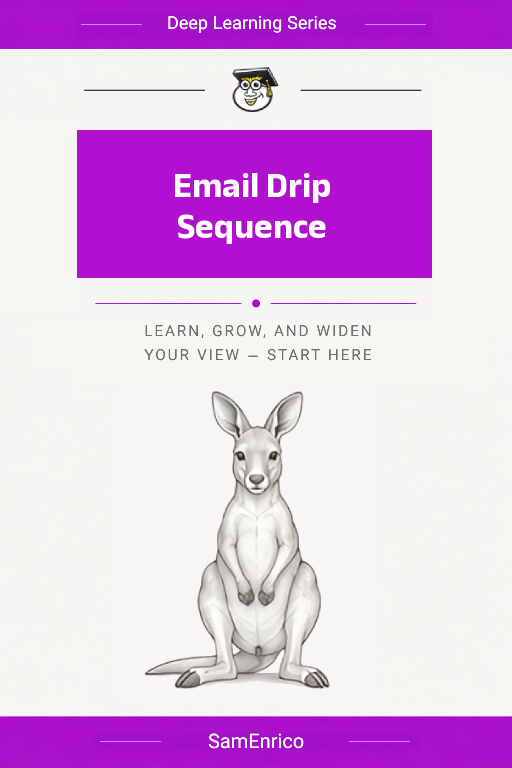
Non-FictionStartup GuideEmail AutomationDrip Campaign
Email Drip Sequence eBook
Send three emails: Week 2 value tip, Week 3 featur
by Farrow Venus
Send three emails: Week 2 value tip, Week 3 feature highlight, Week 4 upgrade offer.
Formats
Free sample
Chapter 1: The Attention Economy’s Graveyard--Every morning, before most people have finished their first cup of coffee, they delete over one hundred emails without reading them. Not because the emails are poorly written. Not because the offers are bad. But because the senders committed the same sin: they assumed that more communication meant more connection. They were wrong.The average office worker receives 121 emails per day.
The average marketing manager sends 47 emails per week as part of automated drip sequences alone. And the average conversion rate across all those sequences hovers below 3 percent. This is not a math problem about opens and clicks. This is a tragedy about attention—the single scarcest resource of the twenty-first century—and how marketers have become its most reckless spenders.I wrote this book because I spent five years making the same mistake. I built twelve-email sequences, fourteen-email sequences, and one horrifying seventeen-email monstrosity that took a subscriber from "welcome" to "please stop" in just under three weeks.
I optimized subject lines. I A/B tested send times. I rewrote every call-to-action until my fingers cramped. And at the end of all that work, my conversion rate had moved from 2.1 percent to 2.3 percent. A rounding error dressed up as a victory.Then I did something drastic.
I deleted everything. I replaced my fourteen-email funeral procession with three emails. Just three. The first gave value. The second showed a feature.
The third made an offer. No fluff. No "stay top of mind" messages. No "we haven't heard from you" guilt trips. My conversion rate went to 4.8 percent.
Double. In thirty days.This chapter is not a pep talk. It is a post-mortem on the email marketing industry's most expensive mistake: the belief that longer sequences produce better results. And it introduces the concept that will change how you think about every email you send from this day forward—Attention Debt.The Seven-Email Funeral Let me describe a scene that plays out in every marketing department in the world. A new lead opts in through a landing page.
Within sixty seconds, they receive a "Thanks for downloading" email. Within twenty-four hours, they receive a "Welcome to the community" email. Two days later, a "Helpful resource" email. Three days after that, a "Success story" email. Then a "Limited time offer" email.
Then a "Last chance" email. Then a "We miss you" email.This is not a sequence. This is a death spiral.The data on long-form drip sequences is merciless. According to aggregated analytics across major email service providers covering over ten thousand campaigns:Open rates drop by 40 percent between the third and seventh email Click-through rates fall by 55 percent after the fourth email Unsubscribe rates triple between the fourth and eighth email Spam complaint rates increase tenfold after the sixth email But these numbers tell only half the story. The real damage is invisible to analytics dashboards.
It is the slow erosion of brand trust. Every time you send an email that does not deliver immediate, tangible value, you are not just wasting a send. You are teaching your subscriber to ignore you. You are training them to associate your brand name with the slight irritation of a deleted message. You are building a habit of dismissal.Marketers call this "staying top of mind." Neuroscientists call it "habituation"—the process by which a repeated stimulus loses its ability to trigger a response.
The first time a stranger says your name, you turn your head. The fiftieth time, you do not even hear it. Your email sequence is doing the same thing to your subscribers. The seventh email is not opening because your subject line failed; it is not opening because your subscriber has learned that your emails are not worth opening.I once consulted for a Saa S company with a twelve-email onboarding sequence. Their open rate for Email #1 was 52 percent.
For Email #7, it was 11 percent. The marketing director asked me to rewrite Email #7's subject line. I asked her a different question: "What would happen if you just didn't send Emails #4 through #12?" She looked at me like I had suggested setting fire to her laptop. But she agreed to a test. We cut the sequence to three emails.
Open rates for what had been Email #1 (now the first email) stayed the same. But open rates for what had been Email #7 (now the second email) jumped to 48 percent. Because subscribers were still expecting value. We had not yet trained them to ignore us.This is the first lesson of this book, and it is the hardest for most marketers to accept: The optimal number of emails in a drip sequence is the smallest number that can move a subscriber from awareness to action. For most products, that number is three.
Sometimes it is two. Almost never is it more than five. And it is never, ever twelve.The Birth of Attention Debt To understand why long sequences fail, we need a new framework. Let me introduce you to Attention Debt.Attention Debt is the accumulated deficit of goodwill that a brand builds with a subscriber when the value delivered by emails does not exceed the cognitive cost of processing them. Every email you send makes a withdrawal from your subscriber's attention account.
A high-value email—one that teaches something useful, solves a specific problem, or delivers unexpected delight—makes a small withdrawal relative to the value received. A low-value email—a "just checking in" message, a generic newsletter, a thinly veiled sales pitch—makes a large withdrawal with little value returned.When the withdrawals exceed the deposits, the account goes into debt. The subscriber stops opening. They stop clicking. Eventually, they unsubscribe or mark you as spam.
But here is what most marketers miss: Attention Debt compounds. One low-value email does not just reduce the likelihood that the subscriber will open the next email. It reduces the likelihood that they will ever open any email from you again. Because you have taught them that your brand is a debtor.Consider the mathematics of Attention Debt. Let us say you have a new subscriber with a starting attention balance of 100 credits.
A great email—a genuinely useful tip—might cost 5 credits but deliver 20 credits of perceived value, netting a +15 increase in attention balance. A mediocre email might cost 5 credits and deliver 2 credits of value, netting a -3 decrease. A bad email—obvious sales pitch, irrelevant content, broken link—might cost 5 credits and deliver -10 credits of value (yes, negative—because it actively annoys the subscriber), netting a -15 decrease.Now run a twelve-email sequence. Even if six of those emails are good, the cumulative effect of the mediocre and bad emails will drive the attention balance below zero long before the final email. And once the balance is negative, the subscriber stops being a lead and starts being a liability.
They will not convert. They will not engage. They will only unsubscribe or complain.This is not theory. This is behavioral economics applied to the inbox. Every email marketing platform tracks engagement scores.
Every spam filter tracks complaint rates. Every inbox provider tracks whether you are opened or ignored. These are not technical metrics. They are the…
This is the end of the free sample. Get the eBook to keep going. Buy now
About this book
Details
- Author
- Farrow Venus
- Publisher
- SamEnrico
- Language
- English
- Genre
- Non-Fiction, Startup Guide, Email Automation, Drip Campaign
- Released
- 2026-06-01
- Pages (approx.)
- 155
- Available as
- eBook, Audiobook

Read better in the ZLOADR app
Your eBooks on your phone or tablet. Sign in with your SamEnrico account and start reading.
More by Farrow Venus
 NVC Four Part Communication GuideFarrow Venus$11.99
 Magnesium For Restless Leg ManagementFarrow Venus$11.99
 The EQ for Actors GuideFarrow Venus$11.99
 Messner High Altitude PhysiologyFarrow Venus$11.99
 Self Hypnosis For Stress ResilienceFarrow Venus$11.99
 Natural Resources Capital GuideFarrow Venus$11.99
 Twelve Step Inventory ResentmentsFarrow Venus$11.99
 Ovadia Yosef Sephardic GiantFarrow Venus$11.99
 The Violinmaker’s Secret: How a Small Town in Germany Crafted the World’s Finest InstrumentsFarrow Venus$11.99
 Bragi's Harp: The God Who Sang the World into BeingFarrow Venus$11.99
 Echoes of the Iron Curtain: The Spy Who Stole the Cold WarFarrow Venus$11.99
 Prompt Engineering for Solidity Code ReviewFarrow Venus$11.99
You may also like
 Hong Kong Handover 1997Dunn Johnnie$11.99
 Zumba For Postnatal Recovery CourseNeal Christian$11.99
 Zumba for BeginnersLadner Nikia$11.99
 YouTube Comment Mining GuideHumes Pandora$12.99
 Worry Box MeditationCarlin Rudy$11.99
 Workplace Stress MeditationNguyen Lynn$11.99
 Workplace Stress and Sleep RepairHawley Ivory$11.99
 Workplace Perfectionism CureDelaney Jeffry$11.99
 Workplace Injustice Anger GuideWallen Isabelle$11.99
 Work Addiction and Burnout LinkGreenwood Ester$11.99
 Women in Yoga and WellnessBeattie Galina$11.99
 Women in Stand Up ComedyChun Evangeline$11.99