
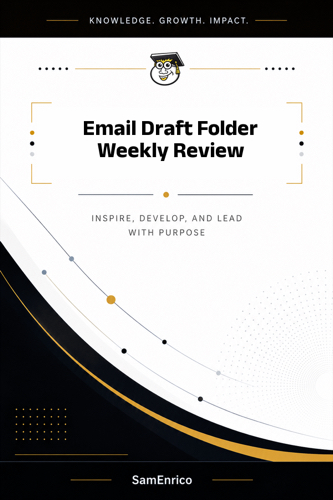
Email Draft Folder Weekly Review eBook
Clear your drafts folder every Friday by sending,
Clear your drafts folder every Friday by sending, deleting, or scheduling.
Formats
Free sample
Chapter 1: The Unsent Confession--Every professional I have ever coached has a secret. It is not an affair, a hidden bank account, or a résumé lie. It is smaller and more damaging than any of those things. It is a folder. A digital manila envelope sitting in their email account with a number next to it.
That number is the count of conversations they started and never finished. That number is the tally of promises they made to themselves and broke. That number is the weight they carry into every meeting, every dinner, every Sunday night panic at 10:47 PM when they suddenly remember the email they were supposed to send three weeks ago.That folder is called Drafts. And this book exists because of what lives inside it.I want you to do something uncomfortable right now. Not physically uncomfortable.
Psychologically uncomfortable. Open your email account. Any of them—work, personal, the old Gmail address you never quite abandoned. Locate the Drafts folder. Do not open any of the emails yet.
Just look at the number. How many are there? Five? Fifteen? Fifty?
One hundred and forty-seven? Do not judge yourself. Just observe. Now scroll through the list. Look at the dates.
How many of these drafts are more than forty-eight hours old? A week? A month? A year?Now I want you to pick one. Not the oldest.
Not the most emotionally charged. Pick one that you cannot explain. One where you wrote two sentences, saved it, and never returned. Read it. Ask yourself a single question, the same question I have asked thousands of professionals in workshops and coaching sessions: Was I avoiding sending this because it wasn't ready, or because I wasn't ready?The answer to that question is the thesis of this entire book.The Psychological Debt Ledger David Allen, the author of Getting Things Done, invented a term that has haunted me since I first encountered it: open loops.
An open loop is any task, commitment, or promise that you have made to yourself or others that remains incomplete. Your brain, Allen argues, is not designed to store reminders. It is designed to process information. When you leave a loop open, your brain does not forget about it. It does not file it away neatly.
Instead, it keeps a low-grade, persistent, background alert running at all times. Psst. You still need to send that email. Psst. Remember that draft?
Psst. When are you going to finish that?Most people think of open loops as big things. The quarterly report. The performance review. The difficult conversation with a spouse.
But open loops are not defined by their importance. They are defined by their incompleteness. And the smallest open loop—a three-sentence email that would take forty-five seconds to send—consumes the same psychic energy as a large one until it is closed. Your brain does not discriminate by size. It only discriminates by status.
Open is open.Your Drafts folder is not a holding pen. It is not a helpful place to save work in progress. It is not a harmless digital closet where unfinished thoughts can rest quietly until you are ready for them. Your Drafts folder is a ledger. Every unsent email is a debit against your psychological integrity.
You told yourself you would send it. You wrote the first paragraph, or the subject line, or just the recipient's name. You saved it. And then you walked away. That act—saving instead of sending—was a small betrayal of your own word.
Do that once, and the damage is trivial. Do that a hundred times, and you have trained yourself to distrust your own intentions.This is not metaphor. This is cognitive science.The Anxiety of Almost Jocelyn Glei, in her excellent book Unsubscribe, writes extensively about the emotional weight of digital clutter. She argues that email has become the primary source of what she calls "ambient anxiety"—the low-hum worry that follows us from our desks to our beds because we know, at some level, that there is always more to do. But Glei makes a crucial distinction that most productivity writers miss.
She distinguishes between the anxiety of incoming (the inbox) and the anxiety of outgoing (the drafts folder). Inbox anxiety is reactive. It is the fear of what others might ask you, the dread of the unexpected, the sense that you are perpetually behind. Drafts anxiety is different. Drafts anxiety is active.
It is the shame of what you have failed to say. It is the guilt of the unfinished request, the apology you owe, the question you were too afraid to ask.I have sat with hundreds of professionals and asked them to describe the feeling of opening their Drafts folder. The words they use are not productivity terms. They are not "inefficient" or "disorganized" or "suboptimal." The words they use are: guilty, ashamed, embarrassed, anxious, heavy, stuck. One senior executive, a woman who managed a team of forty people, described her Drafts folder as "the place where my courage goes to die." Another, a software engineer, said, "Every time I see that number, I feel like I'm lying to someone.
I just don't know who."This is not a small problem. This is not a "nice to fix" productivity tweak. This is a slow erosion of self-trust that bleeds into every other domain of your life. If you cannot send an email to your boss, how confident are you that you will ask for that raise? If you cannot send a difficult conversation draft to a colleague, how certain are you that you will set boundaries with your family?
If you cannot clear your Drafts folder, what else are you leaving unfinished?Perfectionism in a Business Suit Let me tell you about a man I coached several years ago. Let us call him James. James was a mid-level marketing director at a medium-sized software company. He was smart, capable, and widely liked. He was also stuck.
For eighteen months, James had been passed over for two promotions. His performance reviews were glowing, but when leadership positions opened, he was never selected. He came to me not for email help—he thought he needed executive presence training—but after our first session, I asked him a question that had nothing to do with presenting or negotiating. I asked him to show me his Drafts folder.He hesitated. Then he opened his laptop.James had one hundred and thirty-seven drafts.
One hundred and thirty-seven. Some were a few days old. Some were months old. One, a proposal for a new customer segmentation model, was dated four hundred and twelve days earlier. I asked him to open that one.
He did. It was seven paragraphs. It was well-written. It was complete. It had a subject line, a greeting, a data table, a conclusion, and a signature block.
The only thing missing was the send button."Why didn't you send this?" I asked.James stared at the screen for a long time. Then he said something I have never forgotten: "I was waiting for it to be perfect.""Was it perfect?" I asked."No," he admitted."Was it good enough to start a conversation?"A longer pause. "Yes."That draft…
This is the end of the free sample. Get the eBook to keep going. Buy now
About this book
Details
- Author
- Shelley Julene
- Publisher
- SamEnrico
- Language
- English
- Genre
- Non-Fiction, Business Brief, Weekly Routine
- Released
- 2026-06-10
- Pages (approx.)
- 139
- Available as
- eBook, Audiobook

Read better in the ZLOADR app
Your eBooks on your phone or tablet. Sign in with your SamEnrico account and start reading.
More by Shelley Julene
 The Personal Brand Networking GuideShelley Julene$11.99
 Scheduling Relationship TimeShelley Julene$11.99
 Menopause And Caffeine GuideShelley Julene$11.99
 First Time Home Buyers After FiftyShelley Julene$11.99
 Self Validation HypnosisShelley Julene$11.99
 Layoff Survival Recovery GuideShelley Julene$11.99
 Deep Work For Remote TeamsShelley Julene$11.99
 The First Frame: How a Colonial Outpost Brought Cinema to the WorldShelley Julene$11.99
 Brushstrokes Across the Battlefield: The Secret Art of War Correspondent Li WeiShelley Julene$11.99
 Mastering Tallage: Medieval Lord's TaxShelley Julene$11.99
 How to Become a Hatch TenderShelley Julene$11.99
 Ghanaian Export Payment HandbookShelley Julene$12.99