
Non-FictionSelf-HelpDigital ProductivityWorkflow
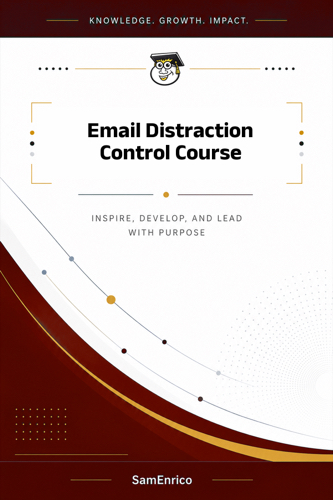
Email Distraction Control Course eBook
Transform your inbox from a source of constant int
Transform your inbox from a source of constant interruption into a scheduled task queue with batching and auto sorting.
Formats
Free sample
Chapter 1: The 23-Minute Theft--You are about to lose twenty-three minutes of your life. Not at the end of this chapter—right now, while you are reading it. Somewhere in your pocket or on your desk, your phone is vibrating with an email notification. You feel it. A tiny muscle in your thumb just twitched.
That urge to glance away, to check, to make sure nothing exploded in the last sixty seconds—that is the addiction this book will break.But first, we need to measure the damage.Let me tell you about a man named Thomas. Thomas was a senior analyst at a mid-sized financial firm. He arrived at work every day at 8:30 AM, proud of his work ethic. By 8:35 AM, he checked his email. By 8:37 AM, he had replied to three messages.
By 8:45 AM, he started his first real task. By 8:52 AM, a new email arrived. He checked it. He replied. He looked back at his task and could not remember where he left off.
By 9:15 AM, he was back up to speed. Then another email arrived.Thomas checked his email fifty-two times that day. He calculated his productivity at the end of the week and felt vaguely disappointed. He had worked sixty hours but accomplished the equivalent of twenty. He blamed himself.
He thought he lacked discipline. He bought a productivity app, then another, then a timer, then a second monitor. Nothing worked.Thomas was not lazy. Thomas was not undisciplined. Thomas was being robbed.The thief has no face and no fingerprints.
It does not break windows or pick locks. It walks right through your front door wearing a friendly mask. Its name is the Context Switch, and it steals twenty-three minutes of your life every single time you check your email while trying to work.The Science of the Stolen Minute In 2014, a team of researchers at the University of California, Irvine did something simple and devastating. They followed knowledge workers through their days and measured exactly what happened when an email arrived. The results, published in the journal CHI and later popularized by Cal Newport in A World Without Email, revealed a number that should be printed on every inbox in the world: twenty-three minutes.That is how long it takes your brain to fully refocus after an interruption.Not two minutes.
Not five. Twenty-three.Here is what happens inside your skull during those twenty-three minutes. When you are deeply engaged in a task—writing a report, analyzing data, coding, designing—your brain builds what neuroscientists call an "attention schema." It is a temporary neural network that holds all the relevant information: where you are, what you are trying to accomplish, what you have already done, what comes next. This schema is fragile. It exists in your working memory, which can hold roughly four discrete pieces of information at any given time.When an email notification appears, two things happen.
First, your brain releases a small burst of dopamine—the same neurotransmitter involved in addiction. You feel a tiny reward just from seeing that something new has arrived. This is not a character flaw. It is biology. Your ancestors were wired to pay attention to novel stimuli because novel stimuli might be a predator or a food source.
Email notifications hijack that ancient circuit.Second, your brain abandons the attention schema. It does not save it gracefully. It does not bookmark your place. It drops everything to evaluate the new stimulus—the email. You read it, you decide whether to reply, and then you turn back to your original task.
But your brain does not remember where you were. It remembers that you were somewhere, but the specific details have been overwritten.So you sit there. Staring at the screen. Trying to remember that sentence you were writing, that number you were analyzing, that approach you were considering. You reconstruct.
You retrace. You reboot. Twenty-three minutes later, you are back at full cognitive speed.Now multiply that by the number of times you check email daily.The $650 Billion Calculation Let us do the math together. I want you to see the number with your own eyes.Assume a knowledge worker earns $50 per hour. This is a conservative average across white-collar professions in the United States, including benefits and overhead.
Some earn less, many earn far more, but $50/hour keeps the arithmetic clean.Assume they check email fifty times per day. This is not an exaggeration. Gloria Mark, the lead researcher on the UC Irvine study, found that knowledge workers check email an average of seventy-seven times per day. Fifty is a conservative estimate.Each check costs twenty-three minutes of refocusing time. But wait—not every check leads to a full context switch.
Sometimes you check email during natural breaks. Sometimes you are already between tasks. For the sake of fairness, let us assume that only half of your email checks cause a full twenty-three-minute disruption. The other half happen during transitions and cost much less.So: 25 full disruptions × 23 minutes = 575 minutes per day.575 minutes is 9.6 hours. That is more than a full workday.
According to this math, the average knowledge worker loses an entire day of productivity every single day to email interruptions. That cannot be right. And it is not—because most people do not actually try to focus between interruptions. They have adapted to the chaos by never diving deeply into anything. They work in a perpetual state of shallow, fragmented attention.
They have lowered their standards without realizing it.Let us use a more conservative estimate. Assume the average worker checks email fifty times but only suffers a full refocus penalty ten times per day. The other forty checks happen during shallow work or natural pauses.10 disruptions × 23 minutes = 230 minutes per day, or 3.8 hours.That is still enormous. Over a 220-day work year (accounting for weekends, vacation, and holidays), that is 46 full days of lost productivity per worker per year. At $50/hour, that is $18,400 per worker per year in lost value.Now multiply by 1,000 workers.
That is $18.4 million per year for a mid-sized company. Multiply by all the knowledge workers in the United States—roughly 60 million people—and you get an annual productivity loss of over $1.1 trillion.But wait. The original calculation in the bestselling book The Hamster Revolution put the number at $650 billion globally. That calculation used lower assumptions: $35/hour, 50 checks per day, and a 20-minute refocus penalty. Either way, the number is staggering.
You are not losing pennies. You are losing a fortune.This is not a productivity hack. This is a financial crisis happening inside your own head.The Myth of the Quick Check Before we go any further, I need to kill something. It is a belief you hold, even if you do not know you hold it. The belief is this: A quick check costs almost nothing.You tell yourself: "I will just glance at my inbox.
I will not reply. I will just see if anything urgent came in." Then you see an email from your boss. You read it. You think about it. You decide to reply later.
You close your email. You return to your work. How long did that take? Thirty seconds? A minute?But the thirty…
This is the end of the free sample. Get the eBook to keep going. Buy now
About this book
Details
- Author
- Justus Sunday
- Publisher
- SamEnrico
- Language
- English
- Genre
- Non-Fiction, Self-Help, Digital Productivity, Workflow
- Released
- 2026-06-09
- Pages (approx.)
- 142
- Available as
- eBook, Audiobook

Read better in the ZLOADR app
Your eBooks on your phone or tablet. Sign in with your SamEnrico account and start reading.
More by Justus Sunday
 Message Sidedness GuideJustus Sunday$11.99
 IBS Exercise Protocol GuideJustus Sunday$11.99
 Parent Guide to Teen Self EsteemJustus Sunday$11.99
 The Rolling Time Block SystemJustus Sunday$11.99
 Talking About Bedroom Preferences GuideJustus Sunday$11.99
 The Benefits Keeper GuideJustus Sunday$11.99
 Accident Scene Emotional ControlJustus Sunday$11.99
 Gait Retraining for Hip OsteoarthritisJustus Sunday$11.99
 The Scandal That Shook the Ton: The Duke, the Duel, and the Disappearing DiamondJustus Sunday$11.99
 Qubit Frontier: The Race to Build the World's First Quantum InternetJustus Sunday$11.99
 The Arctic Express: How a Single Storm Changed Bird Migration ForeverJustus Sunday$11.99
 The Complete Guide to the Official Mayo Clinic PlanJustus Sunday$11.99
You may also like
 Hong Kong Handover 1997Dunn Johnnie$11.99
 Zumba For Postnatal Recovery CourseNeal Christian$11.99
 Zumba for BeginnersLadner Nikia$11.99
 YouTube Comment Mining GuideHumes Pandora$12.99
 Worry Box MeditationCarlin Rudy$11.99
 Workplace Stress MeditationNguyen Lynn$11.99
 Workplace Stress and Sleep RepairHawley Ivory$11.99
 Workplace Perfectionism CureDelaney Jeffry$11.99
 Workplace Injustice Anger GuideWallen Isabelle$11.99
 Work Addiction and Burnout LinkGreenwood Ester$11.99
 Women in Yoga and WellnessBeattie Galina$11.99
 Women in Stand Up ComedyChun Evangeline$11.99