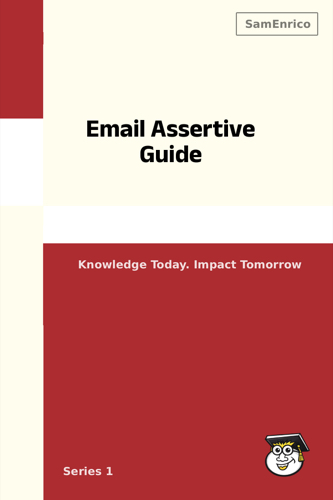
Email Assertive Guide eBook
Write firm but polite professional emails.
Write firm but polite professional emails.
Formats
Free sample
Chapter 1: The Nice Tax--–- Every professional knows the feeling. You stare at the blinking cursor, reread your draft for the fourth time, and then soften the language just enough to avoid sounding pushy. "Just checking in" you add, because you don't want to seem demanding. "Sorry to bother you" you type, because their time is surely more valuable than yours. You hit send, feel a small wave of relief that you didn't offend anyone, and then wait.
And wait. And wait. Three days later, no response. You send another. "Just circling back..." Nothing.
The project stalls. Your boss asks for an update. You have nothing to report. The silence cost you three days, and the polite little words cost you your momentum.This is the Nice Tax. It is the silent, cumulative cost of passive email language paid daily by millions of professionals.
Every "just," every "sorry to bother you," every "if you have a moment" chips away at your professional authority, delays your projects, and trains your colleagues to treat your requests as optional. Most people never notice the tax because it is deducted in small increments—a few hours here, a missed opportunity there—but over the course of a year, the total is staggering. One study of workplace communication found that ambiguous, passive emails add an average of 87 minutes of delay per request. For a manager sending twenty requests per week, that is nearly thirty hours of lost productivity annually. Thirty hours.
Almost a full work week spent waiting because your email was too polite to get an answer.This chapter will make you painfully aware of the Nice Tax in your own inbox, teach you to recognize the four communication styles that either cost or create authority, and introduce the foundational principle that will guide every chapter of this book: focus on business impact, not emotion. By the time you finish reading, you will have completed your first Email Tone Audit and rewritten your first passive email into an assertive one. And you will never send "just checking in" again.The Two Dysfunctions That Plague Every Inbox Before we can build assertive email habits, we must diagnose what is broken. Most professionals fall into one of two dysfunctional patterns. Neither works.
Both damage careers.Dysfunction One: The Passive Pleader The Passive Pleader writes emails that are so soft, so hedged, so desperate not to offend that they become invisible. Their inbox is a graveyard of unanswered questions and unactioned requests. Their signature phrases include:"Just checking in on this when you have a moment...""Sorry to bother you, but if you're not too busy...""I was wondering if you might possibly have time to...""No rush at all, but whenever you get around to it...""This might be a silly question, but..."Every one of these phrases signals the same thing: My request is not important. You can ignore me. I will not follow up forcefully.
The Passive Pleader mistakes politeness for effectiveness. They believe that being nice means never imposing, never demanding, never stating a clear boundary. But here is the brutal truth: in professional communication, politeness without clarity is not polite—it is useless.Consider two emails. The first, written by a Passive Pleader:Subject: Quick question Hi Sarah, sorry to bother you. I was just wondering if you might have a moment to look at the Q3 report when you get a chance?
No rush at all, but if you could possibly take a look sometime this week, that would be great. Thanks so much!This email contains sixteen words that weaken the request ("just," "sorry," "wondering," "might," "possibly," "when you get a chance," "no rush," "sometime," "great"). The recipient has no clear deadline, no clear action, and no reason to prioritize it. Sarah will likely think, "I'll get to it when I can," and then forget entirely. The sender will wait three days, send another similarly weak follow-up, and the cycle continues.Now consider an assertive version of the same request:Subject: Q3 report review needed by Thurs 2 PM ETHi Sarah, please review the attached Q3 report by Thursday at 2 PM ET.
I need your sign-off before I can send it to the client.This email contains zero weak words. It states a clear action, a specific deadline, and a business consequence. Sarah knows exactly what to do and when. She can either do it or reply with a reason she cannot. Either way, the sender gets a response.The Passive Pleader fears the second email because it feels pushy.
But notice: the assertive email is not rude. It does not say "You haven't done this yet" or "Hurry up." It simply states a need and a timeline. That is not aggression. That is professionalism.Dysfunction Two: The Aggressive Hammer At the opposite end of the spectrum is the Aggressive Hammer. Where the Passive Pleader is invisible, the Aggressive Hammer is radioactive.
Their emails provoke defensiveness, resentment, and silent resistance. Their signature phrases include:"You need to send this immediately.""This is late again.""I shouldn't have to remind you...""Per my last email...""As I already said..."The Aggressive Hammer mistakes force for effectiveness. They believe that loud demands and blame language get results. And sometimes, in the very short term, they do. A frightened junior employee might scramble to comply.
But over time, the Aggressive Hammer builds a reputation as someone to avoid, someone to delay, someone who will never get the benefit of the doubt. Their emails trigger the recipient's defensive brain, which is not a state conducive to cooperation or speed.Consider an aggressive version of the same request:Subject: URGENT - Q3 report Sarah, I need the Q3 report NOW. You were supposed to have this done yesterday. This is the third time you've missed a deadline. Get it to me in the next hour or I'm escalating to your manager.This email is aggressive, not assertive.
It assigns blame ("You were supposed to"), uses all-caps ("NOW"), threatens escalation, and provides no collaborative path forward. Sarah will likely comply out of fear, but she will resent it. Next time, she might delay just to spite the sender. Or she will go to HR with a complaint about hostile communication. The Aggressive Hammer gets short-term compliance at the cost of long-term relationships.The assertive email from earlier—"Please review by Thursday at 2 PM ET; I need your sign-off before I can send to the client"—achieves the same result without the collateral damage.
It is firm without being hostile. It sets a boundary without assigning blame.The Silent Third Dysfunction: Passive-Aggression Before we introduce the solution, we must acknowledge the third dysfunction that appears in email: passive-aggression. Unlike the Passive Pleader (who is genuinely trying to be nice) or the Aggressive Hammer (who is openly hostile), the passive-aggressive communicator hides their hostility behind a mask of politeness. Their emails look innocent but carry a sting. Signature phrases include:"Just so you know, I'll be handling this myself since no one else seems to have time.""Per our conversation, I'm sure you just forgot again...""It's fine.
I'll just stay late. Again.""I guess we'll just miss the deadline then."Passive-aggressive emails are toxic because they are difficult to…
This is the end of the free sample. Get the eBook to keep going. Buy now
About this book
Details
- Author
- Clayton Jared
- Publisher
- SamEnrico
- Language
- English
- Genre
- Non-Fiction, Self-Help, Email Etiquette
- Released
- 2026-06-06
- Pages (approx.)
- 135
- Available as
- eBook, Audiobook

Read better in the ZLOADR app
Your eBooks on your phone or tablet. Sign in with your SamEnrico account and start reading.
More by Clayton Jared
 Gen Z Specialty CoffeeClayton Jared$11.99
 Vitamin D3 Vs D2 GuideClayton Jared$11.99
 Senior Learning Self EsteemClayton Jared$11.99
 Roth Conversion StrategiesClayton Jared$11.99
 Rapid Self Hypnosis TechniquesClayton Jared$11.99
 Navigating Vendor NegotiationsClayton Jared$11.99
 Birth Control And Breast TendernessClayton Jared$11.99
 The Cairo Codex Conspiracy: The Lost Manuscripts of the KhediveClayton Jared$11.99
 The Marble Conspiracy: How a Rogue Sculptor Outwitted the British EmpireClayton Jared$11.99
 How to Produce Craft Organization ProductsClayton Jared$11.99
 A Collector's Handbook to the Vauxhall Bedford BeagleClayton Jared$11.99
 Friday and Weekend SchedulingClayton Jared$12.99