
Non-FictionSelf-HelpDigital Communication
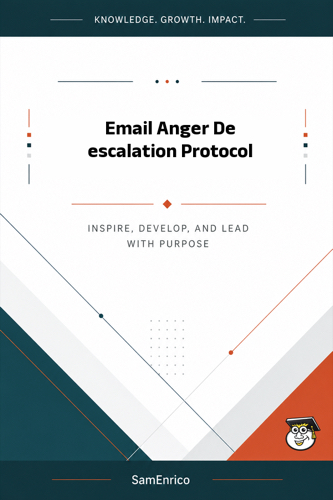
Email Anger De escalation Protocol eBook
Draft, delay, and edit heated messages to avoid pr
by Hoang Joeann
Draft, delay, and edit heated messages to avoid professional embarrassment.
Formats
Free sample
Chapter 1: The Send Trap--–- Every professional remembers the moment. The flush of heat across your chest. The way your fingers seem to move on their own, hammering out words you would never say aloud. The satisfying thud of the Send button. And then—almost immediately—the cold, creeping dread.You open your Sent folder, hoping it was not as bad as you remember.
It is worse. There it sits: a permanent record of your temporary insanity. The all-caps accusation. The CC to your boss's boss. The sarcastic jab that felt so clever ten seconds ago and now reads like something written by a stranger—a stranger you would never want to meet.Within minutes, your phone buzzes.
Then again. Then a third time. The replies are already arriving. Some confused, some defensive, some just as angry as yours. The thread is escalating.
You have started something you cannot stop, and the only thing growing faster than the email chain is your desire to invent a time machine.Welcome to the Send Trap.This chapter is about understanding why otherwise intelligent, composed, successful professionals repeatedly fall into this exact pattern. It is not because you lack self-control. It is not because you are secretly a terrible person. It is because email exploits a fundamental flaw in the way your brain processes social information. Once you understand that flaw—once you see the trap for what it is—you can begin to build a system that protects you from yourself.The Illusion of Conversation Here is the core problem: email pretends to be a conversation, but it is actually a document.When you are sitting across from someone in a meeting, over coffee, or even on a video call, your brain is processing an enormous amount of data that has nothing to do with words.
You see their face. You hear their tone. You read their posture. You register micro-expressions that tell you whether they are angry, confused, amused, or bored. All of this happens in milliseconds, below the level of conscious thought, and it allows you to adjust your communication in real time.If you say something too harsh, you see them flinch, and you soften.
If they misunderstand you, you see the confusion on their face, and you clarify. If the conversation is heading toward conflict, you have dozens of small opportunities to de-escalate before anyone raises their voice.Email offers none of this.When you write an email, you are typing into a void. Your brain, desperate for social feedback, fills that void with assumptions. And here is the crucial insight: when you are already frustrated, your brain does not assume the best. It assumes the worst.That neutral question from your colleague—"Did you review the report yet?"—reads as an accusation.
That brief response from your client—"Thanks, I'll consider it"—reads as dismissal. That one-word reply from your manager—"Noted"—reads as barely suppressed rage. You are not reacting to what they wrote. You are reacting to what your angry brain imagines they meant.This is the illusion of conversation. You feel like you are talking to someone, so you write the way you would speak.
But the person on the other end is not hearing your tone, seeing your face, or understanding your intent. They are reading flat text on a screen, and they are doing the same negative interpretation you just did.The result is predictable: a minor misunderstanding escalates into a major conflict, not because anyone meant harm, but because the medium stripped away every cue that prevents harm.The Neurobiology of the Click To understand why you hit Send when you should not, you need to look under the hood of your own brain.Deep in the center of your skull, behind your eyes and between your ears, sits a small, almond-shaped cluster of neurons called the amygdala. Its job is simple: detect threats and respond instantly. The amygdala does not think. It does not reason.
It does not consider long-term consequences. It reacts.When you perceive a threat—whether it is a predator in the bushes or a passive-aggressive email from accounting—the amygdala triggers a cascade of physiological responses. Your heart rate increases. Your breathing becomes shallow. Your blood vessels dilate.
Your body floods with cortisol and adrenaline. This is the fight-or-flight response, and it is designed to help you survive immediate physical danger.Here is the problem: your amygdala cannot tell the difference between a physical threat and a social threat.An insulting email activates the same neural circuitry as a charging animal. Your brain does not know the difference. So when you read that email that makes your blood boil, your amygdala hijacks your prefrontal cortex—the part of your brain responsible for logic, planning, and impulse control. In under two seconds, you literally become less intelligent.
Your working memory shrinks. Your ability to consider alternative perspectives vanishes. Your vocabulary narrows. You are, for all practical purposes, a different person.This is called an amygdala hijack, a term first popularized by Daniel Goleman in his work on emotional intelligence. And it explains why your angry emails are so much worse than anything you would say in person.
In person, the physical presence of the other person provides a braking mechanism. You see their humanity. You hesitate. Online, with no face to look at and no voice to hear, your amygdala runs unchecked.You are not a bad person for writing angry emails. You are a human being with a normally functioning brain.
That brain is simply not designed for text-based conflict resolution.The Professional Embarrassment Index Let us get concrete. Over the past decade, I have collected case studies of professionals who sent one email they wished they could take back. The Professional Embarrassment Index is not about outliers—it is about ordinary people in ordinary jobs who made ordinary mistakes with extraordinary consequences.Consider Sarah, a senior marketing manager at a mid-sized tech company. She had been working with a vendor who consistently missed deadlines. After the third delay, she wrote an email that began, "I cannot believe the level of incompetence I am seeing." She copied her boss.
She copied the vendor's boss. She hit Send.The vendor fired back within the hour, copying their legal department. The contract was terminated. The project—eight months of work—was abandoned. Sarah kept her job, but just barely.
The VP of Operations later told her, "You cost us six figures because you could not wait ten minutes to cool down."Consider Marcus, a senior associate at a consulting firm. He received what he perceived as a condescending email from a junior colleague. He replied with a single sentence: "When you have been doing this as long as I have, we can talk." He thought it was a firm boundary. The junior colleague forwarded it to HR, citing a hostile work environment. Marcus spent three months in mandatory sensitivity training and was passed over for promotion twice.Consider Elena, a freelance graphic designer.
A client asked for her seventh round of revisions on a logo. She wrote, "I am not a magic machine. Pay me more if you…
This is the end of the free sample. Get the eBook to keep going. Buy now
About this book
Details
- Author
- Hoang Joeann
- Publisher
- SamEnrico
- Language
- English
- Genre
- Non-Fiction, Self-Help, Digital Communication
- Released
- 2026-06-06
- Pages (approx.)
- 151
- Available as
- eBook, Audiobook

Read better in the ZLOADR app
Your eBooks on your phone or tablet. Sign in with your SamEnrico account and start reading.
More by Hoang Joeann
 Interruption Recovery Rapid Protocol WorkbookHoang Joeann$11.99
 Indian Ecommerce Support GuideHoang Joeann$11.99
 Communications Essay AI GuideHoang Joeann$11.99
 The Leo Strauss Political PhilosophyHoang Joeann$11.99
 The Digital Highwayman: Britain's First Cryptocurrency KillerHoang Joeann$11.99
 QuickBooks Data Backup GuideHoang Joeann$12.99
 Metal Fabrication M&AHoang Joeann$12.99
 How to Start a Operation of Ski Hills Business (Beginners Guide)Hoang Joeann$11.99
 Backroom CoordinatorHoang Joeann$11.99
 Understanding Pneumocystis Jiroveci PneumoniaHoang Joeann$17.99
You may also like
 Hong Kong Handover 1997Dunn Johnnie$11.99
 Zumba For Postnatal Recovery CourseNeal Christian$11.99
 Zumba for BeginnersLadner Nikia$11.99
 YouTube Comment Mining GuideHumes Pandora$12.99
 Worry Box MeditationCarlin Rudy$11.99
 Workplace Stress MeditationNguyen Lynn$11.99
 Workplace Stress and Sleep RepairHawley Ivory$11.99
 Workplace Perfectionism CureDelaney Jeffry$11.99
 Workplace Injustice Anger GuideWallen Isabelle$11.99
 Work Addiction and Burnout LinkGreenwood Ester$11.99
 Women in Yoga and WellnessBeattie Galina$11.99
 Women in Stand Up ComedyChun Evangeline$11.99