
Non-FictionBiographyOpen Innovation
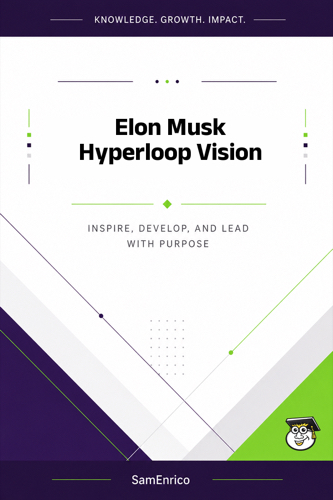
Elon Musk Hyperloop Vision eBook
Turn a white paper idea into a competitive student
by Meyers Lyn
Turn a white paper idea into a competitive student engineering challenge.
Formats
Free sample
Chapter 1: The Gospel of the White Paper...--–- August 12, 2013, began like any other Tuesday for most of the world. Stock markets opened. Coffee was brewed. Meetings happened. Then, sometime in the late morning Pacific Time, a 57-page PDF appeared on Space X’s website and on Elon Musk’s Twitter feed.
The document was titled Hyperloop Alpha. Within hours, transportation engineers stopped what they were doing. Physics professors printed out the pages. And a handful of university students, sitting in dorm rooms and library carrels, felt the ground shift beneath them.The PDF proposed a fifth mode of transportation. Not a car.
Not a train. Not a plane. Not a boat. Something else entirely: passenger pods moving at 700 miles per hour through near-vacuum tubes, powered by solar panels, levitated by magnets or air bearings, and priced more cheaply than a California High-Speed Rail ticket. Musk claimed it could connect Los Angeles to San Francisco in thirty-five minutes.
He claimed it could be built for $6 billion—a fraction of the $68 billion price tag of the proposed bullet train. He claimed it would be earthquake-resistant, energy-positive, and immune to weather.The world reacted in predictable camps. Journalists called it science fiction. Politicians called it a distraction. Environmentalists called it a billionaire’s vanity project.
But a smaller, quieter group—engineers who had spent their careers in vacuum systems, magnetic levitation, and linear induction motors—read the document and saw something different. They saw a gauntlet thrown. Musk wasn’t asking for permission. He wasn’t seeking investors. He wasn’t forming a company.
He was doing something far more provocative: he was giving the idea away.The final page of the Hyperloop Alpha PDF contained a sentence that would become the most important line in the document. Musk wrote that he and the Space X team were “busy with other projects” and therefore “could not dedicate resources to building a working Hyperloop at this time.” Instead, he invited others to build it. He opened the patent pool. He challenged the world to try.This chapter is about that document. It is about the strange power of a white paper—a format that usually dies on servers, unread and unloved—to ignite a global engineering movement.
It is about the gap between vision and reality, between what Musk wrote and what actually works, between the billion-dollar promise and the brutal constraints of physics, regulation, and budget. And it is about the first students who read those fifty-seven pages and said, “We can do this.”The Anatomy of a Provocation To understand why the Hyperloop Alpha paper succeeded where thousands of other white papers fail, you have to look at its structure. Most technical documents are designed to be invisible. They use passive voice. They hedge every claim.
They include phrases like “it is believed that” and “further research may be required.” Musk’s paper did none of these things. It was written in active voice. It made specific, falsifiable claims. It included drawings, equations, and cost estimates. It named names—California High-Speed Rail Authority, you’re too expensive and too slow.
It was, in every sense, a provocation.The paper opened with a table comparing Hyperloop to existing modes. Car: slow and polluting. Airplane: fast but expensive and airport-bound. Train: moderate speed, moderate cost. Hyperloop: faster than a plane, cheaper than a train, cleaner than a car.
This table was not objective. It was polemical. Musk was picking a fight with the entire transportation establishment.Then came the technical core. Musk proposed a system of steel tubes, elevated on pylons, with the air pumped down to one-thousandth of atmospheric pressure. Inside the tube, passenger capsules would ride on a cushion of air—not magnetic levitation, as many assumed, but an air bearing system that used a compressor fan on the front of the pod to draw in the small amount of residual air and redirect it downward, creating lift.
The pod would be propelled by linear induction motors embedded in the tube. Solar panels on the tube roof would generate enough power to run the system, with batteries for nighttime operation.The numbers were specific and ambitious. Top speed: 760 miles per hour, just below the sound barrier. Tube diameter: 7 feet, 4 inches. Pod capacity: 28 passengers.
Departure frequency: every 30 seconds. Energy consumption: 21 watt-hours per passenger-mile, compared to 140 for a Tesla Model S. Cost: $6 billion for the Los Angeles to San Francisco route.These numbers were also, as later analysis would show, optimistic. But that was the point. Musk was not writing a construction manual.
He was writing a challenge. He was saying, “Here is a target. Here is a plausible path. Now prove me wrong.”The Hand-Waving Sections: Where Musk Skipped the Hard Parts Every engineer who reads the Hyperloop Alpha paper with a critical eye notices the same thing: there are sections where the analysis is deep and sections where Musk waves his hands and moves on. The deep sections cover the physics of drag, the design of the compressor fan, and the economics of solar power.
The hand-waving sections cover the problems that are genuinely hard—the ones that would take decades and billions of dollars to solve.Seismic stability is the first hand-wave. California has earthquakes. A rigid steel tube, hundreds of miles long, bolted to pylons, will not survive a major seismic event. Musk acknowledged this briefly, suggesting that the tube could be mounted on frictionless bearings or articulated joints. But he did not provide calculations.
He did not model a magnitude 7.0 quake. He essentially said, “We’ll figure that out later.” Student teams would later discover that seismic joints are one of the most expensive and difficult parts of any tube design. A single failed joint can rupture the vacuum, collapse the tube, and destroy a pod.Thermal expansion is the second hand-wave. Steel expands when it gets hot. A mile of steel tube can grow several feet in length between a cold morning and a hot afternoon.
If the tube is rigidly mounted, it will buckle. If it is loosely mounted, it will leak. Musk proposed bellows—flexible accordion-like sections—every few hundred feet. But he did not specify how often, how wide, or how to maintain the vacuum across a moving joint. Student teams would later learn that bellows are a constant source of leaks.
Every bellow is a potential failure point. Every bellow requires inspection, replacement, and prayer.**The $6 billion cost estimate** is the third and most famous hand-wave. Musk arrived at this number by extrapolating from the cost of steel tubes in oil and gas pipelines, adding a premium for the vacuum pumps and linear motors. Critics immediately pointed out what Musk left out: land acquisition (eminent domain battles up and down California), regulatory approval (environmental impact studies, safety certifications, local zoning), vacuum maintenance (pumps that run continuously for decades), emergency systems (evacuation routes, fire suppression, medical response), and insurance (nobody will underwrite a new mode of transport without years of testing). A 2016 study by the University of California, Berkeley, estimated the true cost at closer to $18 billion.
A 2022 study by the Mineta Transportation Institute put it at $24 billion.These hand-waving sections are not a failure of…
This is the end of the free sample. Get the eBook to keep going. Buy now
About this book
Details
- Author
- Meyers Lyn
- Publisher
- SamEnrico
- Language
- English
- Genre
- Non-Fiction, Biography, Open Innovation
- Released
- 2026-06-06
- Pages (approx.)
- 154
- Available as
- eBook, Audiobook

Read better in the ZLOADR app
Your eBooks on your phone or tablet. Sign in with your SamEnrico account and start reading.
More by Meyers Lyn
 Global Talent Migration and Entrepreneurial EcosystemsMeyers Lyn$11.99
 Growing Up Disney StarMeyers Lyn$11.99
 The Knox Case International Law LessonsMeyers Lyn$11.99
 PNE for Headache EducationMeyers Lyn$11.99
 The Blood Price of Faith: The Sack of Magdeburg and the Fury of the Thirty Years' WarMeyers Lyn$11.99
 SEA Hospitality InvestmentMeyers Lyn$12.99
 Payment Fraud Prevention For ExportersMeyers Lyn$12.99
 Understanding Limb Scalp and Skull DefectsMeyers Lyn$17.99
 How to Start a Opencast Coal Site Business (Beginners Guide)Meyers Lyn$11.99
 Director OperationsMeyers Lyn$11.99
You may also like
 Hong Kong Handover 1997Dunn Johnnie$11.99
 Zumba For Postnatal Recovery CourseNeal Christian$11.99
 Zumba for BeginnersLadner Nikia$11.99
 YouTube Comment Mining GuideHumes Pandora$12.99
 Worry Box MeditationCarlin Rudy$11.99
 Workplace Stress MeditationNguyen Lynn$11.99
 Workplace Stress and Sleep RepairHawley Ivory$11.99
 Workplace Perfectionism CureDelaney Jeffry$11.99
 Workplace Injustice Anger GuideWallen Isabelle$11.99
 Work Addiction and Burnout LinkGreenwood Ester$11.99
 Women in Yoga and WellnessBeattie Galina$11.99
 Women in Stand Up ComedyChun Evangeline$11.99