
Non-FictionHealth & WellnessElliptical
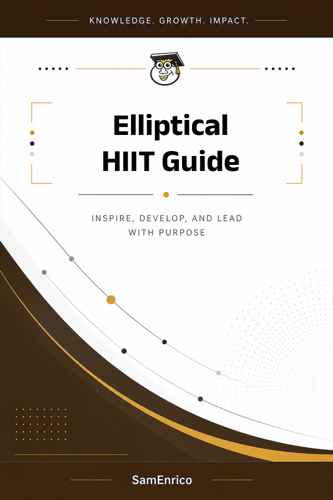
Elliptical HIIT Guide eBook
Vary resistance and incline on elliptical for join
Vary resistance and incline on elliptical for joint friendly intervals.
Formats
Free sample
Chapter 1: The Joint Betrayal--Imagine, for a moment, that you are thirty-four years old. You have spent the last decade building a career, raising children, or perhaps just surviving the beautiful chaos of adulthood. Somewhere along the way, you lost the runner you used to be. The person who could sprint for a bus without feeling it in the knees for three days. The person who could play pickup basketball on Saturday and still walk normally on Sunday.
So you decide to do something about it. You lace up expensive running shoes. You download a couch-to-5K app. You step outside with genuine optimism.By week three, your knees sound like a bowl of Rice Krispies. By week five, you are icing both knees after every run.
By week seven, a friendly orthopedist uses the phrase "patellofemoral syndrome" and suggests you "find a lower-impact activity." You feel a specific kind of grief that no one warns you about—the grief of being told, kindly and professionally, that your body can no longer do what it used to do. And the unspoken addendum hangs in the air: at your age.This book exists because that orthopedist was wrong. Not about the diagnosis. Not about the need for lower impact. But about the implication that lower impact means lower intensity.
About the assumption that protecting your joints and pushing your cardiovascular limits are mutually exclusive goals. About the silent lie that has convinced millions of people over thirty that high-intensity training is something you used to do.The Quiet Epidemic No One Is Talking About Let me share a number that should scare you: according to longitudinal data from sports medicine clinics, the average recreational runner will experience a significant joint-related injury every eighteen to twenty-four months. Not a muscle pull that heals in a week. Not the good soreness that announces progress. Something structural—IT band syndrome, patellar tendinopathy, meniscus irritation, or the dreaded "bone on bone" conversation that ends with a referral to a surgeon.Here is another number: three to five.
That is how many times your body weight crashes through your knees and hips with every single footstrike when you run. A hundred and eighty footstrikes per minute. Ten thousand per hour. Multiply that by three or four runs per week, and you are asking your joints to absorb millions of pounds of deceleration force every month. Your body was designed for this—when you are twenty.
Your body was tolerating this when you are thirty. By the time you are forty, the math changes. The cartilage that once bounced back now compresses a little more each time. The meniscus that once slid smoothly now catches. The synovial fluid that once lubricated like premium motor oil now thins.None of this makes you weak.
None of this means you failed. It means you are human, and humans have biological expiration dates on certain activities. The problem is that the fitness industry has conflated "high intensity" with "high impact" for so long that most people believe you cannot have one without the other. Burpees. Box jumps.
Sprints. Plyometrics. The entire vocabulary of HIIT is built around leaving the ground and crashing back down. And if you cannot do those things anymore, the implication is that you cannot do HIIT.That implication is demonstrably, provably, catastrophically false.The Deceleration Lie Let me explain what actually happens to your body during high-impact exercise, because understanding the mechanism is the first step toward escaping it. When you run, jump, or perform any movement where both feet leave the ground simultaneously, your body must absorb the force of landing.
This is called deceleration force. It is measured in multiples of body weight. A gentle jog produces about three times your body weight at heel strike. A sprint produces four to five times. A box jump from eighteen inches?
You are asking your knee joints to absorb forces equivalent to a small car door slamming into them.Your body manages this through an elegant system of shock absorbers: the menisci in your knees, the labrum in your hips, the intervertebral discs in your spine, and the cartilage that caps the ends of every long bone. These structures are remarkable. They are also finite. Cartilage does not grow back. Meniscal tears do not heal on their own.
Once you wear through the protective layers, you are left with bone grinding on bone, and that is a one-way door.The fitness industry has known about this problem for decades. The response has been... inadequate. "Just stretch more." "Strengthen your glutes." "Buy better shoes." These are not solutions. They are delay tactics.
They might buy you an extra year or two of running, but they do not change the underlying physics: every time you leave the ground, you are spending down a non-renewable resource.This is where the elliptical enters the conversation, and this is also where almost every existing book gets it wrong.Why the Elliptical Has Been Wasted The elliptical trainer was invented in the 1990s as a rehabilitation tool. The original concept was brilliant: create a machine that mimics the natural motion of walking and running while completely eliminating the deceleration phase. On an elliptical, your feet never leave the pedals. There is no flight phase. There is no impact.
The force traveling through your joints drops from three to five times body weight to approximately 0.3 times body weight—essentially the same load as walking, regardless of how hard you push.Here is what happened next: the fitness industry took this rehabilitation tool and marketed it as "easy cardio for people who don't like to sweat." Gyms lined them up in rows facing televisions. The default elliptical workout became twenty to thirty minutes at a steady, mind-numbing pace while watching a talk show. The machine's ability to generate genuine high-intensity effort—the kind that produces real metabolic and cardiovascular adaptation—was completely ignored.Why? Because most trainers and fitness authors do not understand how to use resistance and incline as interval variables. They treat the elliptical like a treadmill with moving handles.
They tell you to "go faster" when they should tell you to "push harder." They have no framework for what I call the Joint-Safe Zone—the specific combination of resistance, incline, and cadence that produces true HIIT-level exertion without impact.Defining the Joint-Safe Zone The Joint-Safe Zone is not a single setting on your machine. It is a range of settings that achieve three simultaneous conditions:Condition One: Your heart rate reaches 85 to 95 percent of its maximum during work intervals. This is the biological definition of high intensity. It is where lactate threshold improves, where VO2max increases, where the hormonal cascade that drives fat oxidation is triggered.Condition Two: Your joints experience zero deceleration force. Your feet remain in continuous contact with the pedals.
There is no flight phase, no landing, no impact spike.Condition Three: The resistance and incline are set high enough that momentum does not do the work for you. This is the mistake most elliptical users make: they set resistance too low, then spin their feet as fast as possible. The flywheel gains momentum, and the machine essentially moves…
This is the end of the free sample. Get the eBook to keep going. Buy now
About this book
Details
- Author
- Reaves Isobel
- Publisher
- SamEnrico
- Language
- English
- Genre
- Non-Fiction, Health & Wellness, Elliptical
- Released
- 2026-06-09
- Pages (approx.)
- 141
- Available as
- eBook, Audiobook

Read better in the ZLOADR app
Your eBooks on your phone or tablet. Sign in with your SamEnrico account and start reading.
More by Reaves Isobel
 WhatsApp Status Comparison TrapReaves Isobel$11.99
 Financial Stress Caregiver GuideReaves Isobel$11.99
 Food Addiction Self Compassion WorkbookReaves Isobel$11.99
 The Polyglot Kings of Mali: Masters of Language and DiplomacyReaves Isobel$11.99
 Learn to Play the Agung a TamlangReaves Isobel$11.99
 How to Start a Binding and Mending of Textiles Business (Beginners Guide)Reaves Isobel$11.99
 Interview Follow Up GuideReaves Isobel$12.99
 PHP DeveloperReaves Isobel$11.99
You may also like
 Hong Kong Handover 1997Dunn Johnnie$11.99
 Zumba For Postnatal Recovery CourseNeal Christian$11.99
 Zumba for BeginnersLadner Nikia$11.99
 YouTube Comment Mining GuideHumes Pandora$12.99
 Worry Box MeditationCarlin Rudy$11.99
 Workplace Stress MeditationNguyen Lynn$11.99
 Workplace Stress and Sleep RepairHawley Ivory$11.99
 Workplace Perfectionism CureDelaney Jeffry$11.99
 Workplace Injustice Anger GuideWallen Isabelle$11.99
 Work Addiction and Burnout LinkGreenwood Ester$11.99
 Women in Yoga and WellnessBeattie Galina$11.99
 Women in Stand Up ComedyChun Evangeline$11.99