
Non-FictionSelf-HelpCrisis Reduction
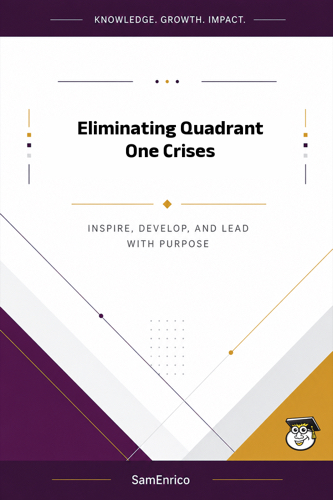
Eliminating Quadrant One Crises eBook
Reduce urgent fires by addressing root causes proa
Reduce urgent fires by addressing root causes proactively over time.
Formats
Free sample
Chapter 1: The Crisis We Manufacture--–- The fire started at 2:47 PM on a Tuesday. Not a literal fire—no flames, no smoke alarms, no firefighters. But inside the open-plan office of a mid-sized logistics company, a different kind of blaze was consuming everything in its path. The CEO, a woman named Sarah who had built the company from nothing over fifteen years, was standing at the whiteboard with a dry-erase marker frozen in her hand. Her face was pale.
Her executive team sat in silence around the conference table. Outside the glass walls, employees moved in the hushed, efficient way people move when they know something is wrong but are afraid to ask.The crisis was simple, predictable, and entirely self-inflicted. Six months earlier, Sarah had signed a contract with a new supplier. The terms were favorable, the timeline was aggressive, and the deal would increase the company's margins by 12 percent. But somewhere in the rush of closing the deal, no one had updated the inventory management system.
No one had trained the warehouse staff on the new supplier's shipping protocols. No one had built a buffer for the transition period. And now, on this Tuesday afternoon, a container ship was sitting in port with eighty thousand units of product that could not be received, could not be processed, and would not reach customers by the holiday deadline.Sarah had known about the risk four months ago. She had seen the email from her operations director, buried in a folder marked "Read Later." She had heard the warning in a staff meeting, filed under "We'll deal with that when we have time." She had felt the nagging anxiety in her gut, the one she had learned to ignore because there was always another fire to put out. And now the fire was here, and it was huge, and it was entirely her fault.But Sarah did not see it that way.
As she stood at the whiteboard, she was thinking about the supplier—they had changed their paperwork without notice. She was thinking about her operations director—why hadn't he flagged this sooner? She was thinking about the customer who would cancel the contract, the board that would demand answers, the weekend she would lose to damage control. She was not thinking about the email she had not read, the meeting she had cut short, the planning she had deferred. She was thinking about everything except the one thing that would have prevented this moment: a quiet Tuesday four months ago when she could have fixed the problem before it became a crisis.The Tyranny of the Now This book is about the fire Sarah is standing in.
It is about the fire in your office, your team, your life—the one that is burning right now as you read these words. It is about the cost of that fire, the shape of it, the reason it exists, and most importantly, the way to make sure it never happens again.The fire has a name. It is called Quadrant I. And before you can eliminate it, you have to understand how you built it.The Time Management Matrix, popularized by Stephen R. Covey in The 7 Habits of Highly Effective People, is one of the most durable and useful frameworks ever created for understanding how we spend our time.
It divides every activity we do into one of four quadrants, based on two questions: Is this important? And is this urgent?Quadrant I: Important and Urgent. Crises, pressing problems, deadline-driven projects. This is where Sarah is standing. This is where you are when the phone rings at 2 AM, when the client threatens to leave, when the report is due in an hour and you haven't started.Quadrant II: Important but Not Urgent.
Planning, prevention, relationship-building, rest, learning, strategic thinking. This is where the work of actual leadership happens. This is where you are when you are designing a system that prevents fires, training a team that can operate without you, or investing in relationships that will pay dividends for years.Quadrant III: Urgent but Not Important. Interruptions, many emails, many meetings, other people's minor issues. This is the quadrant of busyness without impact.
It feels urgent. It is not important.Quadrant IV: Neither Important nor Urgent. Trivia, time-wasting, escape. We all know this quadrant. We spend less time here than we fear and more than we admit.The problem is not that Quadrant I exists.
Some crises are real. Some deadlines are absolute. Some emergencies—a heart attack, a structural collapse, a security breach—demand immediate attention. The problem is that the overwhelming majority of Quadrant I crises are not real emergencies. They are manufactured.
They are the predictable, preventable, and almost always predictable result of Quadrant II neglect.This is the central thesis of this book: You are not overwhelmed because you have too much to do. You are overwhelmed because you have not done what you should have done six months ago.The Mere Urgency Effect Why do we do this to ourselves? Why do smart, capable, well-intentioned leaders consistently prioritize the urgent over the important, even when they know better? The answer lies in a cognitive bias called the Mere Urgency Effect.In a series of experiments, researchers presented participants with two tasks. Task A had high stakes—it would significantly impact the participant's goals—but no deadline.
Task B had low stakes—it was trivial—but had an immediate deadline. Over and over, participants chose Task B. They chose the trivial task with the looming deadline over the important task with no deadline. The mere presence of urgency—even manufactured urgency—overrode the rational assessment of importance.This bias is hardwired. It is not a character flaw.
It is a feature of how our brains process time. The human brain is wired to prioritize immediate threats over long-term opportunities because immediate threats used to kill us. A rustle in the grass might be a lion. A deadline in six months is not going to eat you today. So the brain fires up the stress response, releases cortisol and adrenaline, and pulls attention toward whatever is screaming loudest right now.The problem is that in the modern workplace, almost everything is screaming.
Email screams. Slack screams. The phone screams. The executive who needs an answer in five minutes screams. The Mere Urgency Effect turns every one of these screams into a perceived emergency, and before you know it, you have spent your entire day putting out fires that you could have prevented with thirty minutes of planning last month.Sarah did not ignore the operations director's email because she was lazy.
She ignored it because she was busy. She was busy putting out other fires. Those other fires had been manufactured by earlier neglect. And those earlier fires had been manufactured by neglect before that. The chain of causation runs backward through time like a rope of dominoes, each crisis the parent of the next.
And at the very beginning of the chain, before the first domino fell, there was a choice. A choice to plan or not to plan. To prepare or not to prepare. To invest…
This is the end of the free sample. Get the eBook to keep going. Buy now
About this book
Details
- Author
- Broome Catina
- Publisher
- SamEnrico
- Language
- English
- Genre
- Non-Fiction, Self-Help, Crisis Reduction
- Released
- 2026-06-08
- Pages (approx.)
- 108
- Available as
- eBook, Audiobook

Read better in the ZLOADR app
Your eBooks on your phone or tablet. Sign in with your SamEnrico account and start reading.
More by Broome Catina
 Receiving No with EQBroome Catina$11.99
 Stress Fatigue Chronic ExhaustionBroome Catina$11.99
 Step Five Admitted to GodBroome Catina$11.99
 Whispers in the Wild: The Vanishing of the Dyatlov PassBroome Catina$11.99
 AI for Employee Sentiment AnalysisBroome Catina$12.99
 Learn to Play the Đàn GáoBroome Catina$11.99
 Industrial Security GuardBroome Catina$11.99
 How to Become a Gas InspectorBroome Catina$11.99
You may also like
 Hong Kong Handover 1997Dunn Johnnie$11.99
 Zumba For Postnatal Recovery CourseNeal Christian$11.99
 Zumba for BeginnersLadner Nikia$11.99
 YouTube Comment Mining GuideHumes Pandora$12.99
 Worry Box MeditationCarlin Rudy$11.99
 Workplace Stress MeditationNguyen Lynn$11.99
 Workplace Stress and Sleep RepairHawley Ivory$11.99
 Workplace Perfectionism CureDelaney Jeffry$11.99
 Workplace Injustice Anger GuideWallen Isabelle$11.99
 Work Addiction and Burnout LinkGreenwood Ester$11.99
 Women in Yoga and WellnessBeattie Galina$11.99
 Women in Stand Up ComedyChun Evangeline$11.99