
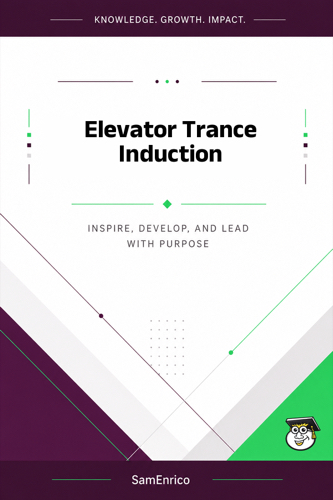
Elevator Trance Induction eBook
Imagine elevator dropping floor by floor into tran
by Lloyd Harvey
Imagine elevator dropping floor by floor into trance.
Formats
Free sample
Chapter 1: The Vertical Tapestry–- Every human being already knows how to enter a trance. This is not a skill you must learn from scratch, nor is it a mysterious gift possessed only by the gifted few. You have done it thousands of times without ever naming it—while staring out a rain-streaked window on a long bus ride, while walking a familiar path lost in thought, while lying in bed suspended between sleep and waking. The elevator induction simply takes this natural, universal capacity and gives it a structure, a direction, and a purpose.The question that opens this book is deceptively simple: Why the elevator? Why not a staircase, a escalator, a diving bell, a submarine, a mineshaft, or any of the other hundred vertical metaphors available to the hypnotist?
The answer reveals something profound about the architecture of the human mind and its relationship with the physical world.The elevator works because it occupies a unique position in our psychological landscape. Unlike stairs, which require effort and conscious attention to each step, the elevator demands only surrender. Unlike an escalator, which moves at a mechanical pace disconnected from our internal state, the elevator responds to our command. Unlike a mineshaft or diving bell, which carry connotations of danger and isolation, the elevator is familiar, mundane, and safe. It is the vertical transportation of modern life—unremarkable enough to be trusted, powerful enough to move us between worlds.The Universal Language of Down Before we examine the mechanics of the elevator induction, we must understand the deeper pattern it taps into.
Across every human culture studied by anthropologists, the direction "down" carries consistent psychological meanings. Down is relaxation, sleep, unconsciousness, death, earth, body, instinct, and the hidden self. Up is alertness, waking, consciousness, life, sky, mind, reason, and the public self.This is not merely poetic metaphor. Brain imaging studies have shown that processing vertical metaphors activates the same neural regions as processing physical vertical movement. When you read the sentence "He fell into a deep depression," your brain's vertical orientation circuits fire.
When you hear "She rose to the challenge," the same circuits activate. The mind does not distinguish between literal and metaphorical descent at the deepest neurological level.The elevator induction exploits this hardwired connection. By asking a subject to imagine descending floor by floor, you are not simply inviting them to play along with a pleasant fantasy. You are directly engaging the brain's vertical orientation systems, which are tightly coupled with arousal regulation, balance, and the sleep-wake cycle. The vestibular system—that intricate network of fluid-filled canals in your inner ear that detects motion and orientation—responds to imagined descent almost as strongly as to physical descent.This is why the "elevator stomach" feeling is so reliably produced by suggestion alone.
Your brain cannot fully distinguish between a real elevator dropping and a vividly imagined one. The same neural pathways activate. The same butterflies flutter. The same shift in consciousness occurs.Traveling Versus Dropping: The Critical Distinction Not all descents are created equal. One of the most important distinctions in this book—one that will inform every technique you learn—is the difference between traveling down and dropping.Traveling down is what happens during progressive relaxation.
You count backward from ten to one. Each number brings the subject a little deeper, a little more relaxed, a little more disconnected from external awareness. This is the classic approach found in countless meditation apps and self-hypnosis recordings. It works. It is reliable.
It produces what we call light to medium trance states, which are perfectly adequate for many therapeutic purposes.But traveling down has a ceiling. It progresses in a straight line, and the human mind adapts quickly to straight lines. After the tenth or fifteenth session, the subject may find that counting from ten to one no longer produces the same depth. The technique has become familiar, and familiarity breeds conscious anticipation rather than unconscious surrender.Dropping—what hypnotists call fractionation—operates on an entirely different principle. Instead of a smooth linear descent, dropping involves sudden shifts.
The subject goes down a few floors, then briefly returns to a lighter state, then drops again, each drop going deeper than the last. This creates a staircase effect that bypasses the mind's ability to anticipate and resist.Think of it this way. If you slowly lower a frog into hot water, it will adapt and survive. If you drop it directly into the same water, it will react immediately. The conscious mind is the frog.
Smooth descent lets it adapt and maintain control. Sudden dropping overwhelms its defenses and opens the door to deeper unconscious access.The elevator induction, properly performed, is a dropping technique disguised as a traveling technique. The subject believes they are simply counting down floors. But the skilled practitioner knows that each "drop" between floors is an opportunity for fractionation, for sudden shift, for the conscious mind to lose its footing just long enough for the unconscious to take over.The Three Tiers of Trance Depth Before we go further, we need a shared vocabulary for what we are trying to achieve. Not all trance is the same.
Not all depth is equal. And many of the inconsistencies in hypnosis literature—claims that one technique produces "deep trance" in thirty seconds while another requires thirty minutes—come from a failure to define terms clearly.This book uses a three-tier model of trance depth. Commit it to memory. It will serve as your map for every induction in every chapter that follows.Stage 1: Light Trance In light trance, the subject experiences physical relaxation that exceeds normal resting states. Eyelids may flutter.
Breathing slows. Small involuntary muscle twitches may appear, particularly around the eyes and mouth. The subject remains aware of their surroundings but feels increasingly detached from them.What can you do in Stage 1? Direct suggestion works well here. You can install simple post-hypnotic suggestions, reduce mild anxiety, and promote general relaxation.
Stage 1 is sufficient for perhaps seventy percent of everyday therapeutic applications—stress reduction, confidence building, mild habit modification.Stage 1 typically requires five to ten minutes of progressive relaxation or simple fractionation to achieve. It is reliable, safe, and accessible to approximately ninety percent of the general population.Stage 2: Medium Trance In medium trance, the subject experiences partial amnesia (they may forget some of what occurred during the trance state), catalepsy (the ability to maintain unusual postures without fatigue), and glove anesthesia (numbness that can be transferred from one body part to another). The subject may open their eyes without emerging from trance, and eye catalepsy—the inability to open the eyes at all—may be present.Stage 2 opens the door to more profound therapeutic work. Age regression becomes possible. Pain management becomes highly effective.
Phobias can be addressed at their source. Limb catalepsy allows for ideomotor signaling—using finger movements to communicate directly with the unconscious mind.Stage 2 typically requires ten to fifteen minutes of fractionation or confusion techniques. It is accessible to approximately seventy to eighty percent of the population with proper training.Stage 3: Deep Trance (Somnambulism)Somnambulism is the deepest stage of hypnotic trance. The name comes from its resemblance to sleepwalking—the subject…
This is the end of the free sample. Get the eBook to keep going. Buy now
About this book
Details
- Author
- Lloyd Harvey
- Publisher
- SamEnrico
- Language
- English
- Genre
- Non-Fiction, Self-Help, Elevator Imagery
- Released
- 2026-06-07
- Pages (approx.)
- 136
- Available as
- eBook, Audiobook

Read better in the ZLOADR app
Your eBooks on your phone or tablet. Sign in with your SamEnrico account and start reading.
More by Lloyd Harvey
 Harvard Extension School Free ElectivesLloyd Harvey$11.99
 NVC For Negotiation SuccessLloyd Harvey$11.99
 The Foreign Service WidowLloyd Harvey$11.99
 The Phantom Actor of Edo: How a Kabuki Star Defied Death to PerformLloyd Harvey$11.99
 How to Produce Bicycle Toe Straps and ClipsLloyd Harvey$11.99
 Remote Work Attack ProtocolLloyd Harvey$12.99
 How to Start a Hobby in Chinese CheckersLloyd Harvey$11.99
 Steering TaxLloyd Harvey$11.99