
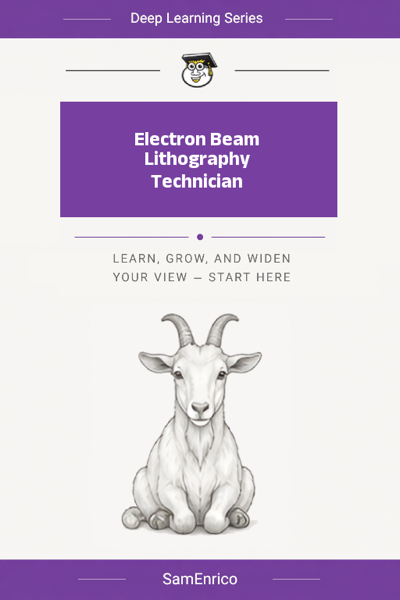
Non-FictionInformativeEducational
Electron Beam Lithography Technician
A Coursebook on Electron Beam Lithography Technici
A Coursebook on Electron Beam Lithography Technician
Formats
About this book
Free sample
Chapter 1: The Invisible Pencil--–- The most expensive pencil in the world cannot be bought at an art supply store. It does not contain graphite or charcoal. It writes with lightning—a focused beam of electrons moving at nearly the speed of light—and its marks are measured not in millimeters but in nanometers. One nanometer is one-billionth of a meter. To put that in perspective: a human hair is roughly 80,000 nanometers wide.
The features this pencil draws are often smaller than a virus, smaller than the wavelength of visible light, smaller than anything the unaided human eye has ever seen or ever will see.And yet, without this invisible pencil, your smartphone would not exist. Neither would the artificial intelligence running on it, the GPS guiding your car, the sensors in your medical implants, or the quantum computers that will eventually crack problems unsolvable by any machine today.This chapter is not about how the pencil works—that comes later. This chapter is about why the pencil exists, who holds it, and why you—whether you are a student, a technician in training, or a seasoned cleanroom veteran—should care deeply about mastering its use.The Great Divide: Optical Lithography vs. Electron Beam Lithography To understand electron beam lithography (EBL), you must first understand the problem it solves. The semiconductor industry has spent trillions of dollars perfecting a different technology: optical lithography.
In optical lithography, light shines through a mask—a stencil of the pattern you want to create—and projects that pattern onto a silicon wafer coated with light-sensitive resist. It is fast, immensely fast. A modern deep ultraviolet (DUV) stepper can expose an entire 300 mm wafer in less than a minute. Extreme ultraviolet (EUV) tools, the current kings of high-volume manufacturing, process over 150 wafers per hour.But optical lithography has a fundamental limitation: diffraction. Light bends.
When you try to project features smaller than the wavelength of light itself, the edges blur, the corners round, and the pattern distorts. You can fight diffraction with fancy tricks—phase-shift masks, optical proximity correction, immersion lenses—but eventually you hit a wall.…
This is the end of the free sample. Get the eBook to keep going. Buy now
Contents
- Chapter 1
- Chapter 2
- Chapter 3
- Chapter 4
- Chapter 5
- Chapter 6
- Chapter 7
- Chapter 8
- Chapter 9
- Chapter 10
- Chapter 11
- Chapter 12
Details
- Author
- Schell Nicholle
- Publisher
- SamEnrico
- Language
- English
- Genre
- Non-Fiction, Informative, Educational
- Released
- 2026-05-18
- Pages (approx.)
- 132
- Available as
- eBook, Audiobook

Read better in the ZLOADR app
Your eBooks on your phone or tablet. Sign in with your SamEnrico account and start reading.
More by Schell Nicholle
 Word of Mouth IncentivesSchell Nicholle$11.99
 Courtroom Body LanguageSchell Nicholle$11.99
 Pogo Character OriginsSchell Nicholle$11.99
 Smoking Relapse Prevention PlanSchell Nicholle$11.99
 The Comeback Kid: How a Disgraced Olympian Reclaimed GlorySchell Nicholle$11.99
 AI for Medical Coding AssistanceSchell Nicholle$12.99
 Learn to Play the SerpentSchell Nicholle$11.99
 How to Start a Closures Made of Plastic Business (Beginners Guide)Schell Nicholle$11.99
You may also like
 Hong Kong Handover 1997Dunn Johnnie$11.99
 Zumba For Postnatal Recovery CourseNeal Christian$11.99
 Zumba for BeginnersLadner Nikia$11.99
 YouTube Comment Mining GuideHumes Pandora$12.99
 Worry Box MeditationCarlin Rudy$11.99
 Workplace Stress MeditationNguyen Lynn$11.99
 Workplace Stress and Sleep RepairHawley Ivory$11.99
 Workplace Perfectionism CureDelaney Jeffry$11.99
 Workplace Injustice Anger GuideWallen Isabelle$11.99
 Work Addiction and Burnout LinkGreenwood Ester$11.99
 Women in Yoga and WellnessBeattie Galina$11.99
 Women in Stand Up ComedyChun Evangeline$11.99