
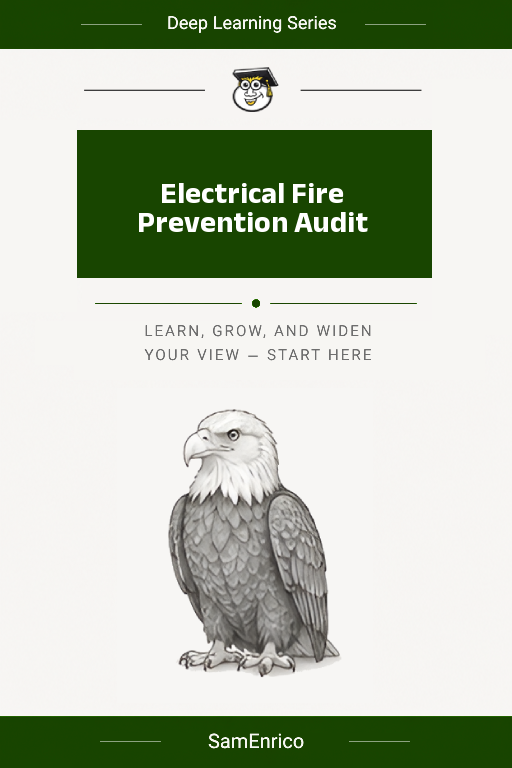
Electrical Fire Prevention Audit eBook
Inspect surge protectors, extension cords, and bre
Inspect surge protectors, extension cords, and breaker panels annually to stop fires before they start.
Formats
Free sample
Chapter 1: The Silent Spark--–- By the time you smell smoke, the fire has already been burning for minutes. By the time you see flames, it may already be too late.This is the fundamental problem with electrical fires. They do not announce themselves with a bang or a scream. They begin in silence, behind walls, under floors, inside appliances, within the insulation of a worn extension cord. They grow in darkness, often while you sleep.
And they kill without warning.I have stood in the ashes of dozens of homes and businesses that burned because of electricity. I have interviewed survivors who lost everything. I have read the autopsy reports of people who never woke up. In every single case, without exception, the fire could have been prevented. Not maybe.
Not probably. Definitely.The tool for prevention already exists. It is not expensive. It is not complicated. It does not require an engineering degree or a license.
It requires only two things: knowledge and attention. Specifically, it requires the annual electrical fire prevention audit.This book is that audit, broken down into twelve chapters that will transform you from a passive occupant of your home or facility into an active defender against one of the most common and most preventable causes of death and destruction in the modern world.The Statistics That Will Change How You See Your Home Let us begin with numbers. Not to frighten you, but to wake you up.According to the National Fire Protection Association (NFPA), United States fire departments responded to an estimated 51,000 home structure fires involving electrical failure or malfunction between 2012 and 2021. That is an average of 5,100 fires per year. These fires caused an annual average of 500 civilian deaths, 1,400 civilian injuries, and $1.3 billion in direct property damage.Let me translate those numbers into human terms.Five hundred deaths per year means more than one person dies every single day from an electrical fire.
One thousand four hundred injuries means four people are hurt every day. One point three billion dollars means that every hour of every day, electrical fires destroy $148,000 worth of property.But the raw numbers do not capture the real tragedy. The real tragedy is that these fires are not accidents. They are not random acts of God. They are failures of maintenance, failures of inspection, failures of knowledge.
In nearly every case, someone—a homeowner, a landlord, a facility manager, an employee—looked at a warm extension cord, a buzzing breaker, a daisy chain of power strips, or a flickering light and decided it was fine. They normalized the deviance. They convinced themselves that because nothing had happened yet, nothing would happen.They were wrong.The Three Mechanisms of Electrical Fire To understand how to prevent electrical fires, you must first understand how they start. There are three primary mechanisms, and they are all invisible during their early stages.Mechanism One: Resistance Heating Every conductor resists the flow of electricity. That resistance converts a small amount of electrical energy into heat.
Under normal conditions, this heat is negligible—a few degrees above ambient temperature. But when a connection becomes loose, when a wire is damaged, or when a conductor is undersized for the load, resistance increases dramatically.Double the resistance, double the heat. Double the heat, double the resistance. This is a feedback loop that ends in one of two ways: either the circuit breaker trips, or a fire starts.The most common location for dangerous resistance heating is at connections. A loose wire nut in a junction box.
A corroded terminal on an outlet. A push-in connection (also called a backstab) that has loosened over decades of thermal expansion and contraction. A breaker lug that was never torqued to specification. Each of these is a potential fire starter.Mechanism Two: Arcing An arc is electricity jumping across a gap. It is a controlled lightning bolt.
The temperature of an electrical arc can reach 10,000 to 20,000 degrees Fahrenheit—hotter than the surface of the sun. At that temperature, virtually anything will ignite instantly.Arcs occur when conductors are close together but not touching. A broken wire inside an extension cord, the two severed ends separated by a hair's breadth of air. A loose screw on an outlet terminal, the wire vibrating in and out of contact with each cycle of heating and cooling. A cracked insulation jacket, exposing two conductors that should never meet.Arcs are silent until they become violent.
The small arcs that precede a full electrical fire make no sound you can hear from across a room. They generate no smoke you can smell. They create no visible light you can see. They exist in the gap between "fine" and "fire," and they can persist for weeks or months before finally igniting nearby materials.Mechanism Three: Insulation Breakdown The plastic, rubber, or nylon coating around electrical wires is not decorative. It is a carefully engineered safety device designed to contain electricity and prevent contact between conductors and between conductors and people.
But insulation degrades over time.Heat accelerates degradation. Every hour a wire operates at 140 degrees Fahrenheit instead of 80 degrees cuts its insulation life by half. UV exposure accelerates degradation. A cord run through a sunny window will become brittle and crack years before an identical cord kept in darkness. Physical damage accelerates degradation.
A cord pinched behind a door, stepped on by heavy furniture, or chewed by a pet is already failing, even if the damage is not visible to the naked eye.When insulation fails, conductors become exposed. Exposed conductors arc. Arcs ignite materials. Materials become fires.Here is what you must understand about these three mechanisms: they do not operate in isolation. Resistance heating causes insulation breakdown.
Insulation breakdown causes arcing. Arcing causes more heat. The fire feeds itself long before any flame appears. By the time you see smoke, the process has been underway for weeks or months.Why Your Breaker Panel Will Not Save You Many people believe that circuit breakers exist to prevent fires. This is only partially true.Circuit breakers are designed to protect the fixed wiring inside your walls from overheating due to an overload.
That is their job. If you plug too many devices into a single circuit, the breaker trips, the circuit opens, and the wires cool down. This is a good thing.But circuit breakers do not protect extension cords. They do not protect power strips. They do not protect surge protectors.
They do not protect the internal wiring of your appliances. They do not protect against arcing (unless you have AFCI breakers, which we will discuss in Chapter 8). They do not protect against loose connections upstream of the breaker. They do not protect against ground faults (unless you have GFCI breakers, which we will discuss in Chapter 7).In other words, circuit breakers protect a small portion of your electrical system. Everything downstream of the wall outlet is largely unprotected.
That means your refrigerator, your television, your computer, your phone charger, your space heater, your lamp, your toaster—every device you plug into a wall—is operating in a zone where the breaker cannot help you.This is why the annual audit is so critical. You cannot rely on…
This is the end of the free sample. Get the eBook to keep going. Buy now
About this book
Details
- Author
- Schultz Darnell
- Publisher
- SamEnrico
- Language
- English
- Genre
- Non-Fiction, Crisis Management
- Released
- 2026-06-01
- Pages (approx.)
- 145
- Available as
- eBook, Audiobook

Read better in the ZLOADR app
Your eBooks on your phone or tablet. Sign in with your SamEnrico account and start reading.
More by Schultz Darnell
 Writer Distraction Protection GuideSchultz Darnell$11.99
 Parent Loss Online Support GuideSchultz Darnell$11.99
 Bipolar Alternative TreatmentsSchultz Darnell$11.99
 Zapier Reminder AutomationSchultz Darnell$11.99
 Paraphrasing Skills WorkbookSchultz Darnell$11.99
 The Shelter Without ExitSchultz Darnell$11.99
 EQ for Difficult ConversationsSchultz Darnell$11.99
 One Suitcase and a PhotographSchultz Darnell$11.99
 Learning Science ReviewSchultz Darnell$11.99
 The Almighty Coin: How the Thirty Years' War Bankrupted EuropeSchultz Darnell$11.99
 The Silent Whistle: How Larry Nassar’s Crimes Were Ignored for DecadesSchultz Darnell$11.99
 The Midnight Tunnel: How a Prisoner Vanished in Broad DaylightSchultz Darnell$11.99
You may also like
 Hong Kong Handover 1997Dunn Johnnie$11.99
 Zumba For Postnatal Recovery CourseNeal Christian$11.99
 Zumba for BeginnersLadner Nikia$11.99
 YouTube Comment Mining GuideHumes Pandora$12.99
 Worry Box MeditationCarlin Rudy$11.99
 Workplace Stress MeditationNguyen Lynn$11.99
 Workplace Stress and Sleep RepairHawley Ivory$11.99
 Workplace Perfectionism CureDelaney Jeffry$11.99
 Workplace Injustice Anger GuideWallen Isabelle$11.99
 Work Addiction and Burnout LinkGreenwood Ester$11.99
 Women in Yoga and WellnessBeattie Galina$11.99
 Women in Stand Up ComedyChun Evangeline$11.99