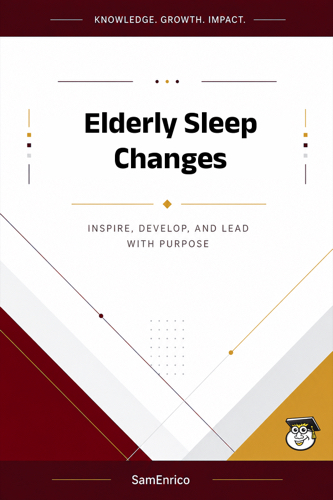
Elderly Sleep Changes eBook
Expect lighter sleep and earlier wake time.
Expect lighter sleep and earlier wake time.
Formats
Free sample
Chapter 1: The Great Sleep Lie--We begin with a confession that most sleep doctors will not tell you: you are probably not broken.If you are reading this book, you have likely spent months—or years—believing that something has gone wrong with your sleep. You fall asleep easily enough, perhaps even earlier than you used to. But then you wake at three or four in the morning, your mind already racing. You lie there, frustrated, watching the clock tick toward dawn. Or perhaps you sleep through the night but feel as though you have barely dozed at all—a thin, translucent layer of rest that shatters at the slightest sound.
You have tried going to bed later, hoping to sleep in. It did not work. You have tried sleeping pills, over the counter and prescription. They worked for a while, then stopped. Or they left you groggy, foggy, and unsteady on your feet.And somewhere along the way, you internalized a terrible conclusion: My body has failed me.This conclusion is wrong.
It is not merely unhelpful; it is scientifically inaccurate. And it is the single greatest obstacle to better sleep after sixty.The truth, which this entire book will unfold, is that your sleep has not failed. It has changed. Those changes are predictable, measurable, and—most important—manageable. But you cannot manage what you do not understand.
And right now, most older adults are operating under a fundamental misunderstanding of what healthy sleep looks like at their age.This chapter dismantles that misunderstanding. It will show you, with data and stories and plain language, why the "eight hours of solid sleep" myth is wrecking your peace of mind. It will explain exactly how your sleep architecture has evolved, why that evolution made perfect sense to your ancestors, and why trying to fight it is like trying to teach a giraffe to purr. By the end of this chapter, you will have a new definition of "normal"—and you will be ready to stop fighting your biology and start working with it.The Myth of the Unbroken Night Let us start with a simple question: where did you learn that good sleep means sleeping through the night without waking?For most of us, the answer is nowhere explicit. No doctor sat us down and said, "Thou shalt sleep eight consecutive hours." No textbook stated it as fact.
Instead, the myth seeped into our consciousness through a thousand small channels: movies showing peaceful sleepers who do not stir until morning; well-meaning articles about "sleep hygiene" that treat any wake-up as a problem; the silent assumption that wakefulness during the night is a malfunction.But here is the truth that sleep laboratories have documented for decades: everyone wakes during the night. Young people wake. Old people wake. People who insist they sleep like logs wake—they simply do not remember it.The difference is not whether you wake. The difference is how quickly you fall back asleep, and whether you remember waking at all.In young adults, most nighttime arousals last less than ten seconds.
They slip back into deep sleep so quickly that the brain never consolidates the memory of waking. In older adults, those arousals last longer—sometimes minutes. And because older adults spend less time in deep sleep, they are more likely to reach full consciousness during a night-time arousal. That is not a disorder. That is physics.
A shallow sleeper is easier to fully wake than a deep sleeper.The problem is not the wake-up. The problem is what happens next.What Actually Happens to Sleep As You Age To understand why your sleep has changed, you need a brief tour of sleep architecture. Do not worry—this will not be a tedious lecture. You only need four concepts.Slow-wave sleep. This is deep, restorative sleep.
It is the stage where your body repairs tissue, clears metabolic waste from your brain, and consolidates memories. Young adults spend about twenty percent of their night in slow-wave sleep. By age seventy, that often drops to less than five percent. Some healthy older adults have almost no measurable slow-wave sleep at all.Stage 1 sleep. This is the lightest sleep stage—the borderland between waking and sleeping.
You drift in and out. A creaky floor, a partner's snore, a car passing outside—any of these can lift you out of Stage 1 into full wakefulness. Young adults spend about five percent of their night in Stage 1. Older adults often spend fifteen to twenty percent.REM sleep. This is dreaming sleep, essential for emotional regulation and learning.
REM changes less dramatically with age than slow-wave sleep, but it becomes more fragmented. Older adults enter REM more quickly but spend less continuous time there.Sleep efficiency. This is the ratio of time asleep to time spent in bed. A young adult with eight hours in bed and seven and a half hours asleep has ninety-four percent efficiency. An older adult with eight hours in bed and six hours asleep has seventy-five percent efficiency.
The lower number is not a sign of disease. It is a sign of age.Here is what these changes feel like on the ground. You go to bed. You fall asleep—perhaps even faster than you used to. But instead of sinking into a deep, oblivious hole, you remain partially aware of your environment.
You hear the furnace kick on. You notice your partner roll over. At some point—perhaps three, perhaps four, perhaps five—you wake fully. Your mind is alert. Your body feels rested enough to be awake but not rested enough to feel good.You check the clock.
You do the math. I have only been asleep for four hours. Something is wrong.But nothing is wrong. You have simply experienced the normal sleep architecture of a healthy older adult. The only thing wrong is your expectation.The Evolutionary Logic of Lighter Sleep If lighter, more fragmented sleep is so common, why does it happen?
Is there a reason—or is it just a design flaw?Evolutionary medicine offers a compelling answer. For most of human history, humans lived in small, multi-generational groups. They slept in the open or in temporary shelters. Predators and enemies were real threats. In that environment, having every member of the group in deep, oblivious sleep at the same time would have been catastrophic.Enter the grandmother hypothesis.
Older adults, who could no longer hunt or bear children, served a crucial role: they watched while others slept. Their lighter sleep and earlier waking times made them natural sentinels. A sixty-year-old who woke at the slightest sound and rose before dawn could detect danger, wake the younger members of the group, and ensure survival.You are not living in a tribal village. You do not need to watch for predators. But your brain does not know that.
Your brain is running software that was written a hundred thousand years ago. It does not care about your alarm clock or your morning meeting. It only knows that you are older, and that older members of the tribe serve a different sleep function than younger ones.This is not a satisfying explanation when you are lying…
This is the end of the free sample. Get the eBook to keep going. Buy now
About this book
Details
- Author
- Power Janessa
- Publisher
- SamEnrico
- Language
- English
- Genre
- Non-Fiction, Health & Wellness, Geriatric Sleep
- Released
- 2026-06-07
- Pages (approx.)
- 145
- Available as
- eBook, Audiobook

Read better in the ZLOADR app
Your eBooks on your phone or tablet. Sign in with your SamEnrico account and start reading.
More by Power Janessa
 Legal Aid Nonprofit Fraud CoursePower Janessa$11.99
 Navigating Racial DialoguesPower Janessa$11.99
 Burnout Prevention Movement PlanPower Janessa$11.99
 The Healers of the Jade Serpent: Olmec Medicine and the Birth of Mesoamerican HealthcarePower Janessa$11.99
 Proptech CAC GuidePower Janessa$12.99
 What Users Do Testing GuidePower Janessa$12.99
 Understanding Xeroderma Pigmentosum, Type 1Power Janessa$17.99
 How to Start a Base Paper for Printing and Writing Paper Business (Beginners Guide)Power Janessa$11.99