
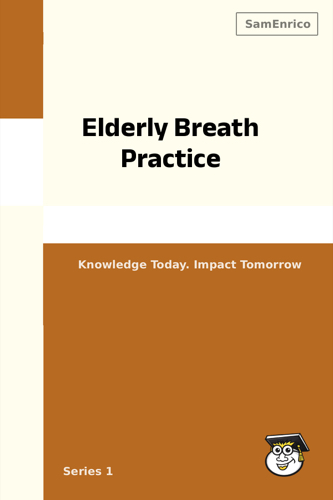
Elderly Breath Practice eBook
Gentle breath awareness for limited mobility.
Gentle breath awareness for limited mobility.
Formats
Free sample
Chapter 1: The Last Free Thing--–- You are still breathing. Right now, in this moment, as you hold this book or listen to someone read these words aloud, your body is doing something remarkable. Your diaphragm is contracting and relaxing. Your ribs are expanding and recoiling. Air is moving in and out of your lungs, carrying oxygen to every cell in your body and carrying waste carbon dioxide back out.
You have done this approximately 22,000 times today already. You will do it another 22,000 times tomorrow. And you have done it every single day of your long, full life, without ever having to remember how.This is the last free thing. The one ability that aging, illness, arthritis, and limited mobility cannot take from you. Your legs may no longer carry you where you want to go.
Your hands may tremble or stiffen. Your back may ache. Your energy may fail. But as long as you are alive, you are breathing. And that breath—simple, constant, available—is the most powerful tool you will ever own.You may have picked up this book because you are short of breath.
Maybe you have COPD, emphysema, or heart failure. Maybe your ribs are stiff from arthritis, and every breath feels like a struggle. Maybe you spend most of your time in a chair or a bed, and you have been told there is nothing more you can do. Maybe a doctor said, "Just take deep breaths," and you tried, but it only made you dizzy and panicked. Maybe you have given up on feeling better and picked up this book only because someone who loves you put it in your hands.I want you to know something before you read another word: You have not failed.
Your body is not broken in a way that makes you less worthy. The advice you received—"just take a deep breath"—was not wrong because you did it incorrectly. It was wrong because it was incomplete. For a body that has been still for a long time, for ribs that have grown stiff, for lungs that have learned to work in a small, tight way, forcing a deep breath is like forcing a rusty lock. It does not open.
It breaks.This book will not ask you to force anything. It will not ask you to sit up if you cannot sit up. It will not ask you to stand if you cannot stand. It will not ask you to hold your breath or push through pain. The practices in these pages are gentle.
They are small. They start exactly where you are—in your bed, in your chair, in your recliner, with whatever mobility you have left.And they work. Not because they are magic, but because they respect the truth that your breath has been your companion your entire life. It knows you. It remembers when you were young and ran and laughed and worked and loved.
It has been with you through every joy and every sorrow. And it is still here, ready to work with you now, exactly as you are.This chapter is about meeting your breath again. Not as a task. Not as an exercise. Not as something you have to get right.
But as a homecoming to a familiar friend.The 22,000 Times You Never Noticed Let us start with a number that might surprise you. The average adult breathes between 12 and 20 times per minute. That is 720 to 1,200 times per hour. That is 17,280 to 28,800 times per day. For the sake of a number we can hold in our minds, let us say 22,000 times each day.Twenty-two thousand times.
Every single day. Without you thinking about it. Without you trying. Without you earning it or deserving it or failing at it. Your body just breathes.Think about what this means.
If you are 75 years old, you have taken approximately 600 million breaths in your lifetime. Six hundred million times, your diaphragm has contracted and relaxed. Six hundred million times, your ribs have moved. Six hundred million times, your lungs have exchanged oxygen for carbon dioxide. Your breath has been the most reliable, most constant, most faithful companion you have ever had.And yet, most of us never notice it.
We breathe like we blink—automatically, unconsciously, without gratitude or attention. It is only when breathing becomes difficult that we suddenly become aware of every single breath. That is one of the cruel ironies of aging and illness: we take breath for granted until it starts to feel scarce. Then we cannot stop thinking about it.If that is where you are right now—if every breath feels like something you have to work for, if you wake up at night gasping, if you find yourself avoiding activities because you are afraid of becoming breathless—I want you to know that you are not alone. Millions of people live with breathlessness.
And the fear of breathlessness is often worse than the breathlessness itself. That fear is real. It is not weakness. It is your body trying to protect you.But here is the truth that this book will teach you: you can change your relationship to breathlessness. You cannot always change the underlying condition—the COPD, the heart failure, the arthritis, the stiff ribs.
But you can change how you respond when breathing becomes hard. You can learn tools that give you back a sense of control. You can discover that even a breath that feels small and tight can be a source of comfort rather than panic.And it starts with simply noticing. Not changing. Not forcing.
Just noticing.The Body You Have Now One of the hardest things about aging is the gap between the body you remember and the body you have now. You remember running up stairs without thinking. You remember carrying groceries in one trip. You remember sleeping through the night without waking up short of breath. You remember when your ribs moved freely and your diaphragm was strong and your lungs felt like they had room.That body is gone.
Grieving it is normal. Necessary, even. But staying in that grief—measuring every breath against the memory of how breathing used to feel—will only make the present harder. Your body now is different. It is not worse.
It is not a failure. It is just different.Let me explain what happens to breathing as we age and as we become less mobile.The diaphragm is a dome-shaped muscle that sits beneath your lungs. When you inhale, it contracts and flattens, pulling downward and creating space for your lungs to expand. When you exhale, it relaxes and domes upward, pushing air out. The diaphragm is the most important muscle for breathing.
And like every other muscle in your body, it becomes weaker with disuse. If you spend most of your time sitting or lying down, your diaphragm does not have to work as hard. It gets lazy. It gets tight. It forgets how to move through its full range of motion.The ribs are attached to your spine at the back and to your sternum at the front.
Between each rib are small muscles called intercostals. These muscles help lift and lower the rib cage with each breath.…
This is the end of the free sample. Get the eBook to keep going. Buy now
About this book
Details
- Author
- Mcmurray Charlott
- Publisher
- SamEnrico
- Language
- English
- Genre
- Non-Fiction, Self-Help, Elderly
- Released
- 2026-06-06
- Pages (approx.)
- 116
- Available as
- eBook, Audiobook

Read better in the ZLOADR app
Your eBooks on your phone or tablet. Sign in with your SamEnrico account and start reading.
More by Mcmurray Charlott
 Jamaican Call Center OutsourcingMcmurray Charlott$11.99
 Blue Zone Coffee Habit GuideMcmurray Charlott$11.99
 Flow In Remote WorkMcmurray Charlott$11.99
 The Caravels of Destiny: How Portugal Charted the UnknownMcmurray Charlott$11.99
 Grant CoordinatorMcmurray Charlott$11.99
 Social Media Privacy Legal TrapsMcmurray Charlott$12.99
 How to Produce Cable ClipsMcmurray Charlott$11.99
 How to Become a BartenderMcmurray Charlott$11.99
You may also like
 Hong Kong Handover 1997Dunn Johnnie$11.99
 Zumba For Postnatal Recovery CourseNeal Christian$11.99
 Zumba for BeginnersLadner Nikia$11.99
 YouTube Comment Mining GuideHumes Pandora$12.99
 Worry Box MeditationCarlin Rudy$11.99
 Workplace Stress MeditationNguyen Lynn$11.99
 Workplace Stress and Sleep RepairHawley Ivory$11.99
 Workplace Perfectionism CureDelaney Jeffry$11.99
 Workplace Injustice Anger GuideWallen Isabelle$11.99
 Work Addiction and Burnout LinkGreenwood Ester$11.99
 Women in Yoga and WellnessBeattie Galina$11.99
 Women in Stand Up ComedyChun Evangeline$11.99