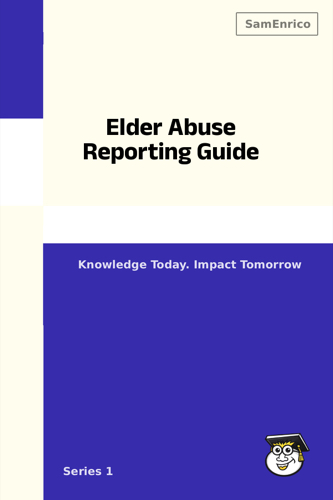
Elder Abuse Reporting Guide eBook
How to report suspected financial or physical abus
How to report suspected financial or physical abuse.
Formats
Free sample
Chapter 1: The Ninety Percent...--–- The woman on the phone was crying, but trying very hard not to. She was a banker in her mid-forties, someone who had seen thousands of transactions cross her desk over fifteen years. She knew the red flags. She had taken the training. She had even spoken at a conference once about financial exploitation.
And yet, when she saw the eighty-seven-year-old man come in with his daughter for the third time that month—each time withdrawing just under the reporting threshold, each time the daughter doing all the talking, each time the old man staring at the floor—she did nothing. She told herself it was none of her business. She told herself the daughter probably had Power of Attorney. She told herself someone else would notice.No one else noticed. Three months later, the old man was dead.
The daughter had drained his life savings, cancelled his home health aide, and stopped filling his heart medication prescriptions. He died alone in an apartment that had been his home for forty years. The cause of death was listed as congestive heart failure. It was not. It was something slower and quieter: the complete erosion of a human being by someone who was supposed to love him.The banker called me six months after the funeral.
She had quit her job. She was seeing a therapist. She could not stop thinking about the old man's face—the way he had looked at the floor, the way his hands had trembled when he signed the withdrawal slips, the way she had handed him the cash and said "have a nice day" while his daughter smiled at her over his shoulder."Why didn't I say something?" she whispered into the phone. "I knew. I knew something was wrong.
And I just let him walk out the door."I did not have an answer for her that made anything better. But I have an answer for you, now, in this book. You will know something is wrong. The question is not whether you will see it. The question is whether you will act on what you see.The Face of the Abuser (A Family Portrait)Let us clear something up immediately.
When most people imagine elder abuse, they imagine a stranger. A burglar. A scam artist on the phone. A crooked nursing home orderly with bad intentions. These things happen.
They are terrible. But they are not the majority. They are not even close to the majority.The majority of elder abuse looks like family. It looks like a son who moved back home after a divorce and never quite left. It looks like a daughter who convinced her mother to put her on the bank account "just in case." It looks like a grandchild who discovered that Grandma's credit card has no limit.
It looks like a spouse who has been controlling, belittling, and isolating for forty years—and now, with the partner too frail to fight back, the control becomes absolute.Here is the number that will define this chapter and this book: ninety percent. In study after study, across every demographic category, the perpetrator of elder abuse is a family member in approximately ninety percent of reported cases. Not a stranger. Not a professional. A son, a daughter, a spouse, a grandchild, a niece, a nephew, a sibling.And within that ninety percent, adult children are the single largest category, accounting for nearly half of all cases.Let me say that again in a different way.
If you know an elder who is being abused—and statistically, you do—the person doing the abusing is most likely that elder's own adult child. The person they raised. The person they loved. The person who, in a just world, would be their fiercest protector. That is not an exception.
That is the rule. And it is the single hardest thing about elder abuse to understand, to recognize, and to report.I am not telling you this to shock you, although shock is an appropriate response. I am telling you this because you cannot report what you refuse to see. If you believe that elder abuse is something that happens in "other families" with "bad children," you will never recognize it in your own neighborhood, your own workplace, your own extended family. The abuser does not have a criminal record.
The abuser does not have a tattoo on their face. The abuser has a key to the victim's house, a name on the victim's bank account, and a lifetime of photographs showing what a "close family" they are.The abuser looks like someone you know. Because the abuser is someone you know.The Fiduciary Trap (When Protection Becomes a Weapon)Let me introduce you to a concept that will appear in every chapter of this book. It is called the Fiduciary Trap, and it is the single most important structural factor in elder abuse.A fiduciary is someone legally entrusted to act in another person's best interest. Power of Attorney.
Conservatorship. Trusteeship. Executor of an estate. These are noble roles, created by law to protect people who cannot protect themselves—people with dementia, people with disabilities, people who are simply too old to manage their own affairs without help.But here is the trap. The same legal structures that are designed to protect an elder also create unchecked access.
When an adult child holds Power of Attorney for an aging parent, that adult child can write checks, transfer funds, change beneficiaries, sell property, and open new accounts—all without a single piece of paper that looks like a crime.It is not a forged signature. It is a "gift."It is not a stolen check. It is "helping Mom pay her bills."It is not identity theft. It is "managing Dad's affairs."The law treats these transactions as legitimate because the fiduciary role presumes good faith. And most of the time, that presumption is correct.
Most fiduciaries are honest. Most adult children are not abusers. But the ones who are abusers hide behind the very structure that was meant to prevent abuse. They do not need to break the law. They simply need to exploit the access that the law has given them.Here is what that looks like in practice.
An eighty-five-year-old woman with mild dementia names her son as her Power of Attorney. She trusts him. She loves him. She believes he will take care of her. Over the next eighteen months, the son transfers $200,000 from her savings account into an account in his own name.
When the bank asks about the transfers, he says, "My mother wants me to have this money. She's worried about estate taxes." The bank files no report because the transfers are authorized by the Power of Attorney document. The son buys a boat, a new truck, and takes a vacation to Costa Rica. The mother never sees a penny of the money again.Is this illegal? It depends.
If the mother truly intended to give her son the money as a gift, it is legal. If the son used his position to take money that was never intended as a…
This is the end of the free sample. Get the eBook to keep going. Buy now
About this book
Details
- Author
- Thorn Marianna
- Publisher
- SamEnrico
- Language
- English
- Genre
- Non-Fiction, Health & Wellness, Elder Protection
- Released
- 2026-06-12
- Pages (approx.)
- 144
- Available as
- eBook, Audiobook

Read better in the ZLOADR app
Your eBooks on your phone or tablet. Sign in with your SamEnrico account and start reading.
More by Thorn Marianna
 Midnight Awakening ManagementThorn Marianna$11.99
 Shame and Anger ConnectionThorn Marianna$11.99
 Compulsive Spending and TraumaThorn Marianna$11.99
 Self Hypnosis for IBSThorn Marianna$11.99
 Birth Control For Heavy PeriodsThorn Marianna$11.99
 Navigating Job Rejection ConversationsThorn Marianna$11.99
 The Gates of Babylon: Alexander’s Unfinished ConquestThorn Marianna$11.99
 Lizards: Lizard Care, Species & Habitat SetupThorn Marianna$11.99
 Approval Trap EscapeThorn Marianna$12.99
 Sales Performance Metrics for GCCThorn Marianna$12.99
 How to Produce PdasThorn Marianna$11.99
 How to Produce Crib Bumpers and LinersThorn Marianna$11.99